
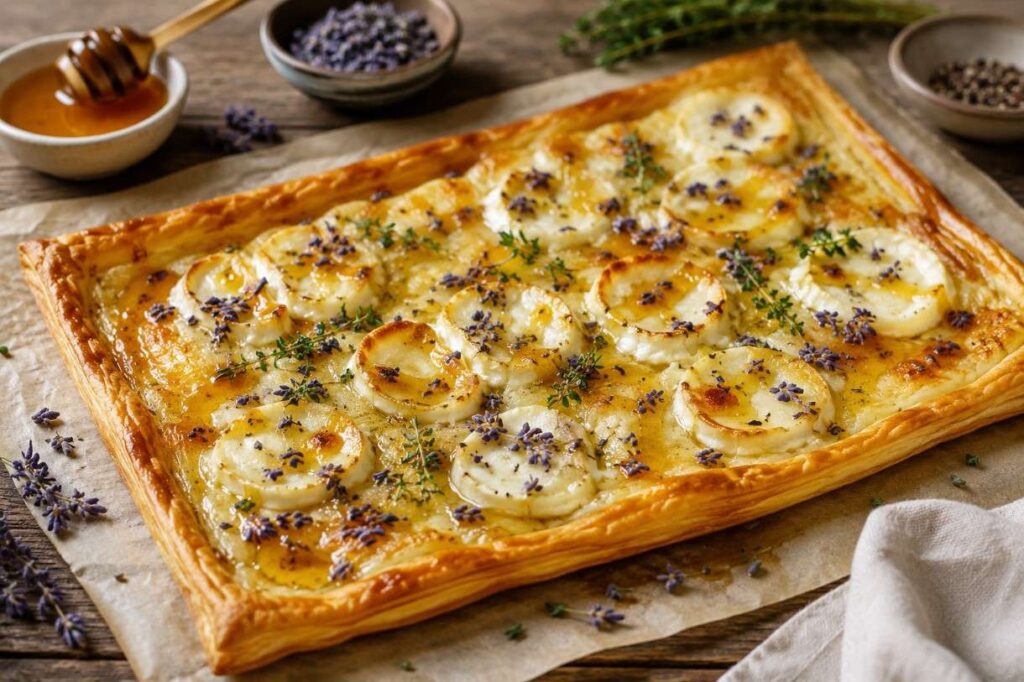
Modern French cuisine thrives on lightness, elegance and the ability to create a harmonious taste experience from a few high-quality ingredients. Few dishes embody this philosophy as beautifully as the tarte fine with goat cheese, honey and lavender. It combines the rustic soul of southern France with the delicate precision of contemporary bistro cooking.
Crisp puff pastry forms the base for creamy goat cheese, whose fine acidity is balanced by floral honey and a touch of lavender. The result is a tart that is at once savory, sweet and aromatic without feeling heavy. Especially in spring and early summer this dish is ideal as a starter, a light lunch or part of a festive menu for Pentecost.
The tarte fine originally comes from the French tradition of thinly topped puff pastry tarts. Unlike the classic quiche it feels noticeably lighter and more modern. The thin layer of pastry provides crispness while the topping is deliberately reduced. This restraint is exactly what makes the dish so elegant.
The Role of the Ingredients
Goat Cheese
For this recipe a mild French goat cheese from a log or a creamy chèvre frais works best. Young goat cheeses have a pleasant freshness and harmonize better with honey and lavender than very strongly aged varieties.
Honey
Lavender honey is the classic choice, as it underscores the floral notes. Alternatively, milder acacia honey or spring blossom honey also work very well. The honey should be gently sweet and support the balance of the dish, not dominate it.
Lavender
Only dried, edible lavender blossoms should be used and only in small quantities. Lavender has intense essential aromas; too much quickly suggests soap or perfume. Properly dosed, however, it brings a fine Provençal elegance.
Puff Pastry
A high-quality butter puff pastry makes a significant difference. The buttery layers provide structure and delicate roasted aromas.
Recipe: Tarte fine with Goat Cheese, Honey & Lavender
Ingredients for 4 people
For the tart
- 1 roll of butter puff pastry
- 200 g goat cheese
- 2–3 tbsp liquid honey
- 1 tsp dried lavender blossoms
- 1 egg yolk
- 1 tsp cream or milk
- Freshly ground black pepper
- A small pinch of sea salt
Optional for serving
- Fresh thyme
- Arugula or mixed wild salad
- Toasted walnuts
- A few drops of olive oil
Preparation
1. Prepare the puff pastry
Preheat the oven to 200 °C (top/bottom heat).
Roll out the puff pastry and place it on a baking sheet lined with parchment paper. With a sharp knife, lightly score a border about 1.5 centimeters wide all around, without cutting through the pastry completely. This creates a nice frame as it bakes.
Prick the inner area several times with a fork so it stays flat.
Mix the egg yolk and cream and brush the border with it. This gives the tart a golden color later.
2. Prepare the topping
Slice or roughly tear the goat cheese. Distribute evenly over the tart, leaving the border free.
Carefully drizzle the honey over it. Less is often more here — the sweetness should accompany the cheese, not overwhelm it.
Rub the lavender blossoms lightly between your fingers and sprinkle sparingly over the tart. Round off with a little black pepper and a small pinch of sea salt.
3. Baking
Bake the tart in the preheated oven for about 18–22 minutes, until the puff pastry is crisp and golden brown.
The cheese should be soft and slightly caramelized without browning too much.
4. Plating
Let the tart rest for a few minutes. Before serving, optionally refine with fresh thyme, a few drops of olive oil or toasted walnuts.
It works particularly well served with a small wild herb salad, which adds freshness and a slight bitterness.
Taste and Texture
The special feature of this tart is the interplay of contrasts:
- The crisp puff pastry provides structure.
- The creamy goat cheese brings freshness and light acidity.
- The honey supplies gentle sweetness.
- Lavender adds floral, Mediterranean notes.
- Pepper and salt give depth and balance.
The dish feels simultaneously simple and sophisticated — typical of modern French cuisine.
Variations and Modern Interpretations
With Caramelized Pears
Thinly sliced pear wedges go wonderfully with goat cheese and lavender. They add additional fruitiness to the tart.
With Figs
Fresh figs make the tart late-summer and particularly elegant.
With Red Onions
Lightly caramelized shallots or red onions add a heartier direction to the dish.
With Nuts
Walnuts, pecans or candied hazelnuts provide additional crunch.
As Mini Tartlets
Small individual portions are excellent for aperitifs, brunch or festive receptions.
Wine Pairing
The following wines pair particularly well with this tart:
- a dry rosé from Provence,
- a mineral Sauvignon Blanc,
- a light Chenin Blanc from the Loire,
- or an elegant Crémant.
The wines should be fresh and aromatic without feeling too heavy.
Serving Ideas for a French Menu
The tarte fine is ideal:
- as an elegant starter,
- as a light lunch with salad,
- as part of a spring buffet,
- or as an intermediate course in a modern French menu.
It pairs particularly well at Pentecost with seasonal ingredients such as asparagus, young herbs and fresh strawberries.
Tips for a Perfect Result
- Always use lavender very sparingly.
- Choose high-quality butter puff pastry.
- Serve the tart immediately after baking.
- Apply the honey only shortly before baking so it does not burn.
- Chill the dough well if it has become soft.
Conclusion
The tarte fine with goat cheese, honey and lavender is a prime example of modern French cuisine: uncomplicated to prepare, elegant in flavor and impressive in its effect. It does not rely on opulent heaviness but on balance, quality and fine aromas.
Especially in spring, this dish brings the atmosphere of Provence to the plate — fragrant, light and full of Mediterranean refinement.