
Such a high workload does not go without consequences. Investigations take more time, priorities have to be set more strictly, and complex procedures tie up considerable resources. Especially challenging areas such as organized crime, cybercrime, financial offenses or domestic violence require specialized knowledge and prolonged investigations. It is precisely here that the personnel shortage is most noticeable.
In addition, French public prosecutors often have less administrative and legal support staff than their European colleagues. While in other countries an extensive staff of legal assistants, aides, and administrative personnel supports the legal work, French public prosecutors have to perform many tasks with relatively limited resources.
Not only the public prosecutors are affected
The structural problems are not limited to the public prosecutor’s office. The number of judges in France is also clearly below the European average.
While Europe has an average of 21.9 judges per 100,000 inhabitants, France has only about 11.3 judges per 100,000 inhabitants. Even based on the median of European countries, France clearly lags behind.
This double understaffing – both among judges and public prosecutors – increases the pressure within the entire judicial system. Procedures accumulate not only at the investigation authorities but also often before the courts. This leads to longer processing times throughout the entire procedural chain.
The French judiciary thus faces a classic bottleneck problem: even if certain parts are strengthened, delays remain as long as other parts of the procedural handling are not expanded accordingly.
Causes of a long-term shortage
The current situation is not the result of a short-term development. It is a structural problem that has built up over decades.
Although justice expenditures have been increased several times in recent years and the number of magistrates has risen, the complexity of cases has also increased. Digitalization, international financial flows, cross-border crime, and new forms of internet offenses result in a much higher processing burden than twenty years ago.
In addition, societal awareness around certain crimes has changed. Cases of domestic violence, sexual assault, or discrimination are now reported more often and prosecuted more intensively than in the past. This progress in victim protection simultaneously increases the workload for police, public prosecutors, and courts.
Many experts therefore point out that merely looking at absolute staff numbers can even underestimate the actual workload. Not only is the number of cases increasing, but also their legal complexity.
A risk to trust in the rule of law
The functioning of justice is essential for the stability of democratic institutions. Citizens expect that crimes are prosecuted, conflicts are resolved in a timely manner, and verdicts are delivered within reasonable periods.
If proceedings are delayed for years or dismissed due to lack of capacity, the impression of an overburdened state easily arises. This can damage trust in the functioning of public institutions.
Several high representatives of French justice have repeatedly pointed out this problem in recent years. They warn that the public’s expectations increasingly clash with the actual capabilities of courts and public prosecutors. The staff shortage is no longer merely an internal administrative issue but poses a challenge to the quality of state justice delivery as a whole.
In this light, the debate about the equipment of the judiciary is gaining increasing political significance. While domestic security regularly takes center stage in public debate, the question is now increasingly raised whether police, public prosecutors’ offices, and courts have sufficient resources at all to effectively achieve the political objectives. The European comparison figures suggest that France still has a great deal of catching up to do in this area.
Author: P. Tiko
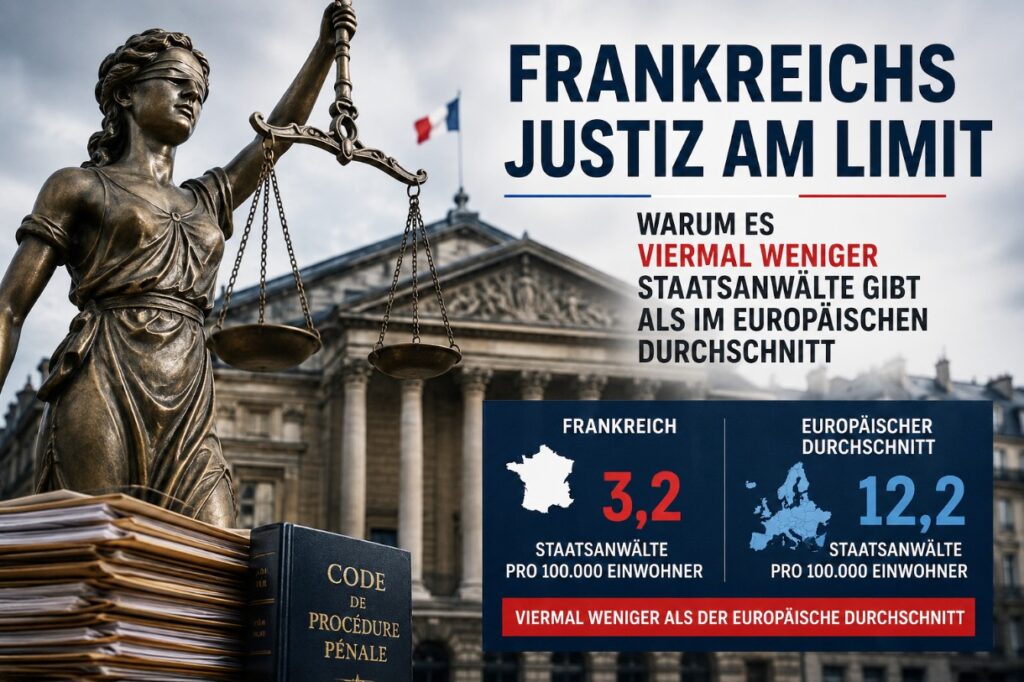
The functioning of a constitutional state is determined not only by its laws but also by the resources available for their enforcement. In France, concerns have been growing for years that the justice system can no longer keep up with social and criminal justice challenges. A central indicator makes the problem particularly clear: France has significantly fewer public prosecutors than most other European countries. This leads to overburdened institutions, long procedural timeframes, and increasing doubts about the efficiency of the justice system.
A European Exception
The most recent comparative data from the European Commission for the Efficiency of Justice (CEPEJ), based on figures from 2022 and published in 2024, shows a remarkable picture. France has only about 3.2 public prosecutors per 100,000 inhabitants. The European average, by contrast, is 12.2, with a median of 11.2 public prosecutors.
As a result, France has approximately four times fewer public prosecutors per capita than the European average. In a Europe-wide comparison, the country ranks near the bottom of the list, just above Ireland. Various countries in Central and Eastern Europe, on the other hand, have rates between 20 and 24 public prosecutors per 100,000 inhabitants.
These figures are all the more remarkable because France is one of the largest economies in Europe and has a highly developed administrative structure. The staffing of the investigative authorities thus clearly contrasts with the economic and political weight of the country.
The consequences of understaffing
Statistical comparisons only gain significance through their practical impact. In the case of the French judiciary, this impact is directly visible.
According to CEPEJ, a French public prosecutor handles on average more than 2,000 cases per year. The European median, by contrast, is around 204 cases. The workload of French public prosecutors is thus exceptionally high and ranks among the highest in Europe.
Such a high workload does not go without consequences. Investigations take more time, priorities have to be set more strictly, and complex procedures tie up considerable resources. Especially challenging areas such as organized crime, cybercrime, financial offenses or domestic violence require specialized knowledge and prolonged investigations. It is precisely here that the personnel shortage is most noticeable.
In addition, French public prosecutors often have less administrative and legal support staff than their European colleagues. While in other countries an extensive staff of legal assistants, aides, and administrative personnel supports the legal work, French public prosecutors have to perform many tasks with relatively limited resources.
Such a high workload does not go without consequences. Investigations take more time, priorities have to be set more strictly, and complex procedures tie up considerable resources. Especially challenging areas such as organized crime, cybercrime, financial offenses or domestic violence require specialized knowledge and prolonged investigations. It is precisely here that the personnel shortage is most noticeable.
In addition, French public prosecutors often have less administrative and legal support staff than their European colleagues. While in other countries an extensive staff of legal assistants, aides, and administrative personnel supports the legal work, French public prosecutors have to perform many tasks with relatively limited resources.
Not only the public prosecutors are affected
The structural problems are not limited to the public prosecutor’s office. The number of judges in France is also clearly below the European average.
While Europe has an average of 21.9 judges per 100,000 inhabitants, France has only about 11.3 judges per 100,000 inhabitants. Even based on the median of European countries, France clearly lags behind.
This double understaffing – both among judges and public prosecutors – increases the pressure within the entire judicial system. Procedures accumulate not only at the investigation authorities but also often before the courts. This leads to longer processing times throughout the entire procedural chain.
The French judiciary thus faces a classic bottleneck problem: even if certain parts are strengthened, delays remain as long as other parts of the procedural handling are not expanded accordingly.
Causes of a long-term shortage
The current situation is not the result of a short-term development. It is a structural problem that has built up over decades.
Although justice expenditures have been increased several times in recent years and the number of magistrates has risen, the complexity of cases has also increased. Digitalization, international financial flows, cross-border crime, and new forms of internet offenses result in a much higher processing burden than twenty years ago.
In addition, societal awareness around certain crimes has changed. Cases of domestic violence, sexual assault, or discrimination are now reported more often and prosecuted more intensively than in the past. This progress in victim protection simultaneously increases the workload for police, public prosecutors, and courts.
Many experts therefore point out that merely looking at absolute staff numbers can even underestimate the actual workload. Not only is the number of cases increasing, but also their legal complexity.
A risk to trust in the rule of law
The functioning of justice is essential for the stability of democratic institutions. Citizens expect that crimes are prosecuted, conflicts are resolved in a timely manner, and verdicts are delivered within reasonable periods.
If proceedings are delayed for years or dismissed due to lack of capacity, the impression of an overburdened state easily arises. This can damage trust in the functioning of public institutions.
Several high representatives of French justice have repeatedly pointed out this problem in recent years. They warn that the public’s expectations increasingly clash with the actual capabilities of courts and public prosecutors. The staff shortage is no longer merely an internal administrative issue but poses a challenge to the quality of state justice delivery as a whole.
In this light, the debate about the equipment of the judiciary is gaining increasing political significance. While domestic security regularly takes center stage in public debate, the question is now increasingly raised whether police, public prosecutors’ offices, and courts have sufficient resources at all to effectively achieve the political objectives. The European comparison figures suggest that France still has a great deal of catching up to do in this area.
Author: P. Tiko