
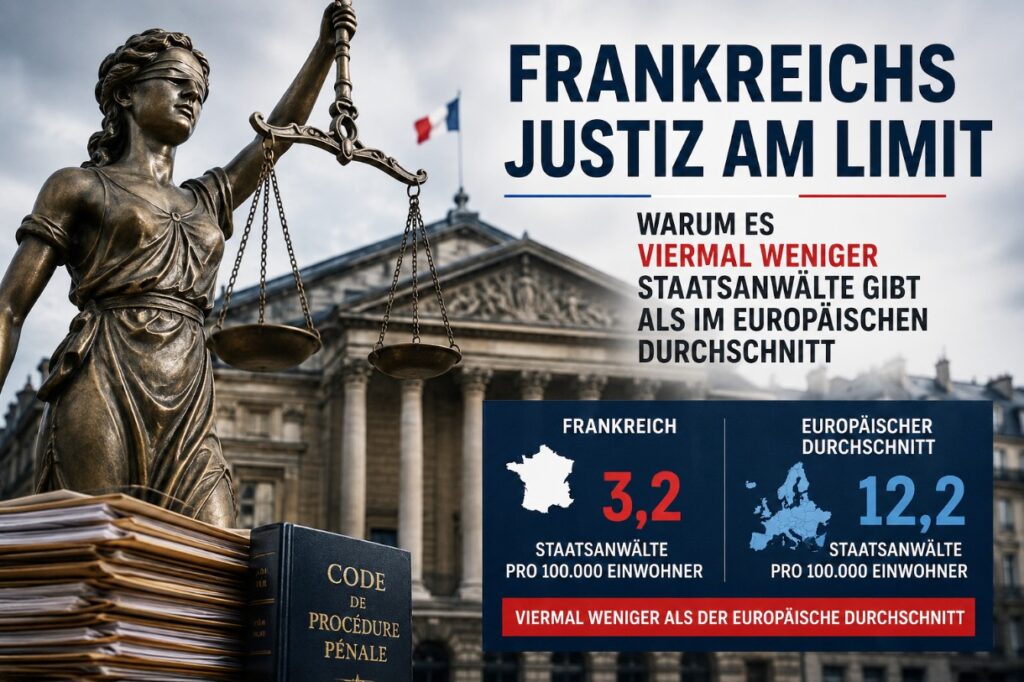
The effectiveness of a rule-of-law state is measured not only by its laws but also by the resources available for their implementation. In France, concern has been growing for years that the justice system cannot keep pace with social challenges and criminal policy. One central indicator highlights the problem particularly clearly: France has far fewer prosecutors than most other European countries. The consequence is overburdened authorities, long processing times, and increasing doubts about the efficiency of the judicial system.
A particular case in Europe
The latest comparative data from the European Commission for the Efficiency of Justice (CEPEJ), based on 2022 figures and published in 2024, paint a striking picture. France has barely about 3.2 prosecutors per 100,000 inhabitants. The European average, by contrast, is 12.2, with a median of 11.2 prosecutors.
This means that, relative to its population, France employs roughly four times fewer prosecutors than the European average. In the European comparison, the country is near the bottom of the table, only ahead of Ireland. Several Central and Eastern European countries have figures between 20 and 24 prosecutors per 100,000 inhabitants.
These figures are even more striking when one considers that France is one of the largest economies in Europe and has a highly developed administrative structure. The staffing of criminal prosecution authorities stands in stark contrast to the country’s economic and political importance.
The consequences of understaffing
Statistical comparisons gain meaning through their practical impacts. In the case of French justice, these are immediately visible.
According to CEPEJ data, a French prosecutor handles on average more than 2,000 cases per year. The European median, by contrast, is approximately 204 cases. Therefore, the workload of French prosecutors is extraordinarily high and among the highest in Europe.
Such an overload cannot be without consequences. Investigations take longer, priorities must be set more strictly, and complex cases consume considerable resources. Particularly demanding areas such as organized crime, cybercrime, financial offences or domestic violence require specialized knowledge and long-term investigative work. It is precisely in these sectors that the lack of personnel is felt most acutely.
In addition, French prosecutors typically have fewer administrative and legal support staff than their European counterparts. While in other countries a large body of clerks, assistants and administrative employees supports legal work, French prosecutors must carry out many tasks with comparatively limited resources.
Not only the prosecution is affected
The structural problems are not limited to the public prosecutors. France is also notably below the European average when it comes to judges.
While Europe has an average of 21.9 judges per 100,000 inhabitants, France has only around 11.3 judges per 100,000 inhabitants. In the median of European countries, France also lags considerably behind.
This double shortfall —both of judges and prosecutors— increases the burden across the entire judicial system. Cases pile up not only in investigative authorities but also frequently in the courts. This prolongs processing times throughout the whole procedural chain.
French justice thus faces a classic bottleneck problem: even if specific areas are strengthened with more staff, delays persist while other stages of the process are not equally expanded.
Causes of a prolonged deficit
The current situation is not the result of short-term developments. Rather, it is a structural problem that has been formed over decades.
Although budgets for justice have been increased on several occasions in recent years and the number of judges has risen, the complexity of proceedings has grown simultaneously. Digitization, international financial flows, cross-border crime and new forms of cybercrime generate a much greater processing effort than twenty years ago.
In addition, social awareness of certain types of crimes has changed. Cases of domestic violence, sexual assault or discrimination are now reported more often and prosecuted more vigorously than before. This progress in victim protection also increases the workload for the police, prosecutors and courts.
For this reason, many experts point out that merely considering absolute staff figures could even underestimate the real burden. Not only does the number of proceedings increase, but also their legal complexity.
A risk to confidence in the rule of law
The capacity of the justice system is of central importance for the stability of democratic institutions. Citizens expect that crimes will be prosecuted, disputes resolved quickly and sentences handed down within reasonable timeframes.
When proceedings drag on for years or are shelved due to lack of resources, the impression of an overwhelmed state is easily created. This can damage confidence in the functionality of public institutions.
Several senior representatives of the French judiciary have repeatedly warned in recent years about this problem. They warn that the public’s expectations increasingly clash with the real capacities of courts and public prosecutors. The lack of staff is no longer just an internal administrative problem, but a challenge to the quality of state justice administration overall.
In this context, the debate about resourcing the justice system is taking on growing political relevance. While internal security issues are often at the center of public debates, the discussion is now intensifying over whether the police, public prosecutors and courts have sufficient resources to effectively implement political goals. Comparative European data suggest that France still has a considerable lag in this area.
Author: P. Tiko