
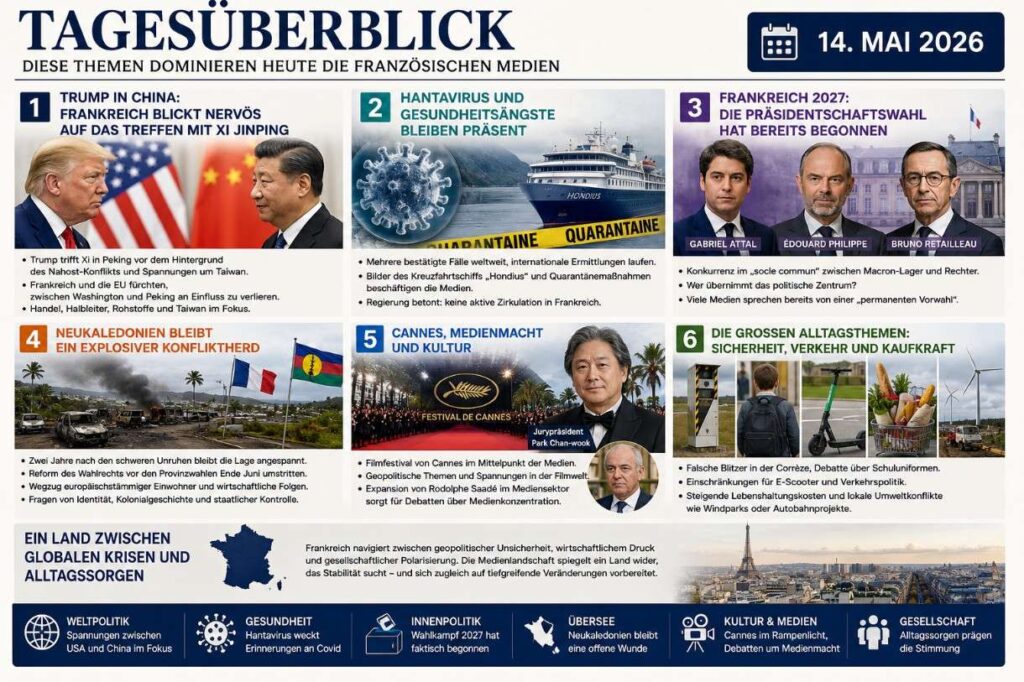
On this May 14th, France begins the day with an unusually dense set of news topics, spanning world politics, domestic political restructuring, and social tension. Although international attention focuses on the relationship between the United States and China, debates around security, health, and political stability are also intensifying domestically. French media depicts an image of a republic in transition — under pressure diplomatically, while already entering election campaign mode at home.
Trump and Xi Jinping: Paris worries about a new world order without Europe
The dominant international topic remains the meeting between Donald Trump and Xi Jinping in Beijing. French media mainly analyze the strategic significance of the talks in the context of Middle East tensions, the Taiwan issue, and global trade conflicts.
In Paris, there is growing concern that Europe will gradually become a bystander to a geopolitical reshuffle negotiated between Washington and Beijing. Commentators note that as long as the European Union cannot act more united diplomatically, France’s influence on key issues such as semiconductor production, resource security, or security architecture will remain limited.
French media especially focus on possible economic easing signals between the US and China. Although stability in the relationship may soothe markets in the short term, it could simultaneously further weaken Europe’s strategic importance.
Hantavirus: The political effects of the COVID memory still persist
The topic of hantavirus remains highly followed. Although French authorities emphasize there is currently no urgent danger to France, media exposure remains high. International quarantine measures and reports of potential infection chains once again feed the unease deeply rooted in social consciousness since the COVID-19 pandemic.
The government is clearly making efforts to appease public sentiment. President Emmanuel Macron and several health officials avoid alarmism, emphasizing the response capacity of French health institutions. However, reports also show that European society’s sensitivity to a potential health crisis has greatly increased.
This is not just a medical issue. The topic touches on fundamental issues such as national credibility, crisis prevention, and international mobility. French commentators point out that the media momentum of health warnings itself can trigger significant economic and political consequences.
France 2027: The Election Battle Has, in Fact, Already Begun
In domestic affairs, the focus is gradually shifting to the 2027 presidential election. Although the formal vote is still some time away, the key figures are already engaged in ongoing positioning.
The current focal figures include Gabriel Attal, Édouard Philippe, and Interior Minister Bruno Retailleau. The three represent different facets of the political center, which is struggling for its future form after the end of the Macron era.
Gabriel Attal is still trying to position himself as a modern continuation of Macronism. Édouard Philippe emphasizes more the national leadership style and the credibility of economic policies. Retailleau stands out particularly within the conservative camp, enhancing his personal image by actively politicizing security and immigration issues.
French mainstream media increasingly discuss the so-called “socle commun” structural weaknesses — that is, the political alliance between the liberal center and the moderate right. Many analysts are beginning to question whether this alliance is sufficient in the long term to effectively counter the Rassemblement National.
New Caledonia Remains an Unhealed Wound of the Republic
The situation in New Caledonia remains tense. Two years after serious riots, French media once again closely follow the political and social consequences of the conflict.
The discussion about electoral law reforms before the provincial elections is particularly sensitive. Critics argue that it interferes with the fragile balance between different groups in the Pacific territories. At the same time, multiple media outlets have reported an increase in the migration of residents of European descent as well as economic turmoil following the unrest.
This debate touches on some fundamental issues of France’s national identity: How far can the cohesion of the Republic go? What role does the colonial legacy play in 21st-century France? How much stability can France’s presence in the Indo-Pacific region maintain?
Paris is still trying to control the situation through political negotiations and security measures. However, many observers have come to see this conflict as a symptom of a deeper crisis in France’s overseas policy.
Cannes: Charm and Political Realities Coexist
The Cannes Film Festival remains an important media topic. As in previous years, the festival is not only a cultural event but also a stage for social and geopolitical discussions.
Jury president Park Chan-wook’s public statements about the role of films during geopolitical crises have received widespread attention. At the same time, many commentaries focus on economic changes in the international film industry, especially the impact of major streaming platforms and the increasing concentration in the media sector.
Against this backdrop, entrepreneur Rodolphe Saadé’s growing influence in the French media market has sparked discussions about journalistic independence and the concentration of media power. France is experiencing a development that troubles many European democracies as well: the increasingly close connection between economic strength, political influence, and media control.
Everyday Concerns Still Dominate Local News
Besides major geopolitical and political issues, traditional everyday concerns still hold an important place in local media. Regional media extensively report on rising living costs, traffic policies, environmental conflicts, and security issues.
Discussion topics include stricter rules for electric scooters, local controversies about wind power projects, and debates around school uniforms and youth violence. It is these local issues that show many French people feel political uncertainty more from concrete changes in their daily lives than from international crises.
The combination of geopolitical tensions, economic pressures, and social polarization is currently shaping public sentiment in France. The country appears increasingly like a society that on one hand seeks stability, and on the other is preparing for profound political change.