
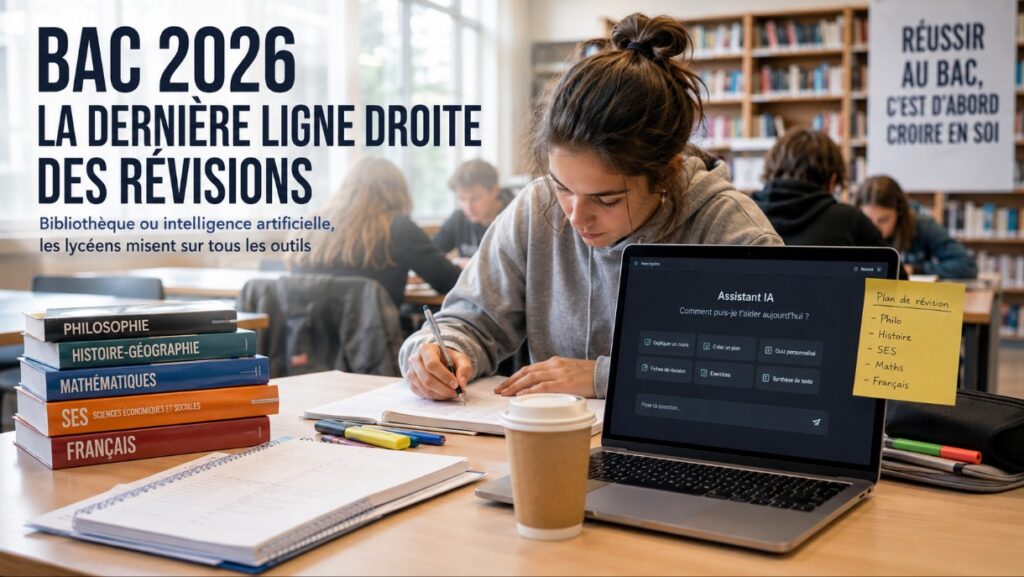
Only ten days remain until the first written exams of the French Baccalauréat. For thousands of students, the decisive phase now begins. Reading rooms in libraries are filling up, study spaces are more sought after than ever, and sitting between schoolbooks, notebooks, and laptops is a new companion at the table: Artificial Intelligence.
What sounded like a thing of the future just a few years ago has now become part of everyday life for many young people. AI-supported applications help review lesson content, explain complicated topics in simple words, or create flashcards and practice exercises within seconds. The question is no longer whether students use artificial intelligence, but how they use it.
At the same time, libraries are experiencing a remarkable renaissance. At first glance, this seems contradictory. Why would young people make the effort to go to a library when digital assistants are available around the clock?
The answer lies less in the books and more in the atmosphere. Those who study at home know the temptations: the smartphone, social networks, or the refrigerator suddenly seem more interesting than mathematics or philosophy. The library, on the other hand, offers a clear framework. Concentration prevails there, and it is precisely this environment that many high school graduates appreciate particularly in the last days before the exams.
While the library creates structure, artificial intelligence often takes on the role of a personal learning coach. Modern applications adapt exercises to the user’s level of knowledge, create individual study plans, and provide explanations at different levels of difficulty. If a concept is not understood, it is simply explained again—formulated differently and often more accessibly.
However, the new learning world also has its downsides.
Teachers increasingly observe that some students confuse good results with genuine understanding. A task solved by AI looks convincing. Whether the learner can develop the solution independently later is another question. Particularly in subjects like history, philosophy, or economics, independent thinking and argumentation are crucial.
On exam day, no one sits next to the candidate. No chatbot answers questions, no software provides prompts. Then only knowledge, concentration, and perseverance count.
For this reason, education experts see the contrast between library and artificial intelligence as a false debate. The most successful learning strategies combine both worlds. AI helps with organizing and understanding, the library creates calm and focus. One does not replace the other.
Abitur 2026 thus marks a turning point. A generation learns differently than its predecessors—more digitally, flexibly, and individually. Yet in the end, an old truth remains: success does not come to those with the best tools but to those who use them wisely.
Author: C.H.