
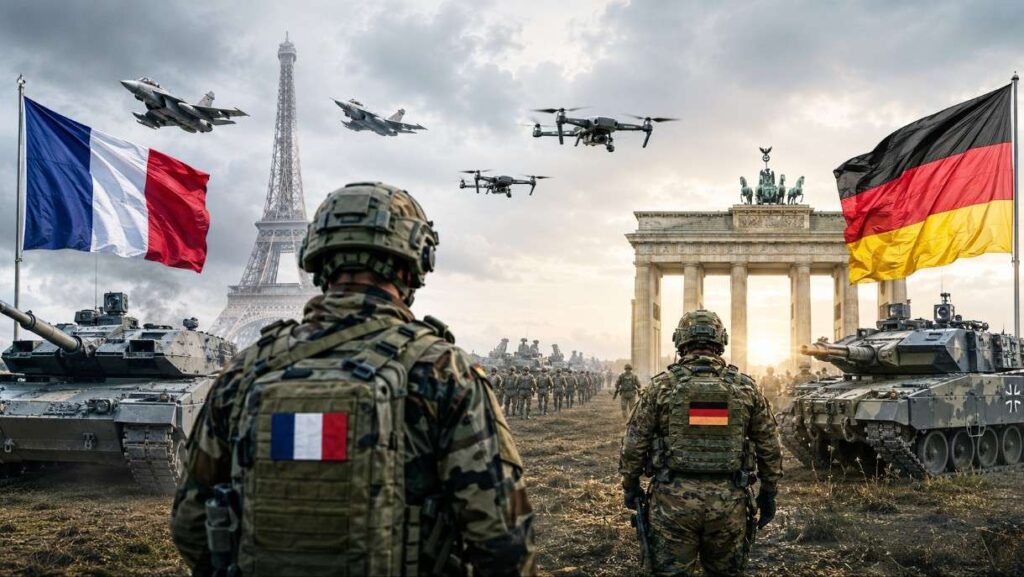
For decades, France has considered itself the leading military power in Europe. The country possesses nuclear weapons, a permanent seat on the United Nations Security Council, an autonomous defense industry, as well as globally experienced armed forces. Few other European states combine military reach, political ambition, and strategic autonomy in a comparable way.
But now a warning signal comes precisely from within its own military ranks. General Fabien Mandon, France’s highest-ranking military officer, has warned in an exceptionally open manner, during a Senate hearing, about a possible loss of importance of the French armed forces. His message was remarkably clear: if Germany maintains its current pace of military modernization, France could lose part of its previously held lead within a few years.
This statement strikes a sensitive chord. Because it concerns not only defense policy issues but also the conception that the Fifth Republic has of its role as a strategic power in Europe.
A breaking of taboo coming from the general staff
Senior military officials usually express their concerns cautiously. All the more remarkable was Mandon’s assessment that a “decline” of France is fundamentally possible. The warning is aimed less at concrete threats than at structural trends in Europe.
Since the Russian aggression against Ukraine, the security landscape on the continent has changed profoundly. In 2022, Germany announced the largest military buildup in its post-war history, with a special fund called “Sondervermögen” of 100 billion euros. In addition, there are permanently increasing defense expenditures and ambitious modernization programs.
While France was traditionally considered the military benchmark state in Europe, Germany is now catching up or even surpassing this power in key areas for the first time in decades. For Paris, this would not be just a simple technical matter of military capabilities: it would alter the balance of power in Europe.
The Dilemma of Strategic Wholeness
For years, French forces have adopted an ambitious approach. Unlike many European partners, Paris tries to maintain all military capabilities by its own means.
This includes nuclear deterrence, a capable navy with an aircraft carrier, modern air forces, space and cyber capabilities, as well as the ability to intervene worldwide. Added to this is a presence in overseas territories and a close security cooperation network with partner African states.
This model offers considerable strategic advantages. France remains independent of external security guarantees and can act militarily autonomously. At the same time, this overall orientation generates high costs.
The challenge is that modern wars are not won solely through exceptional technological performance. They also require industrial mass, large production capacities, and the ability to quickly replace losses.
It is precisely here that Mandon identifies a growing weakness.
The war in Ukraine redefines the criteria
The conflict in Ukraine has upset many assumptions of Western military planners. For decades, many armies focused on limited deployments abroad, fighting terrorism, and very precise operations. The idea of a prolonged conventional war of attrition in Europe was marginal.
The reality on the Ukrainian battlefields paints a different picture. Artillery ammunition is consumed in enormous quantities. Drones partly replace traditional reconnaissance systems. Electronic warfare becomes a decisive factor. Production capacities and supply chains suddenly become as important as cutting-edge technological performance.
Of course, France has modern weapon systems such as the Rafale fighter, nuclear submarines, or advanced guided missiles. However, its industrial base often favors quality at the expense of large volumes.
Mandon described this problem through an unusual comparison: France masters the “haute couture” of defense technology, but will now also need “ready-to-wear” — that is, robust, quickly available, and low-cost systems that can be deployed in large numbers.
The drone revolution as a wake-up call
The need for adaptation is particularly evident regarding drones.
The war in Ukraine has shown that unmanned systems are no longer just supplements to conventional forces. They increasingly shape the entire battlefield. Reconnaissance drones, kamikaze drones, and autonomous systems enable military effects at a relatively low cost.
While a modern fighter costs several tens of millions of euros, some drones can be produced for a few thousand euros. Their loss is calculable, their production scalable.
France is not considered a technological laggard in this field. Nevertheless, the military today acknowledges that the strategic importance of drones has long been underestimated. The forces must therefore adapt their structures, training programs, and supply systems accordingly.
For Mandon, it is not just a technical issue, but a symbol of a profound change in military thinking.
Germany’s rise is changing the European security architecture
At the same time, Germany is gaining weight in security policy. For decades, the Federal Republic was considered an economic great power with limited military influence. This division of roles is beginning to change.
Thanks to increased defense spending, extensive acquisition programs, and enhanced integration within NATO, Germany could become the most important conventional military power in Europe in the medium term.
For the United States, this would present practical advantages. Berlin is geographically at the center of Europe, has significant industrial capabilities, and is increasingly becoming a logistical hub for NATO.
If this development continues, Germany’s importance in Washington could grow. Paris fears that France’s traditional role as the preferred European interlocutor on security matters will gradually be diminished.
However, the competition between the two countries remains politically moderate. France and Germany remain the central partners of the European Union. Nevertheless, a pressure of strategic competition is emerging behind the scenes, which would have been hard to imagine just a few years ago.
More than a budgetary issue
The warning from the chief of staff cannot be explained solely by demands for increased defense spending.
France already invests considerable sums in its armed forces. The real problem, according to many experts, lies in the supply and production structures. The delay between the political decision and the actual delivery of new systems is often very long.
In a context of rising geopolitical insecurity, speed becomes a critical factor. The armed forces must integrate new technologies more quickly, accelerate the ramp-up of production chains, and respond more flexibly to threats.
That is why Mandon is not only calling for additional resources but a complete change of model. The priorities in the future will be industrial scale-up, air defense, electronic warfare, drone systems, logistics, and recruitment.
The French forces must maintain their technological excellence while becoming more resilient and adapted to mass production.
France thus finds itself at a strategic crossroads. Its military model so far was based on global presence, technological excellence, and limited interventions. The new security situation in Europe also demands endurance, industrial capabilities, and rapid adaptability.
The warning from the chief of staff should therefore be seen not as alarmism, but as a clear-headed analysis. France remains one of the most powerful armies in Europe. But the certainties that have supported this status for decades are increasingly being put to the test. Paris’ ability to maintain its special position will depend not only on the billions available, but on how quickly the country adapts its armed forces to the reality of a new European era of deterrence and rearmament.
Author: Andreas M. Brucker