
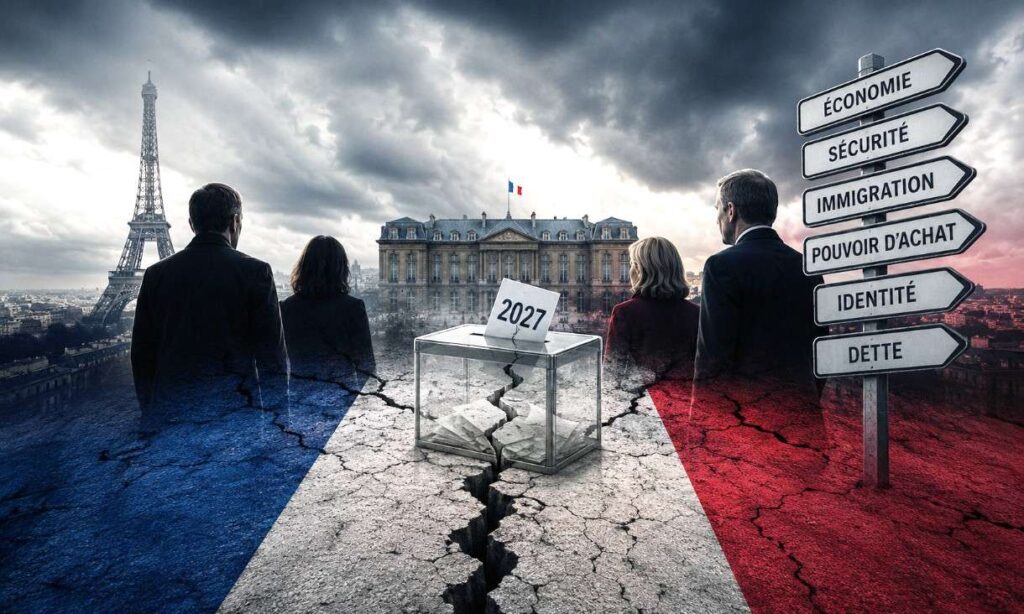
Less than a year before the 2027 French presidential election, public discourse is dominated by one impression: the upcoming election could be the election of multiple crises in France. In the history of the Fifth Republic, few presidential contests have taken place in an atmosphere so filled with geopolitical, economic, social, and identity-political uncertainties.
France is gradually entering the primary phase — accompanied by a series of tense situations profoundly changing the political landscape. The Middle East war, energy policy concerns, a sluggish European economy, high national debt, housing shortages, immigration issues, urban violence, and increasing democratic fatigue intertwine. Each crisis seems to reinforce the next. Against this backdrop, the 2027 election is less a conventional partisan competition than a referendum on whether the country can maintain stability in an increasingly challenging world.
The End of the Macron Era and Political Restructuring
A notable feature of this presidential election is the absence of an incumbent president as a candidate. According to the constitution, Emmanuel Macron cannot run for a third consecutive term. What he leaves behind is a political system profoundly transformed since 2017 but also highly fragmented.
The historic collapse of traditional mass parties — the left-wing Socialist Party and the right-wing Republicans — has yet to be replaced by a new stable balance. The political center, which dominated for nearly a decade, appears increasingly exhausted. Many French now associate Macronism with a technocratic style of governance that, while seemingly efficient, feels alienated in the face of social and regional tensions.
The protest movements of recent years—from the “Yellow Vests” to the intense conflicts around pension reform—have made this alienation obvious. Public trust in institutions, parties, and the media has declined significantly. For many voters, the political center is no longer seen as a solution but rather as a symbol of a system that has lost control over social development.
The Rise of the National Rally
As the influence of the political center wanes, the National Rally (Rassemblement National, RN) is stronger than ever. Jordan Bardella represents a new generation of nationalist politicians, whose influence has far exceeded the traditional far-right voter base.
His strategically polished public image, professional use of social networks, and continuous push for the normalization of the party have changed political perceptions. Today, an RN victory is no longer seen as a fringe hypothesis but as a realistic possibility.
The RN’s success is due to multiple factors: concerns about immigration, a lack of security in the face of global crises, fears of economic decline, and deep skepticism toward European institutions. Especially in structurally weak regions and small towns, the party increasingly presents itself as a protective force against globalization and a sense of loss of control.
Meanwhile, Bardella also benefits from the fact that the traditional Republican right is still struggling with its political identity. Conservative forces oscillate between a tradition of economic liberalism and a nationalist conservative shift, and have yet to present a convincing alternative.
Despite Favorable Issues, the Left Remains Divided
The situation on the left remains contradictory. Social inequality, inflation, climate change, and the crisis in public services should be issues that mobilize support, but the French left is deeply divided.
Socialists, the Green Party, the radical left, and various civic movements have significant differences on issues such as Europe, immigration, security policy, and economic models. So far, there has not been a common candidate or dominant leader.
Furthermore, there are also cultural conflicts within the progressive camp. Some on the left emphasize identity and social issues more, while others advocate a return to traditional socio-economic concerns, such as purchasing power, industrial policy, and social security. These contradictions hinder the formation of a broad political alliance.
At the same time, the traditional working class and lower-middle-class voters no longer automatically support the left. Especially in regions dominated by economic insecurity and security issues, the left has continuously lost influence over many years.
Foreign Affairs and Security Issues Come to the Forefront
The international situation may shape the 2027 presidential election more profoundly than many previous electoral battles. The French public is increasingly concerned about rising geopolitical tensions: strategic competition between the US and China, conflicts in the Middle East, cyber threats, and the return of traditional great power politics.
This makes the question of presidential authority important once again. In France’s political culture, the head of state has always been seen as a guarantee of national stability and international capacity for action. In times of crisis, this expectation often intensifies.
Therefore, future candidates will not only need to propose economic or social reform plans, but they must also answer questions about how France will maintain sovereignty, protect the industrial base, and consolidate its strategic position in Europe.
Especially issues such as defense, energy supply, and economic independence may become more important. A core question facing France is: In a world of globalization and geopolitical fragmentation, how much room for national-level control can still be retained?
A Society in a State of Persistent Fatigue
Perhaps the greatest unknown is the psychological state of the nation. For years, France seems to have been shrouded in collective fatigue: fear of social decline, distrust of the elites, resentment over taxes, media polarization, and the increasing radicalization of public discourse have shaped the social atmosphere.
Social networks have further amplified this dynamic. Political controversies spread faster, discussions become more emotional, and the capacity for compromise diminishes. Public debate is increasingly dominated by short-term waves of anger.
Therefore, the 2027 presidential election may not be primarily driven by the platforms of traditional parties but more likely decided by an emotional underlying tone: fear, anger, fatigue, a need for security, or a desire for a break from radical politics.
At the same time, several core issues are becoming more focused: To what extent can France autonomously shape its economic future? How can the welfare state be maintained without further swelling national debt? To what degree should immigration be controlled? How should a socially acceptable balance between security and personal freedom be achieved? And in a world of rapidly changing geopolitics, what role does France wish to play?
Thus, the 2027 presidential election may not only decide who governs France but also reveal the French people’s level of trust in their own country—and in an era of ongoing crisis, their imagination of stability, identity, and future capacity.
Author: Andreas M. Brucker