
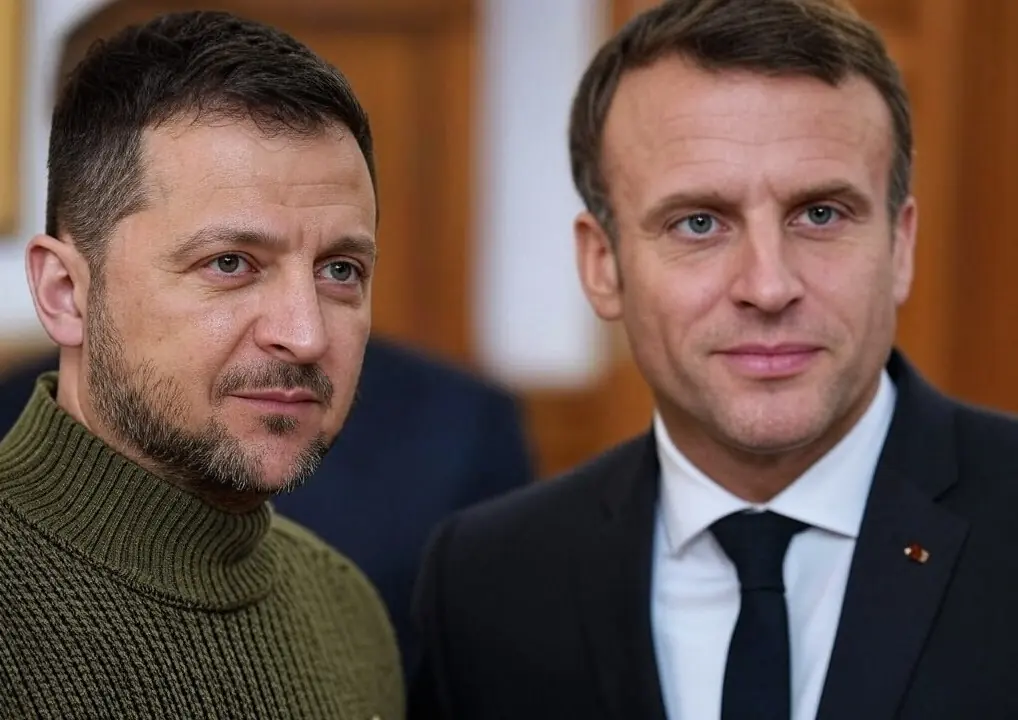
In the midst of a conflict that has long turned into a war of attrition, a diplomatic signal from Kyiv draws attention. Ukrainian President Volodymyr Zelensky has sent a letter to Russian President Vladimir Putin to explore possibilities for a ceasefire and new talks. French President Emmanuel Macron called this step “a good initiative” on Friday during a visit to Montenegro. The response from Paris shows how much European governments are searching for signs that could indicate a possible political movement in a conflict that has been stuck for years.
Diplomacy in Times of Stalemate
The war between Russia and Ukraine is now in its fifth year. Despite numerous military offensives, international mediation efforts, and several peace initiatives, a political solution has not come closer. The front lines have been reinforced in many regions, while the human and economic costs of the war continue to rise.
In this context, every diplomatic initiative carries special significance. Zelensky’s letter to Putin should be seen less as an immediate breakthrough and more as an attempt to keep a political communication channel open. The exact content of the letter has not been made public. The mere fact that Kyiv has taken a direct step, however, sends a message to multiple recipients at once: to Moscow, to Western allies, and to the international public.
In armed conflicts, the symbolic dimension of diplomacy is often just as important as concrete negotiation results. Even if immediate progress is lacking, such steps can help signal a willingness to engage in dialogue and make political positions visible.
France’s balance between support and dialogue
Since the beginning of the war, Emmanuel Macron has pursued a strategy that combines military support for Ukraine with the long-term perspective of a diplomatic solution. France is one of the main European supporters of Kiev, while the French president regularly emphasizes that lasting peace ultimately cannot be achieved solely on the battlefield.
The positive assessment of Zelensky’s initiative fits within this approach. Macron thus makes it clear that Europe still stands alongside Ukraine but at the same time wants to support every serious chance of de-escalation.
This position is not undisputed. Critics sometimes accuse Western governments of overestimating diplomatic signals as long as fundamental differences between the conflict parties persist. Supporters, on the other hand, argue that even limited channels for dialogue can be essential to prepare later negotiations at all.
France traditionally sees itself as a mediation and shaping power within Europe. Support for Zelensky’s initiative therefore aligns with the French ambition to play an active role in security matters.
The major obstacles on the road to negotiations
Despite all diplomatic gestures, the political realities remain difficult. The positions of Moscow and Kiev are broadly far apart.
For Ukraine, restoring its territorial integrity and ensuring its sovereignty are central. Russia, on the other hand, insists on territorial claims and ties possible negotiations to security demands that are currently unacceptable to the Ukrainian leadership.
This is compounded by deep-rooted mutual distrust. Various previous formats for talks failed because neither side was convinced that the other would uphold agreements sustainably. This deficit of trust constitutes one of the biggest obstacles to serious peace negotiations.
The international dimension also complicates a solution. The war is no longer only about Russia and Ukraine. It affects the European security order, the relations between Russia and the West, as well as global issues around economy and energy. Any political agreement would therefore have to consider broad strategic interests.
Europe seeks a common strategy
Macron’s statement also illustrates the current debate within Europe. While military support for Ukraine is widely supported, the discussion is growing about what a possible political end state of the conflict could look like.
Many European governments face a dual challenge: on the one hand, they want to prevent Russia from achieving political goals through military force. On the other hand, there is a growing awareness that lasting stability on the European continent ultimately requires a political solution.
Support for diplomatic initiatives therefore does not necessarily mean a change in Western positions. It is mainly about keeping possible channels for dialogue open and preserving future options. In this context, any initiative that enables direct exchange between the parties to the conflict gains extra weight.
Whether Zelensky’s letter will actually spark a new dynamic is still uncertain. So far, there are no indications that the fundamental differences between Moscow and Kiev have been overcome. Nonetheless, the Ukrainian initiative shows that the diplomatic level has not been completely abandoned despite the ongoing fighting.
In prolonged conflicts, political breakthroughs seldom happen suddenly. They are often preceded by numerous symbolic gestures, informal contacts, and cautious attempts at rapprochement. Zelensky’s letter to Putin should therefore primarily be understood as a political signal: an indication that Ukraine continues its military defense but does not rule out the possibility of future dialogue.
Macron’s positive reaction underscores that Europe closely monitors such signals. Whether concrete progress will result from this, however, does not depend on isolated letters or statements, but on the willingness of all parties involved to revise their previous positions. As long as this condition is not met, diplomacy remains primarily an instrument to keep the prospect of peace open – in a war whose end is still unpredictable.
Author: P. Tiko