
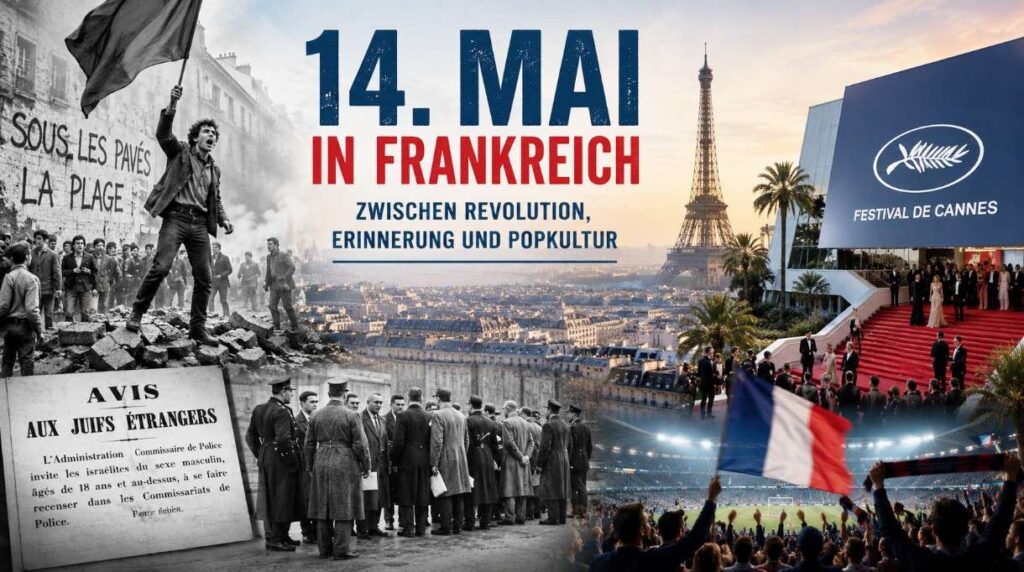
May 14th first seems discreet in the French calendar. No national holiday, no military parades. And yet, this date carries with it an astonishing political and cultural force. After all, France would not be France if even a simple spring day did not provide material for historical debates, social tensions, and grand staging.
May 1968 remains deeply engraved.
Around May 14th, the protest movement then took on a new dimension. What had begun as student demonstrations in Paris suddenly spread to the entire country. Universities were occupied, workers went on strike, factories stopped. In a few days, France transformed into a powder keg. Millions of people stopped working — a movement still considered one of the largest general strikes in Europe.
The images of those weeks still resonate today: barricades in the Latin Quarter, young protesters waving cobblestones, plumes of smoke above Paris. President Charles de Gaulle seemed at times to lose control of the country. France began to discuss everything at once — power, freedom, capitalism, sexual morality, education, hierarchies. The old face of France cracked. And spectacularly so.
Until today, “May 68” almost automatically triggers controversies. For some, this revolt marked the beginning of a more modern and freer country. Others see it as the starting signal of a gradual loss of state authority and social order. In French talk shows, it is often enough to mention “68” for the next major controversy to ignite.
But May 14 also reminds France of a dark chapter of its history.
On May 14, 1941, the so-called “Green Ticket Roundup” began, one of the first major arrest operations targeting Jews in occupied France. Thousands of men, many of them foreign Jews, were then summoned by the French authorities, arrested, and later interned. The fact that the French police actively participated in these measures remains to this day one of the most painful points of the national memory culture.
For a long time, France struggled to confront this past. For decades, the narrative of a country of Resistance dominated. It was only later that the responsibility of the Vichy regime gained public visibility. Today, this work of memory is an integral part of French political culture. Especially since, in view of increasing antisemitic tensions, the memory of such events regains relevance. History never stays dusty in the archives — it takes a seat at the table.
And then there is the other face of France: glamour, cinema, and the grand stage.
In May, attention traditionally turns to Cannes. While photographers fight for the best shot on the beaches of the Côte d’Azur, France presents itself as a cultural nation of global significance. The Cannes Festival is much more than a collection of beautiful dresses and famous faces. It is a place where politics, art, and staging come together. For decades, French cultural policy has regarded cinema as an integral part of national identity — almost as seriously as other countries take their foreign policy.
Sometimes, Cannes seems like a parallel universe to the political daily life of Paris. There, strikes and debates about pensions; here, flashes and champagne. In a way, this contrast perfectly reflects France.
In sports as well, May 14 often falls during a crucial phase of the season. Football championships are decided, cup finals take place, entire cities grow nervous. Football in France has an importance that goes far beyond the sport. Issues of integration, social mobility, and national cohesion regularly reflect on the field.
May 14 therefore exemplifies how France operates: this country lives on memory, disagreement, and passion. Past and present constantly collide here. Even an apparently ordinary day on the calendar suddenly opens a window onto major French themes — rebellion, responsibility, culture, and social identity.
By C. Hatty