
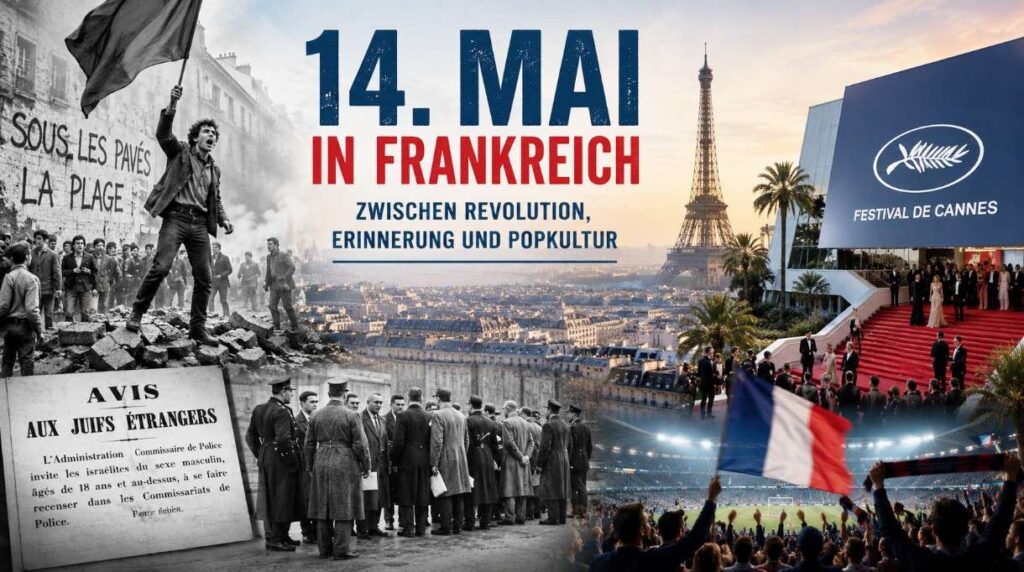
May 14th seems at first glance unremarkable in the French calendar. It is not a national holiday, there are no military parades. And yet, this date holds surprising political and cultural power. France would not be France, after all, if even an ordinary spring day did not give rise to historical debates, social tensions, and grand spectacles.
Especially memorable is May of 1968.
Around May 14th, that protest movement reached another dimension. What had started as student protests in Paris suddenly spread throughout the country. Universities were occupied, workers went on strike, factories came to a halt. In a few days, France transformed into a ticking time bomb. Millions of people stopped working — a process still considered one of the largest general strikes in Europe to this day.
The images of those weeks still resonate: barricades in the Latin Quarter, young protesters holding cobblestones, columns of smoke over Paris. President Charles de Gaulle seemed at moments to lose control of the country. France suddenly debated everything at once: power, freedom, capitalism, sexual morality, education, hierarchies. Old France was cracking. And deeply so.
Until today around “May ’68” controversy almost reflexively erupts. For some, this revolt marked the beginning of a more modern and free country. Others see it as the starting signal for the gradual loss of the authority of the State and social order. In French debate programs, it is enough to mention “68” and — bang — the next serious discussion is already heated.
But May 14 also reminds France of a dark chapter in its history.
On May 14, 1941, the so-called “Green Ticket Roundup” began, one of the first major detention operations against Jews in occupied France. Thousands of men, many of them foreign Jews, were summoned by the French authorities, detained, and later interned. The fact that the French police actively participated in these measures remains one of the most painful points in the culture of national memory.
For a long time, France found it difficult to confront that past. For decades, the narrative of a country of the Resistance prevailed. Only later did the responsibility of the Vichy regime gain greater visibility in public consciousness. Today that trial is already part of French political culture. Especially in the face of rising antisemitic tensions, the memory of those events is gaining weight again. Here history never stays dusty in the archive: it sits at the table.
And then there is the other face of France: glamour, cinema, and the grand stage.
In May, the focus traditionally turns to Cannes. While photographers compete for the best image on the beaches of the Côte d’Azur, France presents itself as a cultural nation with global aspirations. The Cannes Film Festival is much more than a gathering of pretty dresses and famous faces. There, politics, art, and self-presentation intersect. For decades, French cultural policy has seen cinema as part of national identity — almost as seriously as other countries take their foreign policy.
Sometimes Cannes seems like a parallel universe to the everyday politics of Paris. There strikes and debates about pensions, here flashes and champagne. Somehow that contrast fits perfectly with France.
In sports, May 14th also usually coincides with a heated phase of the season. Football championships are decided, cup finals are played, entire cities fall into collective nervousness. Football in France has long had an importance that goes far beyond sport. Questions about integration, social advancement, and national cohesion are periodically reflected on the field.
That is why May 14th exemplary shows how France works: this country lives off memory, contradiction, and passion. Past and present constantly collide here. Even an apparently ordinary day in the calendar suddenly opens a window to major French themes — revolt, responsibility, culture, and social identity.
By C. Hatty