
On the French calendar, May 14th might seem quite ordinary at first glance. It is not a national holiday, nor is there a military parade. But this date carries an astonishing political and cultural weight. If France did not give even an ordinary spring day material for discussion, it would not be France.
Especially significant is May 1968.
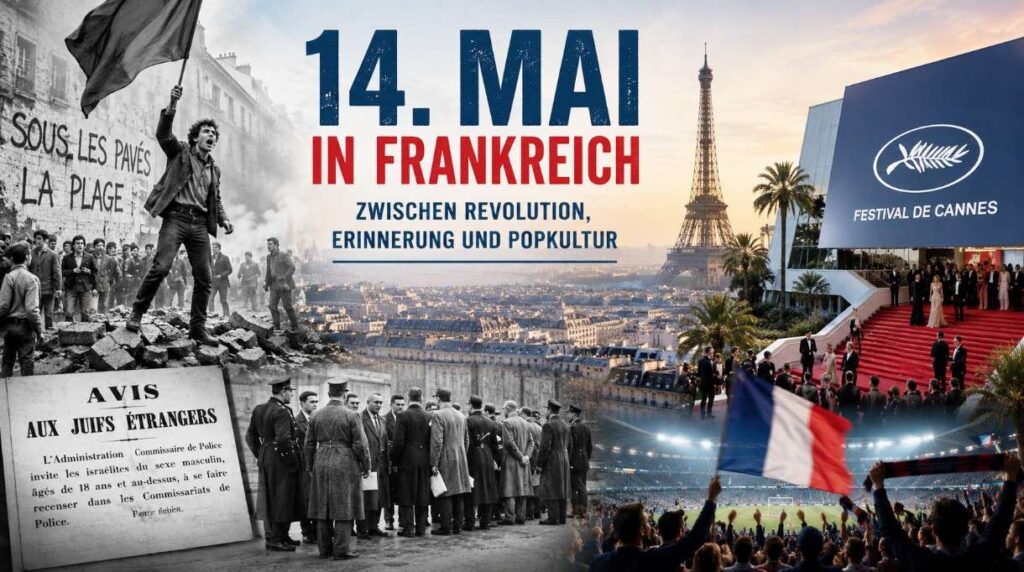
Around May 14th, the protest movement of that period reached a new dimension. The protests, initially started by students in Paris, quickly spread nationwide. Universities were occupied, workers went on strike, factories came to a halt. Within days, France seemed like a powder keg. Millions of people stopped working — this process is still regarded as one of the largest general strikes in Europe.
The scenes of those weeks remain impressive to this day: barricades in the Latin Quarter, young demonstrators holding cobblestones, the smoke shrouding Paris. Then-President Charles de Gaulle seemed at times to lose control of the country. Suddenly, France was simultaneously discussing everything — power, freedom, capitalism, sexual morality, education, hierarchy. The old France showed cracks, and they were enormous.
To this day, “May ’68” almost instinctively triggers debate. For some, this rebellion marked the beginning of a more modern, freer country. For others, it is seen as the start of the gradual loss of state authority and social order. In French talk shows, whenever “’68” is mentioned, a fundamental debate often breaks out fiercely immediately.
But May 14th also reminds France of a dark chapter in its history.
The so-called “Green Ticket Roundup” that began on May 14, 1941, was one of the earliest large-scale arrest operations targeting Jews in occupied France. Thousands of men, many of whom were foreign Jews, were summoned, arrested, and subsequently detained by the French authorities at the time. The French police played an active role in these measures, which remains one of the most painful issues in the nation’s collective memory culture to this day.
For a long time, France found it difficult to confront this part of its past. For decades, the narrative of a “nation of resistance” dominated. Only later did the responsibility of the Vichy regime gradually enter public consciousness. Today, this reflection has become a part of French political culture. Especially at a time of rising antisemitic tensions, the memory of such events once again becomes particularly important. History here is by no means sealed away in archives — it sits at the table with people.
The other face of France is charm, cinema, and the grand stage.
Every May, people’s attention traditionally turns to Cannes. On the beaches of the French Riviera, photographers compete for the best shots, and France presents itself as a cultural powerhouse. The Cannes Film Festival is far more than just a gathering of beautiful dresses and celebrity faces. Here, politics, art, and self-presentation intertwine. For decades, French cultural policy has regarded cinema as part of national identity — almost as seriously as other countries view foreign policy.
Sometimes Cannes seems like a parallel universe alongside everyday politics in Paris. There are strikes and pension debates there; here, flashbulbs and champagne. To some extent, it is precisely this contrast that aptly reflects France.
On the sporting level, May 14th is often a crucial point in the season. Football leagues decide the champion, cup finals take place, and the entire city falls into collective tension. Football in France has long meant more than just the sport itself. Issues of integration, social mobility, and national cohesion are often reflected on the field.
Therefore, May 14th becomes a typical window for observing how France operates: a country that lives by memory, conflict, and passion. The past and present constantly collide here. Even an apparently ordinary calendar day can suddenly open a window onto France’s major themes — rebellion, responsibility, culture, and social identity.
Author: C. Hatty