
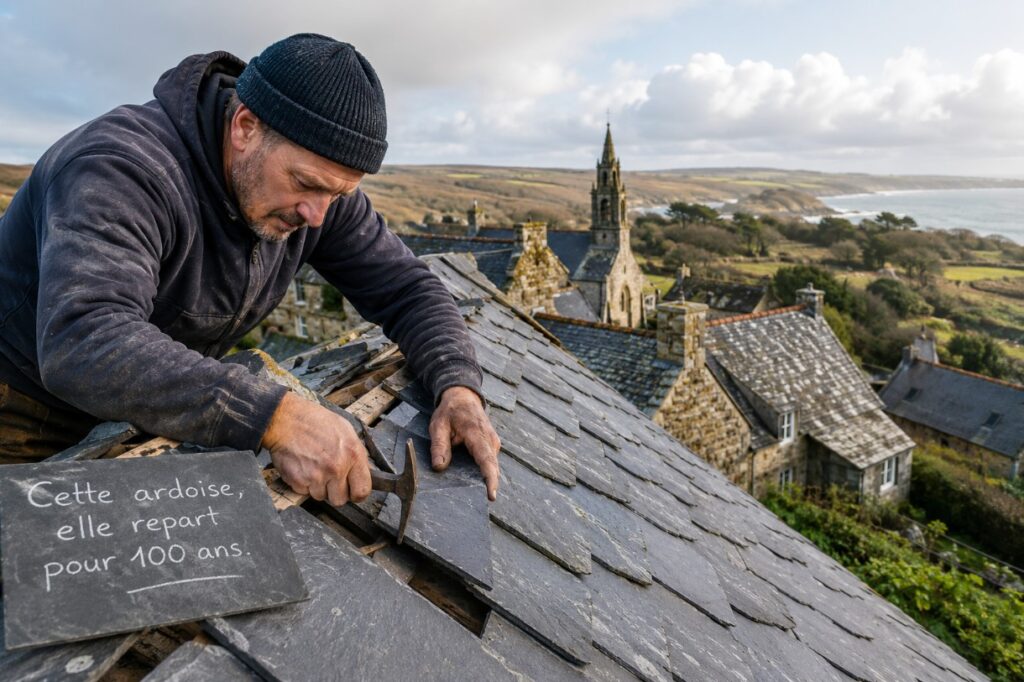
In Finistère, a Breton slate roofer works like a goldsmith of roofs. His craft speaks of durability in a time when many things are merely replaced.
In Brittany, there are roofs that are not built but inherited. Slate by slate, hand movement by hand movement. Anyone watching a slate roofer in Finistère quickly understands: This is not just about craftsmanship. It’s about patience, landscape, and the dignity of old houses.
The phrase comes almost casually. “This slate will last another 100 years.” No big gesture, no advertising slogan. Just the sober statement of a man who knows exactly what his profession is worth. While elsewhere entire components are replaced and discarded, the Breton slate roofer lifts a single slate, examines it with a practiced eye, and puts it back in place. As if gifting an old building another century.
In Finistère, the westernmost tip of Brittany, slate roofs belong to the landscape just like lighthouses, stone walls, and the sea. The Atlantic lashes the coast here with full force. Rain often blows horizontally across the fields, gusts of wind test the resilience of houses daily. Exactly because of this, a roofing culture has developed over generations that relies on durability.
A good slate roof is no quick affair.
Each slate has its own shape, its own structure, sometimes even its own character. The roofer sorts, cuts, and fastens them with precision reminiscent of fine watchmaking. Anyone who thinks roofs are made with brute force will be surprised on a Breton construction site. Experience counts above all here.
Up there on the roof, a glance often decides success or failure. Is the slate exactly in place? Does the water run off cleanly? Will the construction withstand the next winter storm?
The work demands calm.
And it demands respect for what already exists. Many of the buildings that Breton slate roofers work on are much older than their owners. Farmhouses, village churches, or stone houses carry stories in their walls. A new roof should not cover up these stories but preserve them.
This is precisely what makes this profession special. Modern construction methods often focus on speed. When something is damaged, it is often completely replaced. The slate roofer follows a different approach. He repairs, preserves, and extends. His work is more like restoration than an ordinary construction site.
One could say: He works against the throwaway society.
Of course, it is physically demanding. Slate is heavy, roofs are steep, and the Breton weather rarely shows its cozy side. Sunshine in the morning, rain at noon, wind force seven in the afternoon – in Brittany this is almost standard.
Nevertheless, many of these craftsmen radiate remarkable calmness. Perhaps because they see daily how long good work lasts. Those who place a slate carefully today do not think about next season. They think about future generations.
Isn’t that an astonishing thought in a time when products often only last a few years?
That is exactly why the traditional roofing craft fascinates far beyond Brittany. It reminds us that quality does not have to be loud. Sometimes a simple sentence on a roof in the wind of the Atlantic suffices.
“This slate will last another 100 years.”
There is more than a promise in this. It is an attitude. An attitude that shows that real craftsmanship not only protects buildings but also a piece of cultural heritage. And perhaps that is its greatest strength: It connects past, present, and future – slate by slate.
An article by M. Legrand