
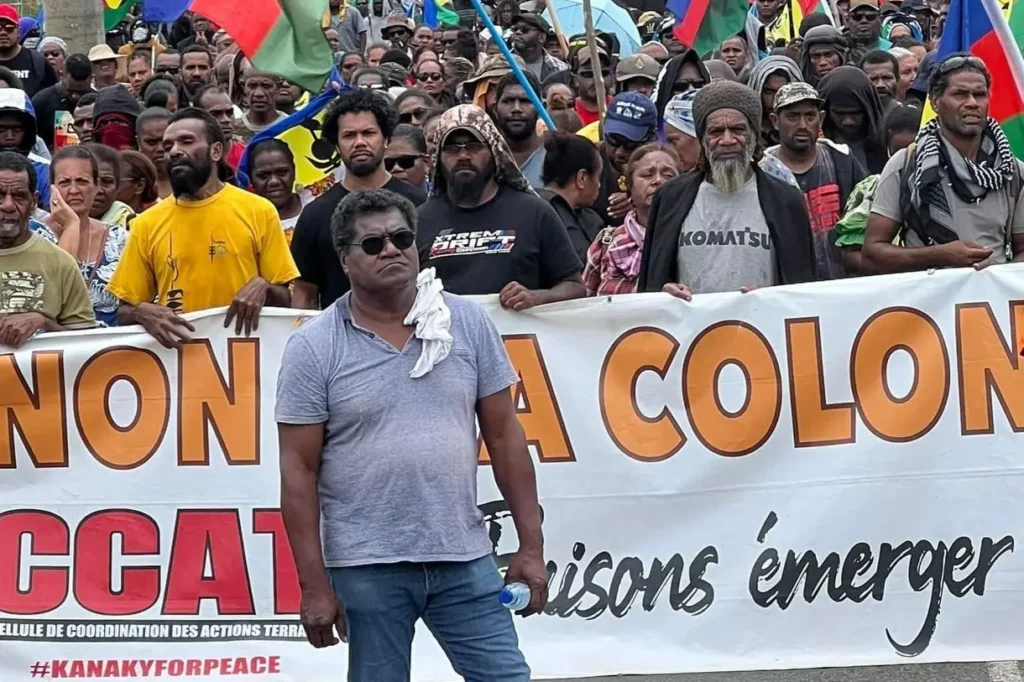
Two years after the serious unrest in New Caledonia, the French justice system has made a decision that goes far beyond the individual legal case. The examining magistrates in Paris have dropped a broad proceeding against fourteen Kanak activists, including Christian Tein, one of the best-known figures of the independence movement. The decision marks a turning point in the legal processing of the 2024 violence – and at the same time raises new questions about the relationship between the French state and its overseas province in the Pacific.
A spectacular turnaround in the proceeding
The investigations against the members of the Cellule de coordination des actions de terrain (CCAT) were among the most politically sensitive proceedings in recent years in France. After the violent riots of May 2024, the main representatives of the organization had been accused of having organized or at least supported a coordinated insurrection movement.
The toll of those disorders was devastating. Fourteen people lost their lives, numerous public and private buildings were destroyed, and the economic damages exceeded one billion. Particularly affected were the capital Nouméa and its suburbs, where roadblocks, arson attacks, and clashes with law enforcement paralyzed public life for weeks.
In this context, the investigative authorities had pursued the case with exceptional severity. The charges ranged from criminal association to complicity in serious acts of violence. For the French government at the time, the stability of a strategically important territory in the Pacific was at stake.
However, now the examining judges arrive at a different conclusion. According to them, the available evidence is not sufficient to bring the accused before a criminal court or even a court of assizes. The judges do not see enough elements to consider that the accused planned or directed an armed revolt.
The political nature of the movement
The legal reasoning behind the decision is particularly significant. The judges clearly distinguish between an independentist political movement and an attempt to violently overthrow the state order.
This addresses a central point of the controversy. The prosecution had argued that the CCAT not only accompanied the unrest but actively organized it. The defense, on the other hand, had from the outset emphasized that the movement pursued political goals within the framework of the decades-long struggle for the self-determination of New Caledonia.
The judges seem to have given at least some credit to the latter argument. In their assessment, the preparation of a violent coup d’état is not predominant, but rather the political mobilization of an independence movement. This does not mean that the violence of 2024 is justified or minimized. Rather, the judges do not find sufficient evidence that the leadership of the CCAT consciously directed or ordered the clashes.
Legally, this is an important distinction. Political claims for independence are fundamentally legitimate in a democratic system. Criminal relevance arises only if there is concrete evidence of the planning or organization of serious crimes.
Christian Tein in the Spotlight
Particular attention is given to Christian Tein. During the crisis, the activist had become a symbolic figure of the Kanak movement. His arrest and subsequent transfer to France had caused significant political tensions in New Caledonia and beyond.
For many Kanak, Tein represented the symbol of a reaction they considered excessive by the French state. Opponents of the independence movement, on the other hand, regarded him as a key figure behind the events of 2024.
Already in 2025 the investigating judges had expressed doubts about the original version of the accusation. At that time they ordered the release of Tein and other activists. According to them, there was not enough evidence that the defendants had organized or promoted armed gatherings. Public appeals for calm, believed to have come from Tein, were also taken into consideration.
The dismissal now ordered is therefore not a completely surprising development. It is rather the result of a gradual reassessment of the large volume of documents.
Justice remains divided
However, it cannot be said that there is a definitive closure. The Paris Public Prosecutor’s Office immediately appealed the decision. Now the competent appellate court will have to deal with the case again.
The Prosecutor’s Office argues that further investigations are necessary and that the documentation cannot yet be evaluated conclusively. Given the complexity of the proceedings, this step is not unusual. The investigations include several thousand documents, testimonies, and analyses of digital communications.
The appeal trial could therefore last for months. Only then will it be clear whether the dismissal will be confirmed or whether some charges will need to be re-examined.
This legal uncertainty also reflects the political complexity of the conflict. The events of 2024 were not just a matter of individual responsibility but an expression of deep social tensions.
New Caledonia between France and independence
The dispute over the CCAT cannot be understood without the historical context. New Caledonia has been part of France since the 19th century and today has a special status of autonomy. However, the indigenous Kanak population has been fighting for greater self-determination or complete independence for decades.
Between 2018 and 2021, several referendums were held on the future of the territory. In all votes, the majority expressed the wish to remain with France. However, the results of the last referendum were not recognized by many supporters of independence, who questioned its validity due to the Covid pandemic and the boycott by a part of the Kanak population.
The unrest in 2024 finally broke out because of a planned electoral reform. Critics saw it as a weakening of the political weight of the indigenous population. Within a few days, this triggered the most serious crisis in recent decades.
In this context, the decision of the investigating judges has great symbolic significance. For the independence movement, it is a confirmation of their old criticisms of the state accusations. For opponents, the question remains open as to who ultimately holds political responsibility for the violence.
The legal decision therefore does not eliminate the fundamental conflicts that have marked New Caledonia for years. Rather, it highlights how difficult it is to distinguish between political protest, social mobilization, and criminal responsibility in highly polarized conflicts. While the courts judge individual guilt or innocence, the political future of the archipelago remains uncertain. The Christian Tein case shows that the real challenge for France is not only in the legal elaboration of events, but in the search for a sustainable political order for a territory whose identity question remains unresolved.