
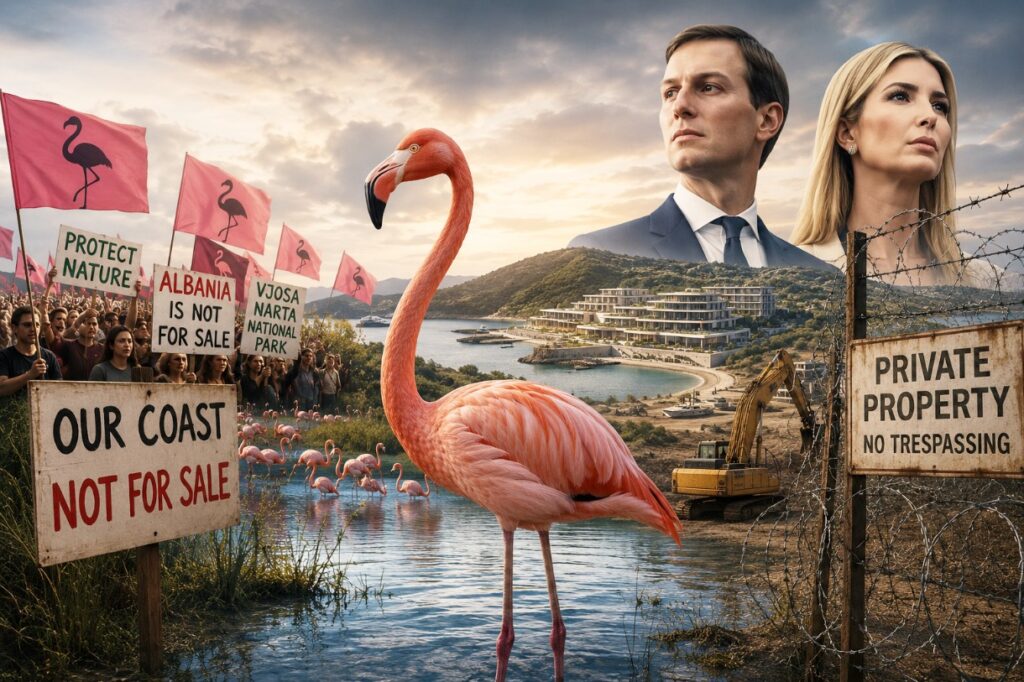
In Albania, resistance is growing against one of the country’s most ambitious tourism projects. A multi-billion luxury resort, linked to investor Jared Kushner and his wife Ivanka Trump, has become a national political issue within a few days. Since the end of May, thousands of protesters have been marching through the capital Tirana, demonstrating against construction plans on Sazan Island and the coastal region of Zvërnec, near the protected lagoon landscape of Vjosa-Narta.
Precisely one bird has become the symbol of the movement: the flamingo. On posters, flags, and inflatable figures, it represents the protection of a coastal landscape that many Albanians consider a national natural heritage.
A multi-billion project on a sensitive coast
The project is supported by the investment company Affinity Partners, founded by Jared Kushner. The planned investments are estimated at at least 1.4 billion euros, depending on the scope of the project. Luxury hotels, villa complexes, tourist infrastructure, and exclusive leisure offerings are planned on Sazan Island, which until now has been largely untouched, as well as along the southern Adriatic coast.
The government considers the project a strategic investment. Albania aims to position itself as a high-quality Mediterranean destination and attract visitors with greater purchasing power. Supporters point to the creation of new jobs, increased tax revenues, and a modernization boost for regions with structural weaknesses.
But precisely this vision faces growing opposition.
The conflict over nature and property
Environmental organizations have been warning for months about the consequences of the project. The Vjosa-Narta region is one of the ecologically most valuable areas in Albania. The wetlands serve as a resting and nesting area for numerous species of birds. In addition to flamingos, sea turtles, rare species of seals, and numerous migratory birds inhabit the area.
Critics fear that the planned works could modify hundreds of hectares of coastline that have so far remained intact. The proximity of the projects to protected natural areas is especially controversial. While the promoters claim to comply with environmental standards and implement sustainable concepts, many conservationists doubt the compatibility of a luxury resort of this magnitude with the sensitive local ecosystems.
Added to this are doubts about the granting of land. Activists accuse the authorities of a lack of transparency. They criticize that the main permits and contracts have not been sufficiently discussed publicly.
From an environmental protest to a political movement
The protests have already taken on a much broader dimension. What began as local resistance against a construction project is increasingly becoming a general criticism of the government and the direction of the state.
Many protesters see the project as a symbol of the close relationship between political power and international investors. The accusation is that the economic interests of privileged actors carry more weight than the concerns of the population.
Slogans like “Albania is not for sale” or “Our coast belongs to everyone” reflect this development. For many participants, it is no longer just about environmental conservation, but about issues of the rule of law, democratic control, and public ownership.
Furthermore, the movement is led by an unusually young generation. Students, environmental activists, and young professionals shape the appearance of the protests. Observers are already speaking of the largest independent party protest movement in years.
Escalation in Zvërnec
The situation became particularly tense after the installation of fences and barbed wire on part of the land planned for construction in Zvërnec. Videos of clashes between protesters and private security forces quickly spread on social media, increasing public outrage.
For many Albanians, this event was a turning point. The images created the impression that a stretch of coastline previously freely accessible was being progressively privatized. In a country where the coast is traditionally understood as public property, this struck a sensitive chord.
The protests then spread from the Vlora region to Tirana and other cities. Demonstrations in solidarity were also organized in the Albanian diaspora.
Edi Rama bets on economic development
Prime Minister Edi Rama firmly defends the project. For years, his government has pursued the strategy of positioning Albania as an attractive destination for international investments. Tourism is considered a central growth driver.
Rama argues that the country needs foreign capital to improve infrastructure and raise the standard of living. From his point of view, stopping the project would send a negative signal to international investors.
At the same time, the head of government is under pressure. The opposition takes advantage of the protests to raise doubts about transparency and anti-corruption efforts. Civil society groups also demand full disclosure of contractual processes and permits.
A test for Albania’s European path
The controversy goes far beyond an individual tourism project. It touches on central questions for the long-term development of Albania.
As an EU candidate country, it faces the challenge of harmonizing economic growth with rule of law standards and environmental requirements. The European Union places equal importance on protecting sensitive ecosystems as on transparent governance and independent control mechanisms.
The so-called Flamenco Revolution is therefore more than just a local protest against a luxury resort. It shows the tensions in a country that on one hand seeks investment and modernization, and on the other wants to protect its natural resources and democratic institutions. The way the government handles this conflict could have an emblematic effect that goes beyond the coastal region of Vjosa-Narta. For Albania, this confrontation is a gauge of its political maturity and its ability to reconcile development and the common good.
Author: P. Tiko