
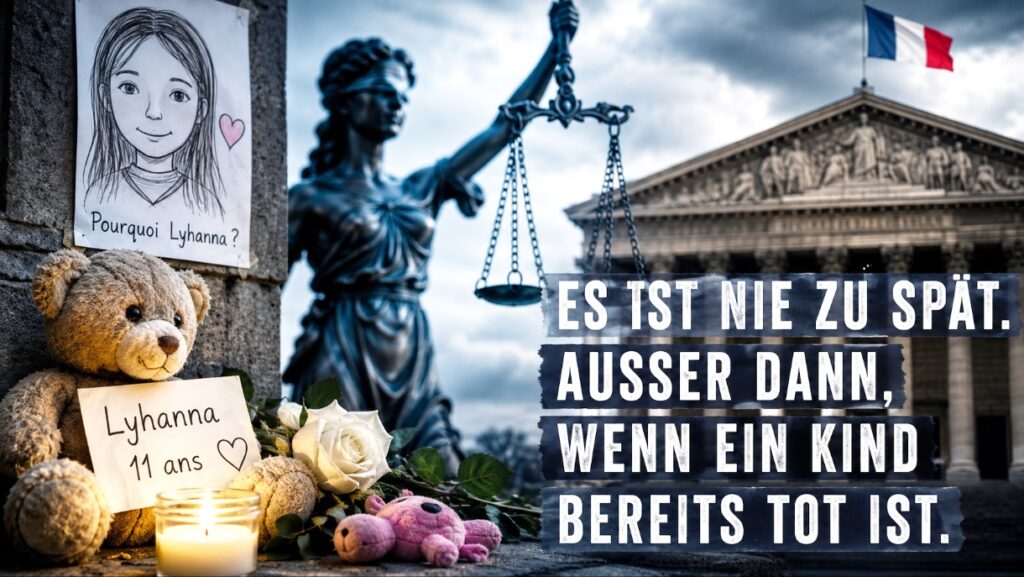
Once again, France stands by a grave and debates reforms.
Once again, politicians overwhelm each other with demands, proposals, action plans, and grand announcements. Disciplinary boards for judges. More resources for justice. Strengthening the precautionary principle. Early interventions. Better oversight. More coordination between agencies.
All measures that suddenly seem urgent.
Suddenly.
Because, as so often, political determination only begins where a child’s life has already been extinguished.
Lyhanna was eleven years old.
Eleven.
An age at which children dream of holidays, birthday presents, the summer vacation ahead of them. Not an age when a name should become a national headline and a face appears on candle photos.
Now all of France asks itself how this could have happened.
A justified question.
But equally justified is another: why is it only asked afterwards?
The suspected perpetrator was apparently by no means a blank slate. There were indications. Procedures. Reports. Warning signs. No crystal ball or supernatural gift was needed to at least look more closely.
And this is precisely where the real tragedy begins.
Not with the crime itself.
But with the astonishing ability of state systems to recognize risks only as risks once they have already become reality.
France is now debating the precautionary principle. A nice word. Almost poetic.
Precaution.
As if the state has just discovered that prevention is cheaper, more humane, and above all more effective than later outrage.
The political class these days seems like a fire brigade arriving at a burned-down house and then holding a passionate debate about purchasing new hoses.
Of course, the justice system needs more resources.
Of course, institutions must collaborate better.
Of course, warning signals must not disappear into archive folders.
But all these truths were true even before Lyhanna disappeared.
This is precisely where the bitterness of this case lies.
No one had to wait for this tragedy to recognize the problems.
Yet it happened anyway.
Now politicians are engaged in a contest of determination. Every proposal sounds a bit stronger than the last. Every demand more decisive. Every press conference a bit more dramatic.
You might almost think that the republic is on the verge of a revolution in child protection policy.
Almost.
Because France already has laws. Already has procedures. Already has reporting systems. Already has institutions.
What is often missing is not the next reform.
It is consequence.
It is attention.
It is the will to act uncomfortably at the first warning signs instead of seeming shocked later.
The truth is unpleasant.
A state does not prove its strength by the number of press releases after a tragedy. It proves it by the number of tragedies that never happen.
But prevention has a big disadvantage: it does not produce headlines.
No one talks about the child who was never a victim.
No one observes a minute of silence for a disaster that was prevented.
No one gains political points from a drama that never happened.
And so public life often follows a sad pattern: first failure. Then outrage. Then promises of reform. Then forgetting.
Until the next name.
Until the next child.
Until the next national shock.
Lyhanna did not need a debate.
No investigative committee.
No political competition for the hardest demand.
She needed something much simpler: that warnings are taken seriously in time.
Nowadays one often hears the phrase: “It is never too late to draw consequences.”
That sounds comforting.
But only for those who are still alive.
For Lyhanna, every consequence came too late.
And precisely for this reason, France should ask itself less which reform is now being announced.
But why so many responsible parties only want to act when there is nothing left to save.
By C. Hatty