
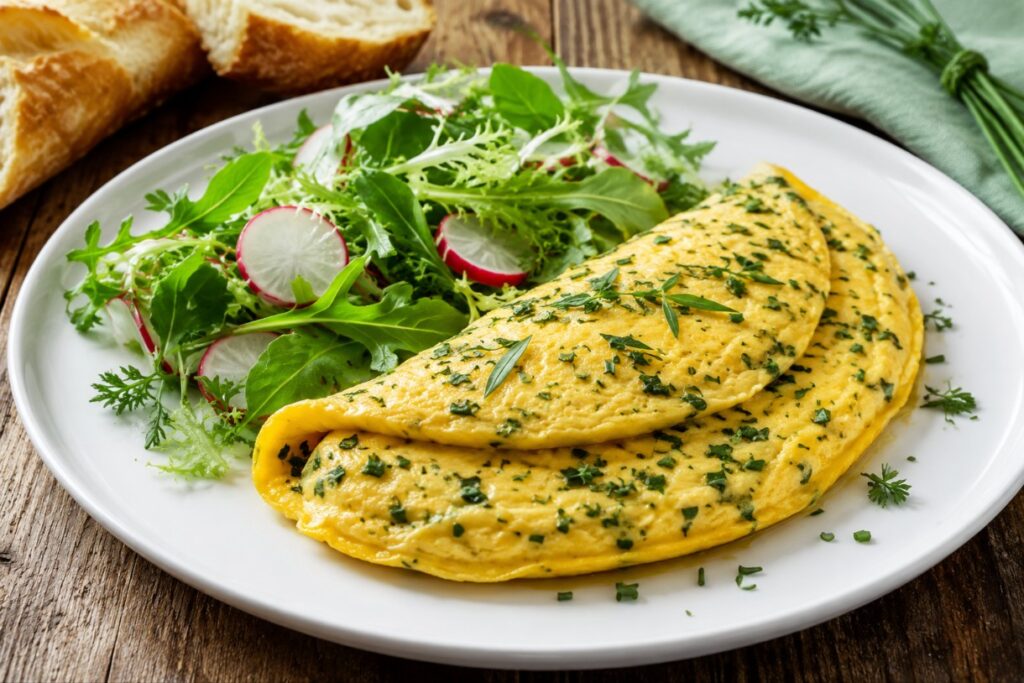
Few dishes embody French cuisine as impressively as the Omelette aux Fines Herbes. At first glance, it seems almost modest: eggs, herbs, some butter. But it is precisely this reduction to a few ingredients that makes the omelet a culinary discipline by which generations of French chefs have measured themselves. In the bistros of Paris, the country houses of Provence, and the traditional kitchens of Lyon, the perfectly prepared omelet is still regarded as an expression of craftsmanship and precision.
Especially in the early summer season, the Omelette aux Fines Herbes experiences its glory days. The markets fill with fresh herbs whose aromas are now at their peak. Chives, chervil, tarragon and flat-leaf parsley give the dish its characteristic freshness and transform simple eggs into a refined meal that convinces both as a light lunch and an elegant dinner.
The Meaning of the “Fines Herbes”
The term “Fines Herbes” refers in classical French cuisine to a mixture of particularly fine and aromatic herbs. Traditionally, this mix includes:
- Chives
- Chervil
- Tarragon
- Flat-leaf parsley
While parsley provides a fresh base note, chives contribute a mild onion flavor. Chervil brings light anise aromas, while tarragon, with its distinctive scent, gives the omelet depth and character. The combination of these herbs creates a remarkable balance of freshness, flavor, and elegance.
Modern interpretations sometimes complement the mixture with sorrel, basil, dill, or young fennel tips, without however losing the classic character.
Why the Omelet is a Masterpiece of French Cuisine
A French omelet clearly differs from many international variants. It should be neither thick nor heavily browned. The surface remains light and soft, the inside creamy and slightly moist.
The goal is to create a silky texture where the eggs are just set. This consistency requires attention, timing, and proper temperature control. That is why the omelet is often considered a touchstone for a cook’s skills in France.
Modern cuisine also appreciates the dish for its versatility. It fits perfectly with a contemporary food style that focuses on seasonal ingredients, high-quality proteins, and simple preparation.
A Modern Omelette aux Fines Herbes
This recipe combines classic French technique with a contemporary freshness. The herbs are used generously, while a touch of crème fraîche adds extra creaminess.
Ingredients for 2 People
For the omelet:
- 6 fresh organic eggs
- 1 tablespoon crème fraîche
- 2 tablespoons finely chopped chives
- 1 tablespoon finely chopped chervil
- 1 teaspoon finely chopped tarragon
- 1 tablespoon finely chopped flat-leaf parsley
- 20 g butter
- sea salt
- freshly ground white pepper
For the modern herb salad:
- 50 g young salad leaves
- A few radishes
- A handful of pea shoots
- 1 tablespoon extra virgin olive oil
- 1 teaspoon lemon juice
- sea salt
Preparation
1. Prepare the herbs
Wash all herbs carefully and pat dry. Then chop very finely. The herbs should be processed as fresh as possible to preserve their essential oils.
2. Beat the eggs
Put the eggs in a bowl and stir together with the crème fraîche. Do not beat too hard so that the mixture remains airy but not foamy. Season with some salt and white pepper.
Fold in the prepared herbs.
3. Cook the omelet
Heat a non-stick pan over medium heat. Melt the butter without browning it.
Pour in the egg mixture and immediately stir slowly with a silicone spatula. Pull the solidified parts towards the center each time.
Once the mixture is about 80 percent set, stop stirring and let the omelet rest briefly.
4. Create the classic shape
Tilt the pan slightly upwards and carefully roll or fold the omelet into an oval shape.
The surface should remain light and show no browning. The texture inside may still be slightly creamy.
5. Arrange the salad
Mix leaf lettuce, radishes and pea shoots with olive oil and lemon juice. Season lightly so that the herb aromas of the omelet remain central.
6. Serve
Place the omelet on preheated plates immediately after cooking and serve with the fresh salad.
Modern variations
Contemporary French cuisine interprets the Omelette aux Fines Herbes increasingly creatively.
With green asparagus
Briefly blanched green asparagus is cut into small pieces and distributed over the omelet before folding. This variant is especially suitable for May and June.
With goat cheese
Some dollops of creamy goat cheese provide extra freshness and go perfectly with tarragon.
With peas and mint
Shelled peas and finely chopped mint give the dish a particularly summery touch.
With smoked salmon
Thin slices of high-quality salmon complete the omelet with an elegant, slightly luxurious component.
The perfect accompaniment
Traditionally, an Omelette aux Fines Herbes is served with:
- Fresh baguette
- Sourdough bread
- Green leaf lettuce
- New potatoes with butter
- A light white wine from the Loire Valley
- A dry Crémant
For a modern bistro version, a salad of pea shoots, fennel, and lemon vinaigrette is also recommended.
Conclusion
The Omelette aux Fines Herbes convincingly proves that haute cuisine does not depend on complicated techniques or an abundance of ingredients. The strength lies in the perfection of simplicity. Fresh eggs, aromatic herbs, and careful preparation suffice to create a dish that has held a permanent place in French culinary culture for centuries.
Especially in early June, when the herbs are in full bloom and the markets are characterized by seasonal freshness, this classic omelet shows its full beauty. The modern variant combines traditional craftsmanship with contemporary lightness and turns an apparently simple dish into a culinary highlight of early summer.