
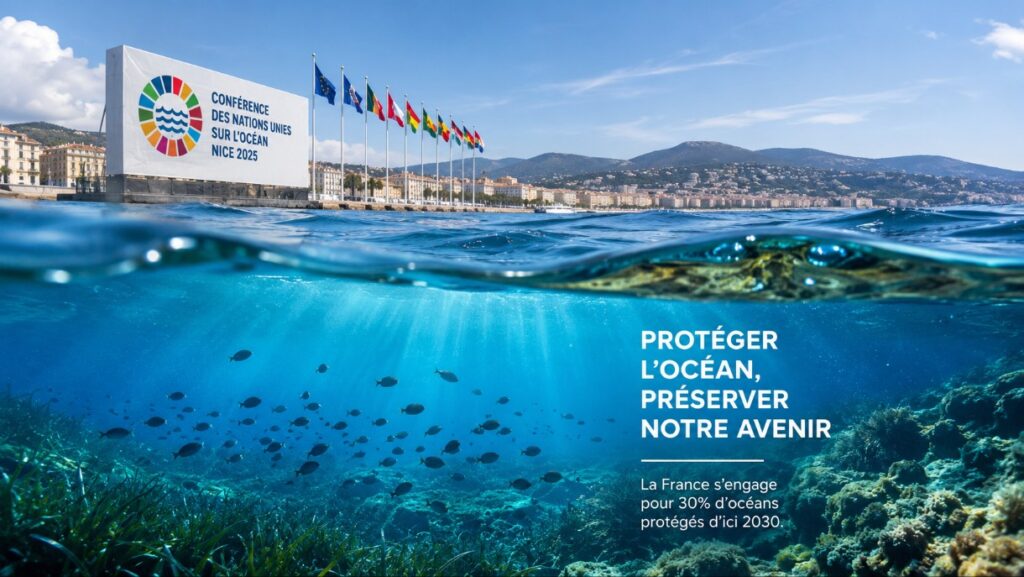
While the oceans are increasingly under pressure due to climate change, overfishing, and plastic pollution, France is seeking to redefine its role as a major maritime power. On the occasion of the third UN Ocean Conference (UNOC) in Nice about a year ago, the French government announced a series of ambitious measures aimed at significantly strengthening the protection of marine ecosystems. At the center is the creation of the largest marine protected area in the world in French Polynesia, along with new initiatives to combat plastic pollution in the Mediterranean.
The announcements were important not only from an environmental perspective but also have a geopolitical dimension: France has the second largest exclusive economic zone in the world and increasingly sees itself as a leading player in international ocean politics, aiming to reconcile biodiversity and economic use.
The largest marine protected area in the world
The most spectacular step concerns the extension of marine protection in French Polynesia. In the future, about 4.8 million square kilometers of sea will be protected. In this way, the protected area will cover almost the entire exclusive economic zone of the overseas territory in the Pacific.
Particularly noteworthy are the so-called strictly protected areas. About 900,000 square kilometers will be subject to strong restrictions or total bans on human interventions. The goal is to preserve sensitive habitats from the effects of industrial activity and to provide refuges for some threatened species.
The size highlights the importance of the project: the strictly protected area corresponds to more than one and a half times the surface area of France. There are few protected sites of this scale in the world.
For Paris, this measure also has strategic significance. The French overseas territories ensure the country an extraordinary maritime presence in all the oceans. Especially in the Pacific, the management and sustainable control of marine resources are becoming increasingly important due to rising geopolitical rivalries.
Greater protection in French waters
In addition to the measures in Polynesia, the government has announced an extensive expansion of marine protection throughout the French maritime territory. By the end of 2026, 78% of French marine areas must be protected in some form. The share of strictly protected zones is set to rise from the current 4.8% to 14.8%.
Even in the European waters of France, the situation will change significantly. Here, the share of strictly protected areas will increase from 0.1% to 4%. This decision responds to the criticisms of numerous scientists and environmental organizations, who have for years complained that many protected areas exist only on paper.
In fact, many French marine protected areas have so far allowed intensive economic activities. This had created the international impression that the protection status was often not accompanied by effective restrictions.
The new regulations aim to address these criticisms. In particular, bottom trawling will be more strictly regulated by authorities. This fishing method is considered particularly problematic because it can cause lasting damage to coral reefs, sponge communities, and seagrass meadows. Such habitats are among the ocean ecosystems richest in biodiversity and play an important role in carbon sequestration.
The fight against the plastic wave
A second focus of the French initiative concerns the fight against plastic pollution. According to estimates, the oceans today contain millions of tons of plastic waste. The Mediterranean, particularly affected, is considered one of the most polluted seas in the world due to its limited water exchange.
Within the framework of the Barcelona Convention, the Mediterranean coastal states have committed to intensifying efforts to reduce the entry of plastic. France intends to take on a coordinating role in this area.
The focus is on promoting circular economy models. The “Circe.Med” initiative, supported by Paris, brings together over 200 actors from science, economy, and politics. The goal is to reduce plastic waste production at the source, develop recycling infrastructure, and prevent waste from reaching the sea via rivers.
This approach is based on a growing awareness in recent years: cleaning polluted seas is technically complex and costly. It is much more sustainable to prevent plastic entry from the start.
An international signal
The French announcements are closely linked to the United Nations’ global biodiversity goals. The core is the so-called “30×30” target: by 2030, at least 30% of terrestrial and marine areas must be under protection.
So far, the share of protected ocean areas is significantly lower. However, the commitments presented in Nice by several states could substantially increase this percentage globally. France seeks to position itself as a trailblazer and to encourage other countries to adopt similar measures.
The strategy follows a pattern already observed in international climate policy: individual countries set ambitious standards with the hope of triggering a dynamic that encourages other governments to act.
It remains to be seen whether this approach will succeed. Many developing and emerging countries point to the lack of financial resources and the economic importance of fishing for their populations. International negotiations on mandatory protection constraints therefore prove complex.
The real test will come after the political announcements. Marine protected areas are effective only if they are actually monitored and controlled. In the remote regions of the Pacific, this poses major logistical challenges. Satellite monitoring, international cooperation, and adequate financial resources will be essential to prevent illegal fishing and other violations.
However, the UN Ocean Conference in Nice marks an important turning point. France sends the signal that ocean protection must no longer be a marginal issue in environmental policy, but rather a central priority in international governance. Given the increasing pressure on marine ecosystems, the future of global environmental protection may be decided not only on land but especially in the planet’s oceans.
Andreas M. Brucker