
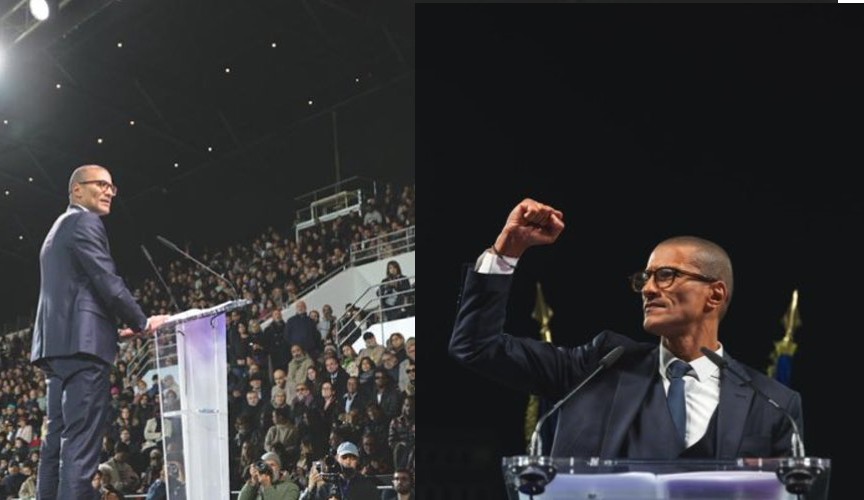
The French left has been searching for a new identity for years. Between Jean-Luc Mélenchon’s dominant but polarizing movement, the ongoing crises of the Socialists, and the declining influence of the Greens, there has so far been no figure capable of uniting different voter groups. Now, Karim Bouamrane steps onto the national stage, claiming exactly this role for himself. The socialist mayor of Saint-Ouen has officially announced his candidacy for the 2027 presidential election, thereby opening a new debate about the future of the French left.
From Suburban Mayor to National Figure
Karim Bouamrane is one of the most remarkable political up-and-comers in recent years. The 53-year-old mayor of Saint-Ouen-sur-Seine, a traditional working-class town north of Paris, gained nationwide recognition especially during the 2024 Olympic Games. Parts of the Olympic Village were located within his municipality, making Bouamrane a frequent contact for national media.
His biography follows a narrative that has become rare in France: son of a Moroccan mason, raised in the suburbs, social advancement through education and political engagement. At a time when questions of social mobility and integration increasingly shape political debate, his life story contrasts with the often elite careers of France’s political elite.
Bouamrane deliberately leverages this profile. He presents himself as a representative of a republican left that aims to combine social justice with economic dynamism. This appeals not only to traditional voters of the Parti Socialiste but also attempts to attract parts of the political center.
The Countermodel to Mélenchon
Politically, Bouamrane consciously positions himself against the course of Jean-Luc Mélenchon and his movement La France insoumise. While Mélenchon relies on a confrontational opposition strategy and regularly criticizes political institutions, Bouamrane advocates a governable social democracy based on the European model.
This difference is not only programmatic but touches on the strategic core question of the French left. Since the presidential elections of 2017 and 2022, the left has increasingly rallied around Mélenchon’s movement. The NUPES alliance and later the Nouveau Front Populaire were largely formed under his influence.
Bouamrane considers this development a dead end. He argues that closeness to La France insoumise’s positions has deterred many moderate voters. In his view, the left can only win majorities again if it remains credible in economic policy, embraces European integration, and focuses on institutional stability.
Because of this stance, he inevitably comes into conflict with parts of the current Socialist Party leadership. Within the Parti Socialiste, there has been an ongoing debate about whether an independent social-democratic line or close cooperation with the radical left is the more promising way forward.
A Movement Beyond the Party Apparatus
Remarkably, Bouamrane does not organize his ambitions solely through the traditional structures of the Parti Socialiste. As early as 2024, he founded the movement “La France humaine et forte,” which serves as a political network and platform for ideas.
This strategy resembles developments that have fundamentally changed French politics in recent years. Emmanuel Macron also rose to the presidency in 2017 by creating his own movement outside the classical party structures. Mélenchon, too, relied with La France insoumise on an organizational form less dependent on traditional party structures.
Bouamrane is now attempting a similar path. However, he currently lacks the nationwide structures and financial resources that established presidential candidates possess. His movement is still being built and must first prove it can generate resonance beyond the Paris region.
The Crisis of the Socialists as an Opportunity
For the Parti Socialiste, Bouamrane’s candidacy could be both an opportunity and a burden. Since the end of François Hollande’s presidency, the party has experienced a dramatic decline. While the Socialists were for decades one of France’s two dominant political forces, they now play only a marginal role.
In the 2022 presidential elections, the socialist candidate Anne Hidalgo achieved only 1.75 percent of the vote—the worst result in the party’s history. Despite some successes in parliamentary and municipal elections, there still lacks a convincing national leadership figure.
Bouamrane could fill exactly this gap. His supporters see in him a politician who is neither burdened by the defeats of recent years nor part of internal party power struggles. His background from the banlieues also grants him credibility in milieus that have increasingly become alienated from the traditional left.
At the same time, there is the risk of further fragmentation. With François Hollande, Fabien Roussel, Yannick Jadot, and possible other candidates, a broad field of potential candidates to the left of the political center is already emerging. The more personalities run, the harder it becomes to agree on a common candidate.
Can Bouamrane Surprise France?
The real challenge, however, lies at the national level. France’s presidential elections are traditionally shaped by personalities who already have considerable political experience and high name recognition. So far, Bouamrane holds neither a government office nor a national mandate.
Nevertheless, he has some qualities that could be advantageous in the current political environment. He is younger than many of his potential competitors, embodies social advancement, and addresses topics that concern both urban middle classes and suburban residents. His more economically friendly orientation could also attract voters who feel caught between Macronism and the traditional left.
Whether this develops into a serious presidential candidacy depends on several factors: his ability to build a national network, the evolution of the Socialists, and not least whether he can at least partially unite the numerous currents of the French left behind him.
One thing is already clear: his candidacy revitalizes strategic debates within the left. After years of disorientation, the question suddenly arises again whether a modern social-democratic alternative can have a future in France. Karim Bouamrane is betting that the answer will be positive. Whether this actually turns into a path to the Élysée Palace remains to be seen in the coming months.
Author: P. Tiko