
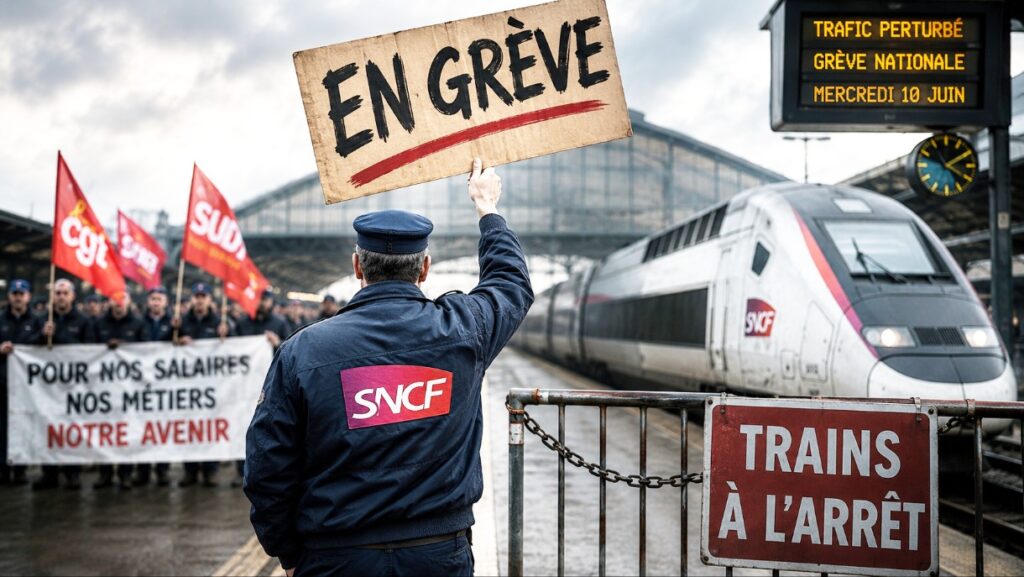
The nationwide strike at the French state railway SNCF on June 10 significantly disrupted rail traffic and simultaneously highlighted social tensions within the company. What initially appears to be a one-day mobilization could quickly develop into a longer labor dispute. This is suggested by statements from the union SUD-Rail, which has already announced that “of course there will be further steps” if the demands of the employees remain unanswered.
At the center of the conflict are classic social issues: wages, working conditions, and company organization. The unions criticize that the burden on employees has steadily increased over recent years without this being adequately reflected in compensation. At the same time, internal restructurings and the progressive opening of the French rail market to competition have created uncertainty among the workforce.
Particularly noteworthy is the unusually broad union alliance. With CGT, UNSA, CFDT, and SUD-Rail, all representative unions of the SNCF have joined the strike. Such a united front has been rarely observed in recent years. The unity adds additional weight to the demands and increases pressure on management.
Behind the current conflict lies a deeper debate about the future of the French railway. The gradual liberalization of the rail sector, driven by European directives, is perceived by many railway workers as a threat to the traditional SNCF model. They fear increasing competitive pressure, job cuts, and deterioration of working conditions. Management, on the other hand, argues that the reforms are necessary to secure the company’s competitiveness in the long term.
The tone between the conflicting parties remains tense so far. Julien Troccaz, one of the leading representatives of SUD-Rail, warned SNCF management not to let the conflict escalate through a strategy of waiting. Already the day after the strike, a cross-union consultation is planned. Furthermore, a meeting with SNCF President Jean Castex is scheduled for June 23. However, the unions are pushing for earlier talks to prevent further escalation.
The impact was already clearly felt by travelers. Numerous high-speed trains were canceled; intercity traffic was also significantly restricted. Particularly in the Île-de-France region, there were considerable disruptions in local transport. The mobilization thus once again emphasizes the central role of the railway for the economic and social functionality of France.
The coming weeks are likely to be decisive. If SNCF management responds to the unions’ demands and opens new negotiations, an escalation could still be prevented. However, if concrete concessions are lacking, a continuation of protests before the start of the summer travel period seems quite probable. For the government and company management, this would not only represent a transport policy problem but also become a symbol of ongoing social tensions in the public sector.
Author: P. Tiko