
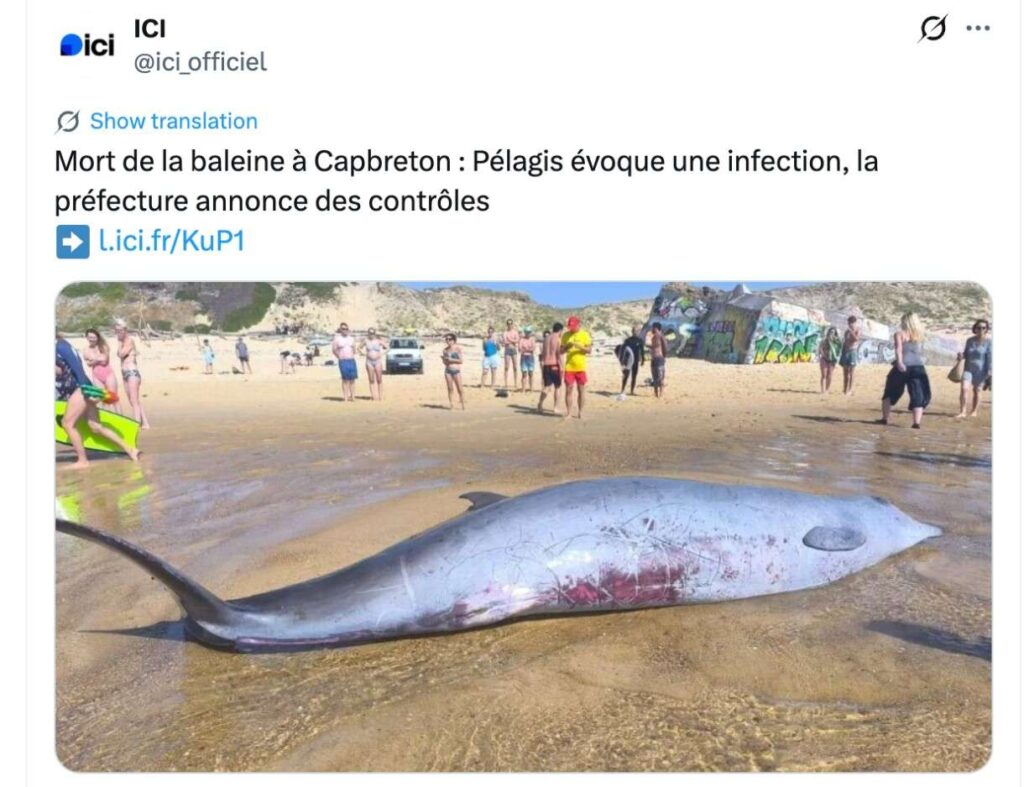
The death of a rare sperm whale washed ashore on May 28 on the Atlantic coast of Capbreton still troubles scientists and conservationists. According to the initial investigation results announced on June 9, there is increasing evidence that this young animal may have died as a result of a severe infection. This conclusion is derived from the analysis conducted so far by the French Marine Mammal Institute Pelagis. However, it is not yet definitively confirmed, and additional laboratory investigations are currently underway.
The whale was found on May 28 on the La Piste beach in Capbreton. This unusual incident immediately attracted great attention. Numerous onlookers watched surfers, rescuers, firefighters, and experts from the National Marine Mammal Network as they attempted to return the whale to the sea. Several successful attempts were made to guide the whale back to the water, but the whale kept returning towards the shore, a behavior commonly observed in weakened or sick marine mammals. Soon after, the whale died.
The identity of the beached whale is particularly noteworthy. Experts identified this whale as a True Sperm Whale (True-Schnabelwal), which is one of the most understudied whale species in the world. These whales typically inhabit the deep waters of the Bay of Biscay and are very rarely seen. Much about their lifestyle, migration routes, and health status remains largely unknown.
Shortly after the whale died, scientists conducted an extensive examination of the carcass. From the initial results, some of the first hypotheses were questioned. No signs of ship collision or severe trauma were found. Also, any connection to the currently ongoing underwater construction work for the Capbreton coastal power infrastructure expansion has not yet been established.
Instead, natural causes are increasingly emerging as important factors. According to the researchers, tissue and organ samples taken during the autopsy indicate a serious infection. Such diseases likely weakened the whale considerably and caused disorientation. In whales, severe infections often lead to loss of the ability to find food, difficulties in dive regulation, or loss of the ability to maintain navigation routes in the sea.
This case is scientifically very important. Each stranded sperm whale provides valuable information about a group of animals that are usually rarely seen by humans. The ongoing investigation will not only clarify the exact cause of death but also offer new insights into the health risks and diseases of deep-sea whales.
The final results are expected to be announced within the next few weeks, helping to better understand the fate of this special visitor to the French Atlantic coast, as well as expanding knowledge about one of the most mysterious whale species in the world.