
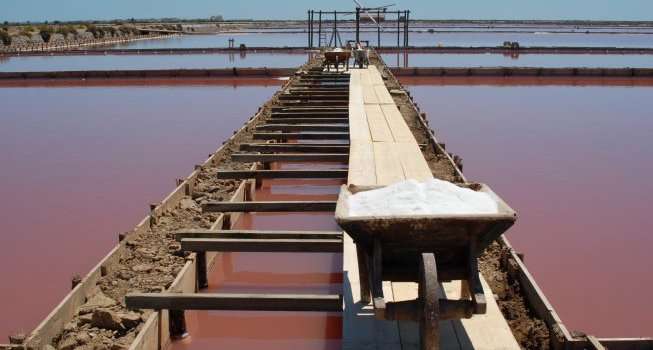
A hint of salt lingers in the air, the sun sparkles on shallow water surfaces, and suddenly everything shimmers pink. No, this is not a filter in front of the camera lens – these are the Salins de Gruissan. A place that looks as if nature really had a wild time here.
Right in the middle of the natural paradise between the hilly La Clape massif and the azure Mediterranean coast south of Narbonne, this fascinating saltworks spreads out. It looks like a painting – but here it is not just admired, it is also harvested. And how!
Salt with History
Even the ancient Romans knew the value of this area. The precious salt – then as valuable as gold – was highly sought after. But what is now known as the “Salins de Gruissan” only took shape in its current form in 1911. The site spans around 350 hectares, crisscrossed by shallow water basins, dams, and windmills.
In the 1970s, around 30 families lived off salt production – a small world of their own with its own rules. Then came the provisional end in 2004. The saltworks were shut down, and much was forgotten. If it hadn’t been for Patrick Gabanou. The former “saunier” (as the salt workers are called here) could not bear to see this cultural heritage just disappear. So he rolled up his sleeves in 2009 – and brought the salt back to Gruissan.
Why is the Water Pink?
A question that is probably asked here daily. And the answer is as fascinating as it is simple: Dunaliella salina is the tiny algae that lives in the highly concentrated salt ponds. It produces beta-carotene, a pigment that bathes the water in magical pink and orange hues.
And it gets even crazier: the algae serve as food for small crustaceans – and these in turn are the favorite food of the flamingos. These graceful birds, with their long legs and feather-light gait, are not only eye-catchers but also constant inhabitants of the saltworks.
Nature as you rarely experience it
The Salins de Gruissan is not just a natural “industrial area” with a fancy color. The site is classified as a ZNIEFF (Zone naturelle d’intérêt écologique, faunistique et floristique) – meaning it is considered ecologically particularly valuable.
Here, stilts, avocets, and terns nest, while salt-tolerant plants like glasswort or samphire make their way between the ponds. Anyone who brings binoculars can watch birds for hours – or simply let their gaze wander.
The Saunier – a profession requiring finesse
A true saunier is not a simple worker. He is a conductor who plays with wind, sun, and evaporation. No day is like the other, and every harvest depends on the interplay of these natural forces. Almost poetic, isn’t it?
At the saltworks, the salt is still harvested by hand – with traditional wooden tools, just like a hundred years ago. During the guided tours, they tell stories about the lives of the salt farmers, show old tools in the Ecomuseum, and introduce visitors to this ancient craft.
A visit with all the senses
A classic tour of the saltworks lasts about 75 minutes – and the time flies by. You stroll along the water basins, see, smell and feel the salt, marvel at the flamingos, and learn along the way how this fragile ecosystem has endured over centuries.
Afterwards? Definitely stop by the “Cambuse du Saunier.” This charming restaurant is located right at the saltworks. They cook with what the region offers – fish, seafood, shellfish, and of course dishes with fleur de sel. With a view of the pink water surface, even a simple fish broth tastes of the sea and magic.
What remains?
Les Salins de Gruissan is more than just a pretty backdrop for Instagram. It is a place where humans and nature have worked in harmony for centuries – and you can feel it with every step.
What makes this place so special? Maybe it’s precisely this mixture of history, natural wonder, and honest craftsmanship. Or the radiant colors, the bizarrely beautiful calm, and the feeling of being part of something greater.
A place where children delight in pink water, bird lovers gape with amazement, and gourmets revel in seventh heaven.
In short: Anyone traveling in the region should definitely plan a detour to the Salin de Gruissan. It is an experience that stays – in the nose, in the heart, and, yes, also in the stomach.
A travel report by V.O.Yager