
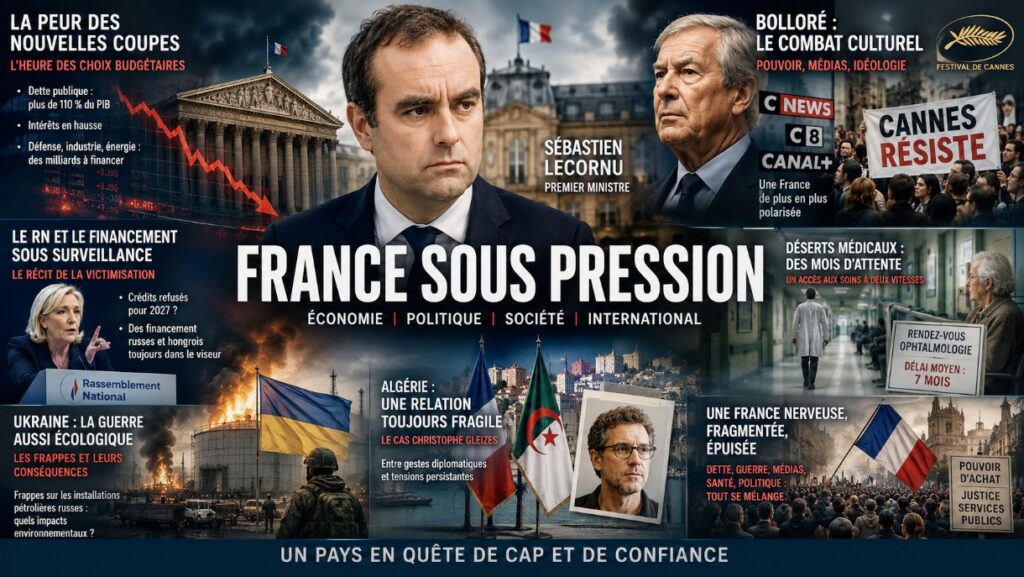
France is facing a political moment on May 20, 2026, where multiple crises are simultaneously emerging and influencing each other. Public debate is no longer limited to individual reforms or isolated conflicts but focuses on fundamental questions: Is the French model still financially sustainable, politically controllable, and socially integrative? The image of a nation in constant tension is emerging, from national finances to media power to healthcare provision.
Revival of Austerity Policies
Currently, the dominant issue is the debate over public finances. Prime Minister Sébastien Lecornu is increasingly suggesting cutback measures to the public. His tone reminds many observers particularly of France’s austerity period during the early 2010s European fiscal deficit crisis.
From the government’s perspective, the situation is serious. France’s national debt now far exceeds 110% of GDP, and interest burdens are increasing simultaneously. Added to this are huge structural burdens: defense spending, industrial policy, energy transition, and social security funding are all competing for limited resources.
The political tension lies not so much in the numbers themselves but in their social impact. France traditionally has a strong welfare state, deeply connected with the republican self-identity. Pensions, medical services, or cuts to local government budgets therefore directly strike at the social core of the country.
Many editorials now mention the possibility of a “tournant de rigueur (turn to austerity).” The memories of previous social protests, represented by the Yellow Vest movement and pension strikes, further increase the sense of unease.
The Power of the Media and the Conflict Over Bolloré
At the same time, the ideological conflict surrounding the conservative entrepreneur Vincent Bolloré and his ever-expanding media empire is intensifying. The recent escalation was triggered by protests and statements at the Cannes Film Festival.
What initially seemed like an industry-specific dispute is gradually developing into a fundamental debate about cultural power and political influence. Critics accuse Bolloré of attempting to build a conservative, nationalist media network modeled on the Italian example. On the other hand, supporters see the cultural protests as an expression of the left-wing cultural elites that have long dominated the cultural sphere.
This conflict touches on the sensitive nerves of French public opinion. It is a connection between the media, politics, and cultural identity. Television stations such as CNews and Canal+ symbolize a deeper ideological division.
What is noteworthy is how strongly and directly cultural debates have become politicized. Issues concerning journalistic independence, cultural expression, and diversity of opinion are merging and clashing among liberals, conservatives, and right-wing populists.
National Rally and the Victim Narrative
The National Rally is strategically using this atmosphere. The discussion about difficulties in election fundraising perfectly suits the party’s self-presentation as if it were an excluded opposition force.
Officials of the National Rally claim that French banks are systematically refusing to lend to the party. This once again ties Marine Le Pen’s camp to the long-cultivated victim narrative—that the political and economic establishment is trying to prevent the party’s rise.
At the same time, past issues remain. Previous funding from Russia and Hungary continues to raise questions about geopolitical affinity and political dependence. Especially in the context of the Ukraine war, this issue has once again become a sensitive topic of discussion.
What is interesting here is the strategic shift of the National Rally. The party currently presents itself not so much as a radical protest movement but as an apparently ordinary alternative government unfairly treated by the “system.” This normalization remains one of the main factors in French politics ahead of the 2027 presidential election.
The Ukraine War and Environmental Aspects
The war in Ukraine remains a close issue, but the focus of French discussions is shifting. In addition to military developments, the environmental impact of the war is increasingly receiving attention.
In particular, attacks on Russian oil facilities and their potential environmental damage are being debated. This has changed perspectives. While Russian environmental destruction was long the main focus, current commentators are increasingly questioning the environmental impact of modern warfare as a whole.
This discussion shows how environmental issues are now also being viewed from a security perspective. War is no longer just a military or humanitarian disaster but is increasingly recognized as a long-term environmental burden.
French media often link this debate to the fundamental issue of Europe’s energy security. Dependence on fossil fuels, geopolitical conflicts, and the relevance of climate policy have become clearer than a few years ago.
Healthcare Supply Crisis
However, what many French people particularly feel in their daily lives about this crisis is access to medical services. The so-called “medical deserts,” or areas severely lacking doctors, remain one of the most emotional topics in domestic politics.
Long waiting times for specialist care such as ophthalmologists and dermatologists are no longer just a problem in rural areas. Even medium-sized cities are increasingly suffering from medical shortages.
The problem has several causes: aging doctors, unattractive working conditions outside urban areas, and an educational plan for the healthcare system that has been criticized for decades.
This development is politically dangerous because it undermines the Republic’s promise of equality. As medical services increasingly depend on where people live, the impression arises of a regionally divided country with privileged urban centers and left-behind areas.
This perception further strengthens political support for populist and anti-elite movements.
Fragile Relationship with Algeria
France remains in a state of tension on the diplomatic front as well. The relationship with Algeria is still one of the most sensitive issues in French diplomacy.
The incident involving French journalist Christophe Glaize once again shows how quickly domestic politics and historical conflicts can impact bilateral relations. Every diplomatic approach is immediately interpreted politically either in Paris or Algiers.
The background goes far beyond the current conflict. The colonial past, immigration issues, security cooperation, and the role of people of Algerian descent in France make this relationship particularly complex.
It is notable how much symbolic gestures are valued. A minister’s word or diplomatic talks often provoke greater debate than concrete political achievements.
France continues to remain caught in a difficult balance of historical responsibility, geopolitical interests, and domestic political pressures.
Current France appears to be a country where crises are constantly overlapping. Economic instability, geopolitical conflicts, cultural polarization, and social tensions are intertwined and reinforcing each other. What is remarkable is not the existence of individual issues but the fact that they are condensed simultaneously.
While the political class is trying to convey stability, the media and public opinion are increasingly dominated by an atmosphere of fatigue. Trust in institutions remains fragile, and social divisions are evident.
But at the same time, a typical French pattern can also be seen. During times of great tension, political debates become particularly intense. France is a country that openly expresses conflict, often loudly, extremely divided, and contradictory, but never indifferent.