
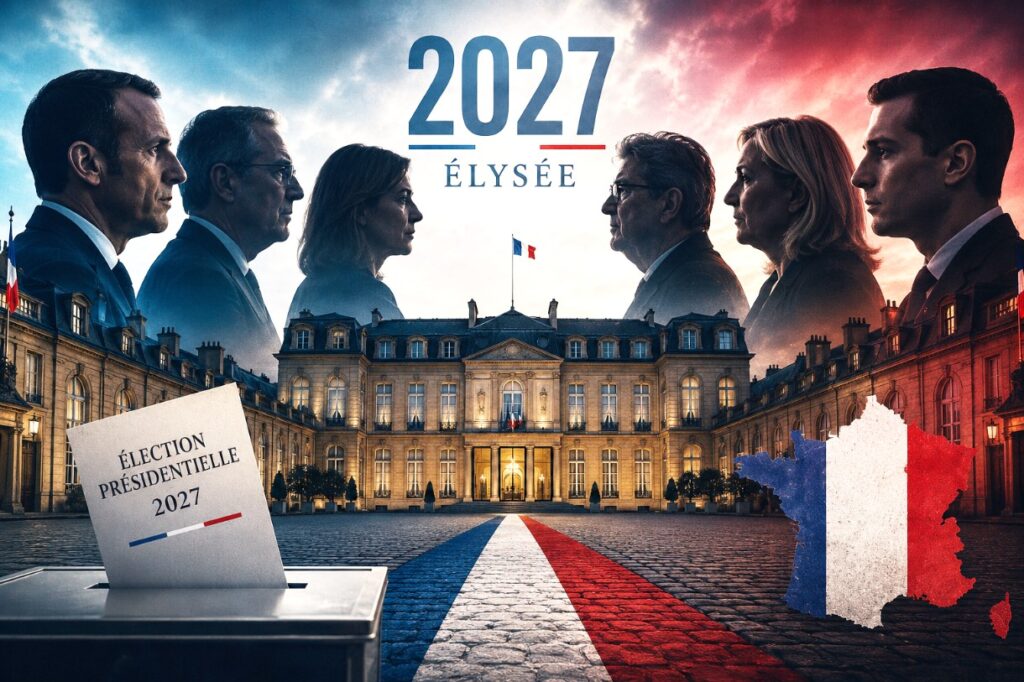
Although the French presidential election will not take place until the spring of 2027, Parisian politics is already in campaign mode. Candidacies have been announced, party machinery mobilized, and the first major events have become measures of political strength. At first glance this may seem like an unusually early campaign, but in fact it reflects a profound realignment of France’s party system. The era of clearly defined political blocs is over. Instead there is an increasingly fragmented landscape in which no political force has a clear claim to succeed President Emmanuel Macron.
The right seeks unity
Within the conservative camp, preparations have taken concrete form. Interior Minister Bruno Retailleau has been designated as the presidential candidate by members of The Republicans, symbolizing the party’s effort to regain influence after years of political decline. At the same time, Xavier Bertrand remains steadfast in his ambitions, while Cannes Mayor David Lisnard, after leaving The Republicans, has also entered the race.
The large number of conservative candidates clarifies a central paradox of the French right: On the one hand they hope to regain their position as the leading political force, on the other the risk of vote-splitting is very high. Since the traditional populist parties declined in 2017, the Republican Party has not been able to build a convincing leader who can sustainably unify the diverse tendencies.
Even more important for the election outcome may be developments within the Rassemblement National. Marine Le Pen remains the commanding figure in her political bloc, although she is facing legal uncertainties. If for legal reasons she cannot run, the most likely successor would be Jordan Bardella. This new 30-year-old party chairman has in recent years significantly raised his political profile and is seen by many voters as a credible representative of the new generation of the right.
The center-left hopes for unity and faces internal competition
The situation is even more complicated on the left of the political spectrum. Jean-Luc Mélenchon has confirmed he is willing to run for president for a fourth time, continuing his political project. At the same time, an increasing number of elements within the moderate left and the ecological left want a common candidate outside Mélenchon’s circle.
Many prominent politicians have supported the idea of holding a primary election. Marine Tondelier, François Ruffin, Clémentine Autain and Benjamin Lucas are figures who see an open primary as an opportunity to select a candidate who can achieve consensus. Such a vote could be held in the autumn.
This debate recalls previous efforts by the French left to overcome chronic fragmentation. However, political experience in recent years shows that organizational unity does not necessarily lead to agreement on a political platform. Differences over European, economic and security policies remain very large. Still, a successful primary could at least make it easier for the left to compete in the first round.
The Macron bloc seeks a successor
Developments in the political center are being watched especially closely. Emmanuel Macron cannot run again after two terms; for the first time in a decade the question of his successor has become prominent.
Gabriel Attal has officially declared his candidacy, positioning himself as the natural heir to Macronism. The former prime minister has high name recognition and has tried to combine his successful recent years with a promise of political renewal. His challenge is to find a balance between continuity and distinction. Too close to Macron could be a burden, but too far risks undermining the cohesion of the ruling bloc.
At the same time, attention is increasingly turning to Raphaël Glucksmann. The MEP has sharpened his political profile in recent years and attracts voters who are neither part of the left-wing opposition nor traditional Macronism. His public events and major planned meetings are being closely watched as a test of whether his appeal can develop into a solid presidential candidacy.
The significance of early endorsements
In the early phase of the campaign, political alliances play a central role. endorsements from mayors, MPs, regional representatives or well-known figures are not merely symbolic. They signal the potential for political action and instill confidence in potential voters.
From a historical perspective, these dynamics have often been crucial. Emmanuel Macron benefited from quickly rallying prominent supporters, helping his youthful movement gain legitimacy from 2017. Nicolas Sarkozy and François Hollande also relied on extensive networks within their political blocs before winning.
There is also a practical aspect: In France, presidential candidates must have a certain number of endorsement signatures from elected delegates. Whoever builds a strong network early will not only raise public awareness but also improve their organizational standing.
A shifting political landscape
The 2027 presidential election could become one of the most open and unpredictable contests of the Fifth Republic. Unlike previous electoral cycles, there is currently no clear frontrunner dominating the political scene. Traditional parties are trying to reclaim lost ground. New political movements are seeking to establish stable positions. At the same time, social moods are changing amid economic instability, geopolitical tensions and growing distrust of established institutions.
The coming months will be shaped less by debates about political programs than by strategic calculations to position oneself. Whoever builds coalitions, overcomes intra-party rivalries, and develops a convincing narrative for the future will have a decisive advantage. The only thing certain today is: the official campaign may still be ahead, but the political race for the Élysée has long since begun.
Author: P. Tiko