
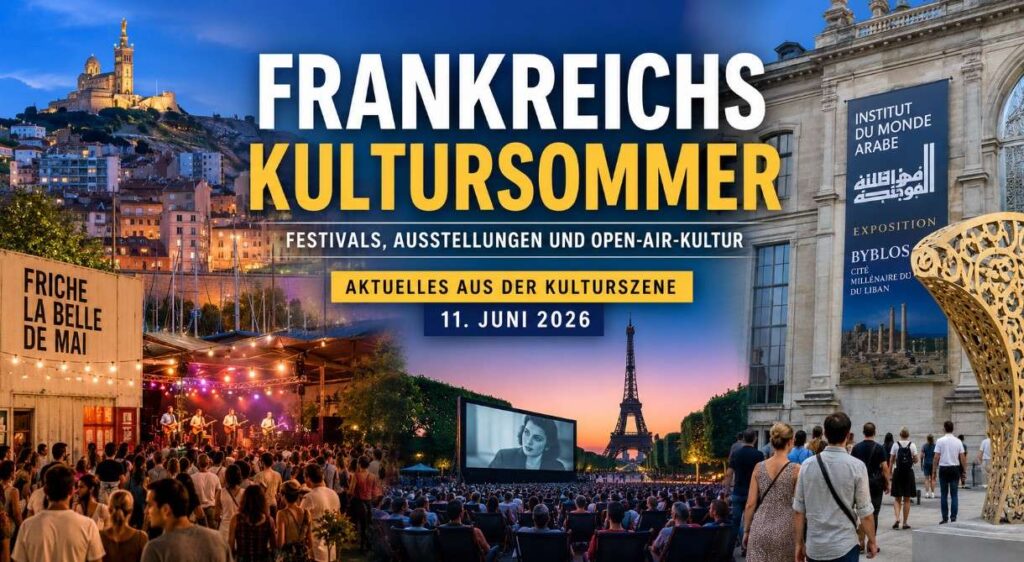
When June begins, it traditionally marks the start of a period in France when culture unfolds not only in museums, theaters, and cinemas but also on streets, squares, parks, and many other places across the country. In 2026, the French cultural scene is expected to be especially vibrant. Large-scale exhibitions, international festivals, and free outdoor events combine to create a cultural mosaic that spans generations.
The festival season is currently reaching its peak.
In Marseille, the prestigious Rencontres à l’Échelle festival, which brings together artists from across the Mediterranean, is underway. Here, theater, dance, music, and performance art intersect, fostering a creative dialogue among diverse cultures. At the same time, the port city is preparing for the upcoming Festival de Marseille, where international works will be showcased in the Provence region. The entire city is once again transforming into an open-air stage.
Culture is also highly popular around Paris. Compared to the past, families, children, and youth are now more at the center of participation. The family festival “Un neuf trois Soleil!” held in the Seine-Saint-Denis area joyfully combines art, theater, and cultural education. This type of program clearly demonstrates how many cultural institutions strive to attract new visitors and bridge cultural gaps.
France continues to play a role as a talent hub in the field of cinema.
The short film festival Côté Court, held in Pantin, has established itself for years as an important meeting place for young directors. Many filmmakers who are now recognized at international film festivals had their first experience presenting their work to the public here. This event provides space not only for traditional short films but also for experimental works and new narrative formats. Thanks to this, the festival serves as an indicator of developments in the French film industry.
At the same time, interest in the cultural and social significance of film is growing. Various events discuss how cinema records historical developments and reveals social changes. Film is increasingly recognized not just as simple entertainment but as a mirror reflecting its own era.
Museums are also welcoming the start of a successful summer season.
Especially in Paris, major special exhibitions are attracting many visitors. The Institut du Monde Arabe is gaining attention with several projects focused on the history and culture of the Mediterranean region. By combining historical themes with modern exhibition methods, it draws in a wide audience.
Another noticeable trend is the attempt in many French museums to make exhibits not just viewed, but experienced. Interactive elements, audiovisual installations, and thematic presentations offer a new approach to art and history. As a result, traditional museums feel much more lively than in the past.
But the most striking feature of the 2026 cultural summer festival is the return to public spaces.
Free concerts, outdoor film screenings, and open-air cultural events attract thousands of visitors. In Marseille, Friche la Belle de Mai is once again developing into a vibrant venue where artists and audiences meet. In Paris, film nights and cultural summer events create a special atmosphere between historic buildings and modern urban areas.
The message is clear: culture must unfold where people live.
After years of great challenges, the French cultural scene shows renewed confidence. Museums, festivals, and cultural centers focus on openness, diversity, and encounters. The summer of 2026 vividly proves that culture in France is not just preserved but actively experienced— not only on grand stages but also in the middle of streets across the country.
Text: C. Hatty