
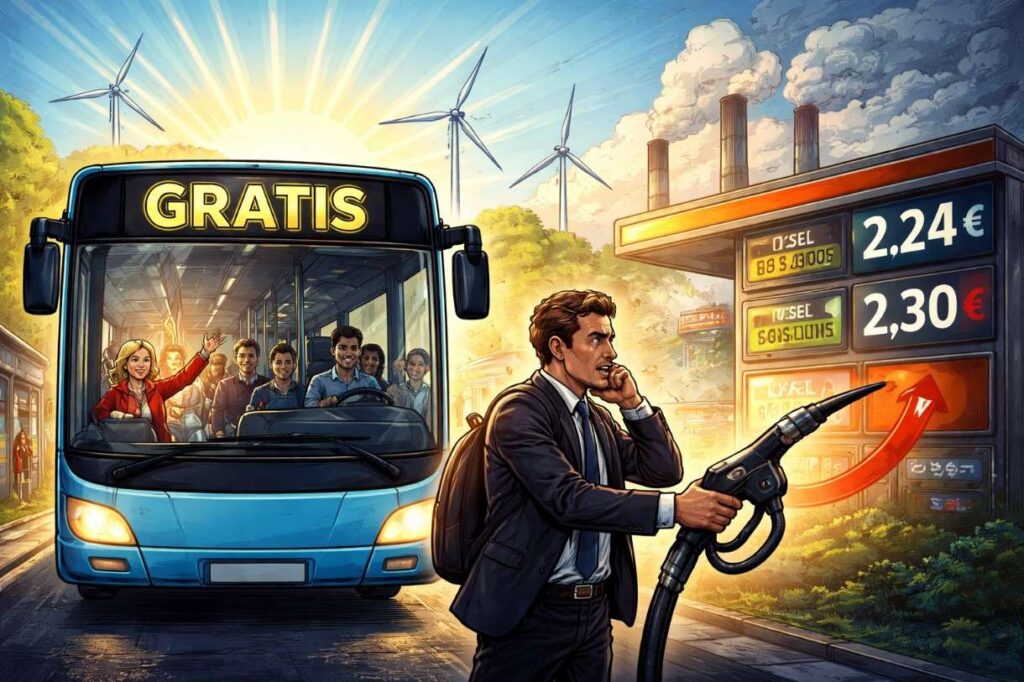
This is a strange sight that has been repeated lately. Gas station numbers rise by one cent at a time, wobbling like a silent thermometer of a society that has gotten used to wrong things. And politics? They discuss caps, discounts, and compensation, as if trying to put out a fire with a cup of water.
However, the solution is already on the street. No, rather, in the bus lanes.
What if we think in reverse? Instead of forcing car driving to remain affordable, finally strengthen what should be natural and close at hand — that is, public transport. Free. Accessible. Taken for granted.
Like in Dunkirk.
There, they understand the true meaning of mobility. Not the freedom to buy expensive fuel, but the freedom to move without fearing the next bill. The freedom to not always have to weigh whether to drive today or not.
It is a matter of dignity.
And, yes, also a matter of fairness.
Because at gas stations, while further profits flow into the pockets of major oil companies, people are paying twice. First when refueling, and then again through taxes for inadequate support measures. This is an absurd system, almost ironic. They are forcibly maintaining infrastructure that is increasingly hostile to their own citizens.
Why is that?
Why don’t they have the courage to change course?
Free public transportation is not a gift. It is a decision, a political stance. It is a rejection of the logic that mobility should be a luxury, and a clear message: the city is not only for those with full tanks, but for everyone.
Of course, it costs money. Everything costs money. Roads cost money. Subsidies also cost money. Stagnation is the greatest cost. But which is more expensive—a functioning bus system or a society where mobility becomes increasingly difficult?
It is enough to honestly ask this question once.
And soon, you will sense how off track the current debate is.
This is no longer just a matter of transportation policy. It is a matter of the image the country paints of itself. Will we simply watch as social division deepens at gas stations? Or will we take a step forward towards mobility that creates connections rather than divisions?
Dunkirk answers this. Quietly, not flashy but effectively.
Buses run, and people board them. No tickets, no barriers. And suddenly, something that was previously complicated begins to work. Just like that.
Perhaps this is the real scandal: that it can be done. That it already works. And that elsewhere, there is still hesitation to implement it.
In other words—somewhat radically, somewhat irritably: we already know what is right. We just do not yet have the courage to carry it out thoroughly.
But how much longer will that be?
Comment by C. Hatti