
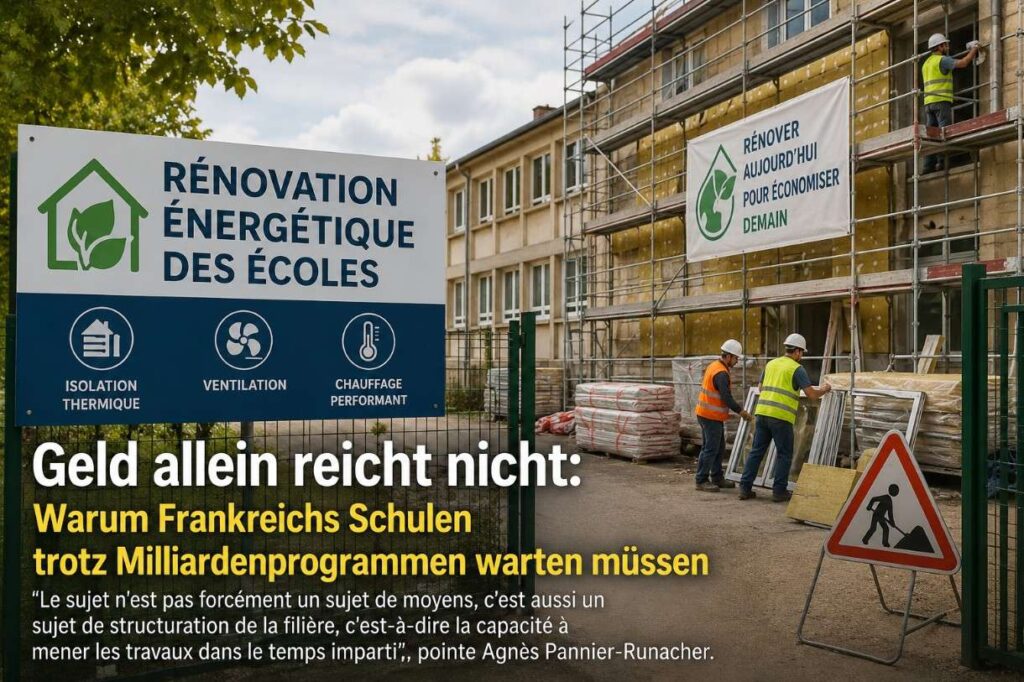
In a remarkable frank statement, French Energy Minister Agnès Pannier-Runacher pointed out a core issue in the ecological transition. Regarding the renovation of school energy systems, she said: “The problem is not necessarily a funding issue, but rather a structural issue in the sector – that is, the ability to carry out the work within the specified timeframe.” This statement indicates a development far beyond individual school buildings. France is gradually reaching the limits of its practical implementation capacity in the energy transition process.
The bottleneck lies in construction sites
In political debate, the question of total investment has dominated for a long time. Multi-billion euro programs to carry out the ecological transition are considered the decisive lever to achieve European climate targets. However, it is now clear: public funds alone do not guarantee rapid implementation.
Especially in the energy renovation of public buildings, a structural problem has become apparent. France, despite having support programs, state subsidies, and European financial sources. However, at the same time, many places lack companies capable of carrying out the actual work.
The modernization of school energy systems is one of the most technically complex areas in construction. Insulation, window replacement, heating system conversion, ventilation systems, or roof repairs need to be closely coordinated. Added to this are new requirements for heat protection and energy efficiency. However, many localities report long waiting times, a lack of specialized companies, and tender packages that almost no company participates in.
The situation is particularly difficult in rural areas. There, specialized craftsmanship facilities or sufficiently competent engineering offices are often lacking. At the same time, pressure on villages and districts to modernize their buildings faster is increasing.
Shortage of qualified skilled workers
The main problem lies in the shortage of skilled labor. France has faced the issue of a lack of young workers in the construction and craft sectors for many years. Many professions are considered physically demanding and less attractive in society. Many companies can no longer find sufficiently qualified workers.
Meanwhile, energy renovation increasingly requires high-level professional skills. Modern buildings not only need to be insulated but must also be intelligently engineered. Mistakes can have serious consequences. Poor ventilation can lead to moisture problems, inadequate summer thermal protection can cause classrooms to overheat. Moreover, actual energy savings are often lower than theoretical calculations if tasks are poorly coordinated.
Thus, the debate shifts from purely financial issues to the country’s industrial capability. France needs not only investments but also an efficient value chain: training centers, craft workshops, engineers, material suppliers, and local construction businesses.
Issues with Tight Timelines
In addition, there is an organizational factor emphasized by Pannier-Runacher: the timing of carrying out the work. Schools can only be renovated within the limits of the ongoing teaching process. Therefore, many larger measures must be carried out during the summer holidays.
This significantly reduces the available time frames. Local authorities therefore often try to carry out as much work as possible simultaneously within a few short weeks. For the construction industry, this means enormous pressure during peak periods. Even with sufficient funds, handling thousands of construction projects simultaneously in the shortest possible time is impossible.
This problem may become even worse in the coming years. France has set ambitious climate targets and is under pressure from Europe to significantly reduce the energy consumption of buildings. Public buildings play a central role since they account for a large portion of energy consumption.
Schools as a symbol of the infrastructure crisis in France
The discussion is also politically sensitive because many schools in France are in poor condition. Most of the buildings were constructed in the 1960s and 1970s. At that time, many school complexes were built quickly and cheaply, often with poor energy quality.
Today, many facilities suffer from broken heating systems, poor insulation, and inadequate ventilation. The European energy crisis since 2022 has exacerbated these issues. Many local communities have had to bear sharply increased heating costs, while pressure to reduce carbon emissions continues to grow.
Added to this is the increasingly important role of protection against heat. France has experienced more severe heatwaves in recent years. Many school buildings are not prepared to cope with this. Classrooms in summer sometimes become uncomfortably hot, which is increasingly becoming an educational and public health issue.
A shift in political thinking
Pannier-Runacher’s statement therefore also marks a change in discourse within the French government. For a long time, policy mainly presented the ecological transition as a financial issue. Currently, practical feasibility is placed more at the center.
This not only affects the renovation of buildings. Similar bottlenecks also appear in the expansion of renewable energy, power grids, or transportation infrastructure. Everywhere, the same question arises: Does France have sufficient industrial and personnel capacity to manage the transition at the expected speed?
The minister indirectly suggests that the ecological transition could fail not because of political goals, but due to the actual capability of the economy. Climate policy thus enters a new phase: moving away from symbolic declarations toward questions of production capacity, training, and organizational efficiency.
This may be the greatest challenge in the coming years. The energy transition is not only decided within ministries or at international climate conferences. It is also decided right on construction sites, in vocational schools, and within local craft structures.
Author: P. Tiko