
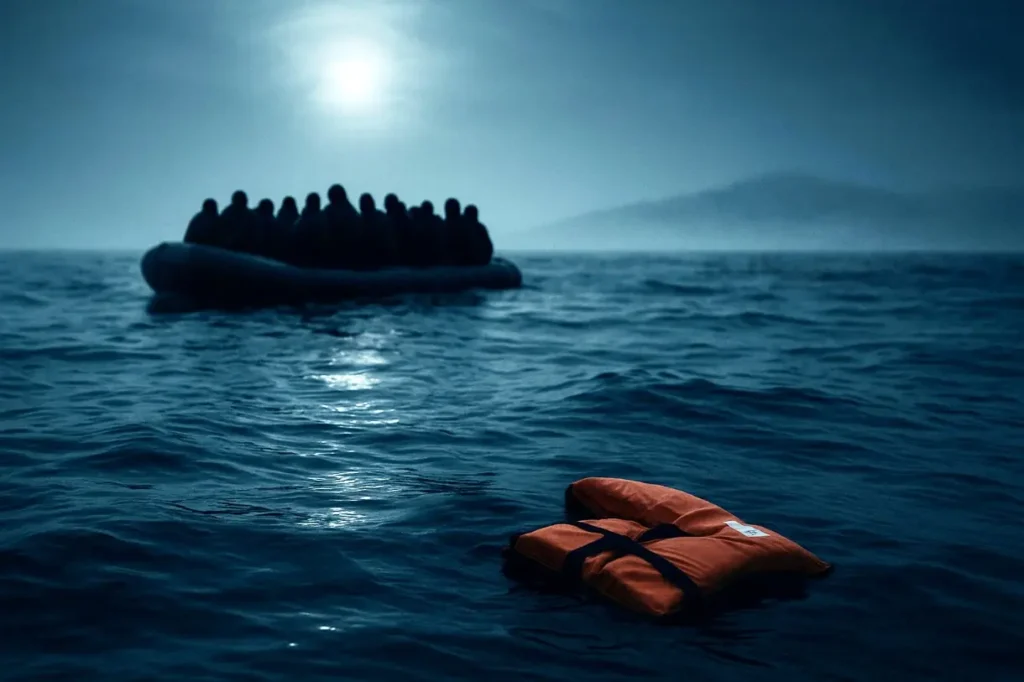
The Dunkirk Criminal Court handed down harsh prison sentences against a smuggling network that organized many illegal crossings of the English Channel between 2022 and 2024. Six men from Iraq, Syria, and Iran were recognized by the investigation authorities as being involved in a total of 69 crossing attempts, 36 of which are believed to have successfully reached the UK coast.
Particularly serious responsibility was assigned for two fatal accidents. Three of the defendants were also tried for negligent manslaughter. In one case, a 7-year-old girl died, and in another case, a 20-year-old woman suffocated in an overcrowded rubber boat. These tragedies highlight the dangers of this route, which represents the last hope for many migrants.
The investigation records reveal the nature of a professionally organized system. Smugglers recruited new customers at makeshift camps near the northern French coast, organized transport routes, procured boats, and coordinated nighttime departures. They promised safe crossings for high sums of money to those fleeing, but in reality, the risks were increasing. To maximize profits, the boats were frequently overcrowded far beyond their intended capacity.
The English Channel has become one of the most dangerous routes of movement in Western Europe today. Despite close cooperation and increased surveillance between France and the UK, the number of cross-border crossings continues to rise year by year. Smuggling organizations constantly change their methods and adapt flexibly to new crackdowns, creating a cat-and-mouse chase situation that has yet to lead to a fundamental solution.
The trial in Dunkirk highlights issues beyond the individual guilt of the defendants. Those who exploit and deceive people seeking protection and put their lives at risk must of course be held accountable. This ruling sends an important message to criminal organizations.
However, fundamental challenges still remain.
Thousands of migrants are stranded in coastal areas around Calais, Dunkirk, and Le Touquet, and as long as no realistic prospects are in sight, for many people travelling to the UK is considered the only way out. The English Channel is seen less as a dangerous border and more as a gateway to a new life.
The dilemma lies precisely here. Criminal proceedings can punish perpetrators, but they cannot remove the underlying causes of the smuggling business. It is precisely where there is despair and legal avenues are closed that a market to exploit this arises. The issue is not only how to stop the smugglers, but also how to eliminate the demand for their services in the first place.
Andreas M. Brucker