
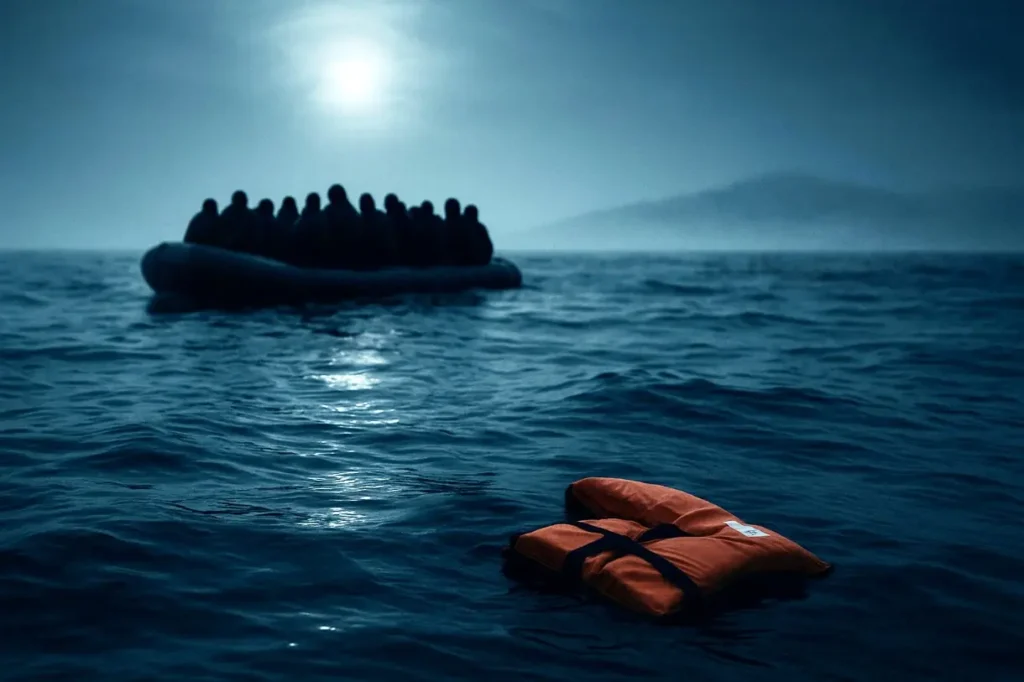
With harsh prison sentences, the criminal court of Dunkirk convicted a trafficking network that allegedly organized numerous illegal crossings of the English Channel between 2022 and 2024. Six men from Iraq, Syria, and Iran received prison sentences after investigators attributed their involvement in a total of 69 crossing attempts. 36 of them apparently successfully reached the British coast.
The responsibility for two fatal accidents is particularly serious. Three of the accused also had to answer for negligent homicide. In one case, a seven-year-old girl died, and in another, a 20-year-old woman suffocated on an overloaded inflatable boat. The tragedies highlight the risks of a route that has become the last hope for many migrants.
The investigation files paint a picture of a professionally organized system. The traffickers recruited new clients in temporary camps on the northern French coast, organized transport routes, obtained boats, and coordinated night departures. People fleeing were promised safe crossings in exchange for large sums of money. However, the dangers constantly increased. To maximize profits, the boats were increasingly overloaded, often far beyond their actual capacity.
The English Channel has become one of the most dangerous migration routes in Western Europe. Despite close cooperation between France and the United Kingdom and increased surveillance, the number of crossings has been rising for years. Traffickers continuously adapt their methods and react flexibly to new controls. This creates a cat-and-mouse game that has so far not led to a sustainable solution.
Therefore, the trial in Dunkirk raises questions that go far beyond the guilt of the individual accused. Of course, those who exploit people seeking protection, deceive them, and endanger their lives must be held accountable. The sentences send an important signal against criminal networks.
But the real challenge remains.
As long as thousands of migrants remain trapped in the coastal regions around Calais, Dunkirk, and Loon-Plage and do not see a realistic perspective, the crossing to the UK will continue to be for many an apparent way out. The English Channel ceases to be perceived as a dangerous border and becomes the last door to a hoped-for new beginning.
Therein lies the dilemma. Criminal proceedings can punish the guilty, but they do not eliminate the causes that sustain the traffickers’ business. Where there is desperation and a lack of legal avenues, a market arises that others are willing to serve. Therefore, the issue is not only how to stop the traffickers, but also how to prevent their services from being demanded in the first place.
Andreas M. Brucker