
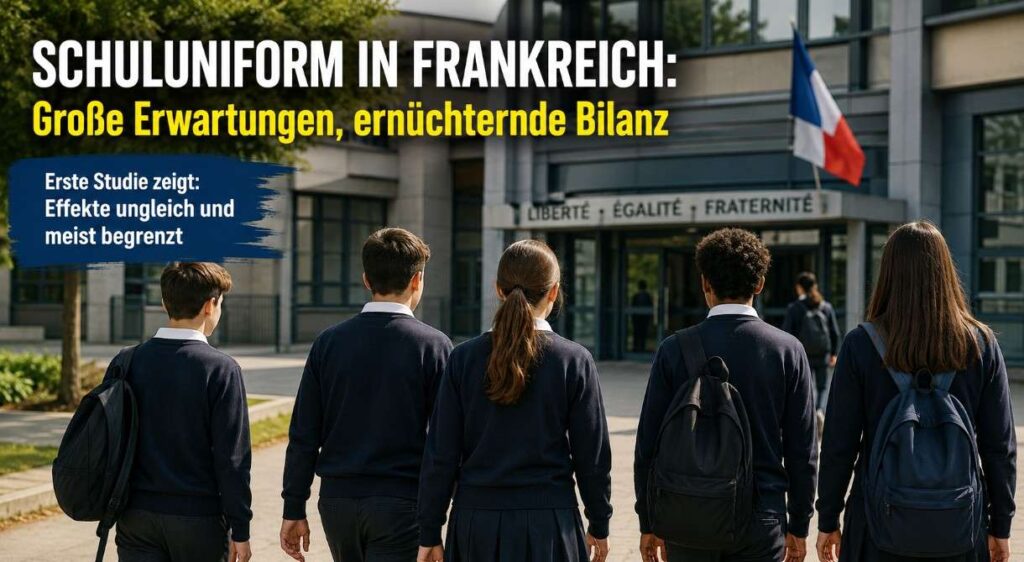
Two years ago the school uniform in France was still considered a political symbol. It stood for order, authority and the hope of a school that would regain a lost sense of direction. Today the tone sounds decidedly more sober. The first nationwide evaluation of the experiment, which has been running since the 2024 school year, paints a mixed picture – with limited successes and many open questions.
The project was initiated by then Education Minister Gabriel Attal. The idea seemed simple at first glance: if everyone wears the same clothes, social differences disappear at least outwardly. Less brand pressure, less exclusion, fewer conflicts. Plus more cohesion and a stronger sense of community.
Almost a hundred schools as well as several voluntary Collèges and Lycées took part in the trial.
Reality, however, is more complicated.
Many school principals do report positive effects. The sense of belonging to one’s school has strengthened, tensions over clothing have partly decreased. Some teachers even describe calmer classroom atmospheres. In some institutions something like a new team spirit developed – almost a bit like in sports clubs, where the shared jersey creates an identity.
But the big breakthrough did not materialize.
The Education Ministry’s study explicitly speaks of ‘unequal’ and ‘limited’ effects. Especially between individual schools there are enormous differences. While some institutions observe small improvements, elsewhere practically nothing changes.
This is particularly evident with academic performance. So far neither better grades nor measurable learning progress can be detected. The researchers remind that social tensions at schools are rarely linked only to clothing. Exclusion happens even without expensive sneakers. Young people find other ways to make differences visible – via smartphones, language, social networks or leisure behavior. In short: fabric alone does not solve societal conflicts.
The students’ perspective is also interesting.
Many adolescents react significantly more skeptically than adults. Especially in secondary schools many young people perceive the prescribed clothing as a restriction of their personality. Some complain about uncomfortable cuts or impractical fabrics. Others simply say: ‘It won’t change anything anyway.’
That is probably the crux of the debate.
Because in France the topic of uniforms has long since been about more than just sweaters or blazers. For supporters it embodies a return to discipline, respect and republican values. Critics, on the other hand, see it as a symbolic measure that covers up deeper problems: teacher shortages, social tensions, violence in schools and an education system that in many places groans like an old diesel engine on the eve of winter.
Add to that the question of costs.
Outfitting entire year groups causes considerable expenses for municipalities and families. A nationwide introduction could cost billions. In times of tight budgets this leads to additional political caution.
The French government is therefore acting cautiously. The Education Ministry wants to wait for further results before deciding on any expansion.
In the end one insight remains, which often gets lost in political sparring: school does not change automatically just because children wear the same jacket in the morning.
By C. Hatty