
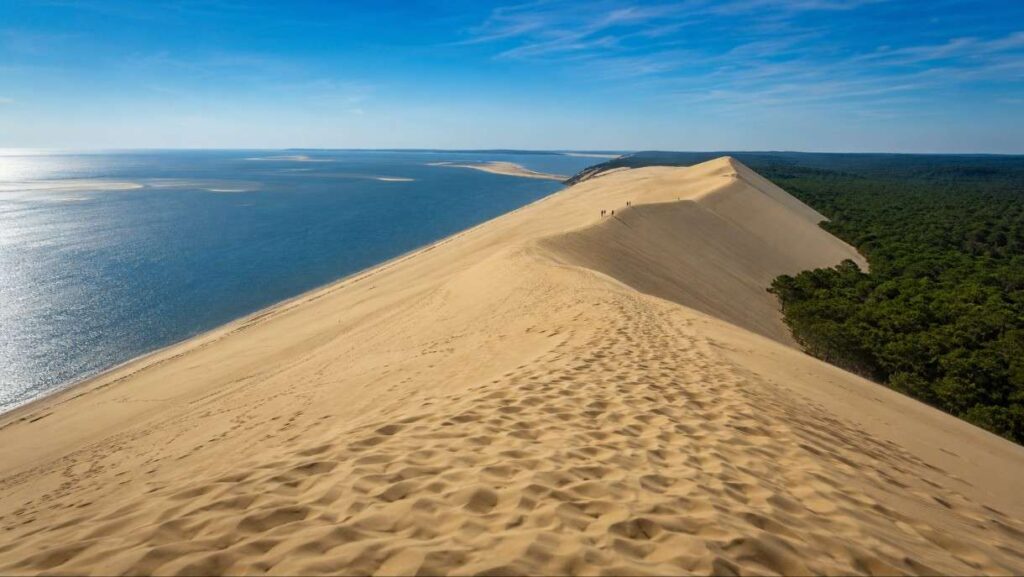
Anyone standing before the Dune du Pilat for the first time experiences a moment of amazement. Like a massive wall of sand, the dune rises at the entrance to the Arcachon Basin and clearly towers over the surrounding landscape. On one side, the Atlantic glistens; on the other, an endlessly vast pine forest spreads out. In between lies a natural wonder that attracts millions of visitors every year and also represents one of the most dynamic landscapes in Europe.
With a height of around 101 meters, the Dune du Pilat is considered the highest migrating dune in Europe. But its size is by no means fixed. Wind, waves, and storms continuously reshape the enormous mass of sand. Therefore, the height, width, and volume vary from year to year. The dune resembles a huge organism that remains constantly in motion.
Its formation began several millennia ago. After the last Ice Age ended, enormous amounts of sand were deposited along the French Atlantic coast. Ocean currents transported the material along the coast, while strong winds carried it inland. Over many generations, this process created the large dune systems of Aquitaine. The present-day Dune du Pilat developed step by step over a period of about 4,000 years.
Particularly fascinating is its movement. Unlike a mountain made of rock, the dune does not stay in one place. Every year it moves on average between one and five meters eastward. The principle behind this seems almost simple: The wind pushes sand grains up the gently rising sea-facing slope. When they reach the dune crest, they slide down the steeper forest side again. This process repeats continuously. In this way, the entire dune slowly but steadily migrates inland.
The consequences of this movement can be vividly observed on site. In many places, only the tips of pine trees still jut out of the sand. Some trees are still fighting against the enormous masses, others have completely disappeared beneath it. Those walking through the adjacent forest repeatedly discover half-buried tree trunks—silent witnesses to a landscape in flux.
Not only nature has had to give way to the dune. Over the decades, the sand swallowed roads, buildings, and even military installations from World War II. What was once visible today lies hidden beneath millions of tons of sand. Isn’t that astonishing? While humans often try to fix landscapes permanently, nature here writes its very own story.
The dune’s height also changes regularly. Many visitors assume that the sand hill grows taller year after year. In reality, its development is much more variable. Some years the dune gains height, while in others it loses several meters. Intense winter storms can erode large amounts of sand, while calmer periods favor new deposition. Experts have been observing a slight decrease in maximum height over recent years.
Another influencing factor is climate change. Rising sea levels and more frequent extreme weather events increase pressure on the entire Atlantic coast. Storms more aggressively attack the dune and change the distribution of the sand. Nonetheless, scientists view this development with nuance. Movement and change are ultimately part of the nature of the Dune du Pilat. Without wind and erosion, this unique landscape would not exist in its current form.
That is precisely where its special appeal lies. The dune reminds us that nature is not a fixed stage set. Everything changes—sometimes slowly, sometimes surprisingly fast. Anyone who dares the steep climb up the sand giant today and lets their gaze roam over the Atlantic experiences a place that may already look a bit different tomorrow.
Perhaps that is exactly what makes the fascination of the Dune du Pilat. It impressively shows that change is not a sign of weakness, but part of the natural balance. And let’s be honest: How many places are there that show a new face every year?
An article by M. Legrand