
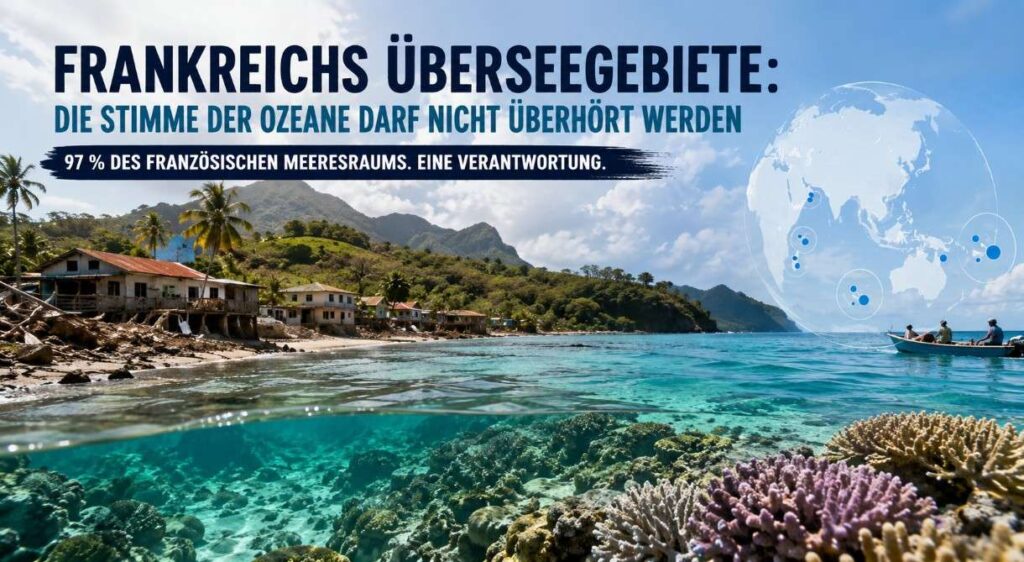
When talking about maritime policy in France, many people immediately think of the Atlantic coast, Brittany, or the Mediterranean. But the country’s real maritime wealth lies thousands of kilometers away. Mayotte in the Indian Ocean, Guadeloupe and Martinique in the Caribbean, French Polynesia in the Pacific, and Guyana on the northern coast of South America together form the pillars of France’s presence on the world’s oceans. About 97 percent of France’s maritime area lies within these overseas territories.
At the United Nations Ocean Summit 2025 in Nice, the Outre-mer regions are brought more into the spotlight. This is no surprise. After all, many of these regions are on the front lines of the climate crisis. Rising sea levels, increasingly fierce storms, coral bleaching, and the growing acidification of the oceans have become daily realities there. What European capitals often discuss as future scenarios already exist right at the doorstep on many islands.
This creates a remarkable paradox. The overseas territories often play only a minor role in political debates in Paris. At the same time, France’s status as a maritime power largely depends on them. Without these scattered lands across three oceans, France would not possess one of the largest exclusive economic zones in the world nor have significant influence in international marine issues.
However, this size comes with responsibility. The overseas territories contain a significant portion of France’s biodiversity. Coral reefs, mangroves, and sensitive coastal ecosystems provide habitats for countless animal and plant species. At the same time, many people live right on the coasts. For them, the state of the ocean not only determines nature conservation but also affects income, nutrition, drinking water supply, and housing.
Therefore, many representatives of the Overseas Territories have for many years requested greater participation. They do not only want to be regarded as a geographical extension of France, but also as political actors with their own experience and interests. For many island communities, protecting the sea is not an abstract issue of international diplomacy. It is very concretely related to the future of their community. In some places, the question has been raised whether certain stretches of coastline will still be habitable in the coming decades.
At the same time, the overseas territories show that they are not only victims of climate change. French Polynesia recently attracted international attention with the announcement of a large marine protected area. Such initiatives demonstrate that creative solutions are often formed far from political centers. The periphery is believed to be increasingly developing into a laboratory for modern maritime policy.
The key question is not only how to protect the oceans. Equally important is who will decide on reserves, fishing, resource exploitation, and adaptation measures. As long as these decisions are mainly made in Paris, Brussels, or international conferences, the role of overseas territories has not been fully taken into account.
Outre-mer reminds France of a simple truth: maritime greatness is not only measured by area in square kilometers. It is primarily reflected in the willingness to take responsibility and listen to the people who daily live with the consequences of changes in the global oceans.
By Andreas M. Brucker