
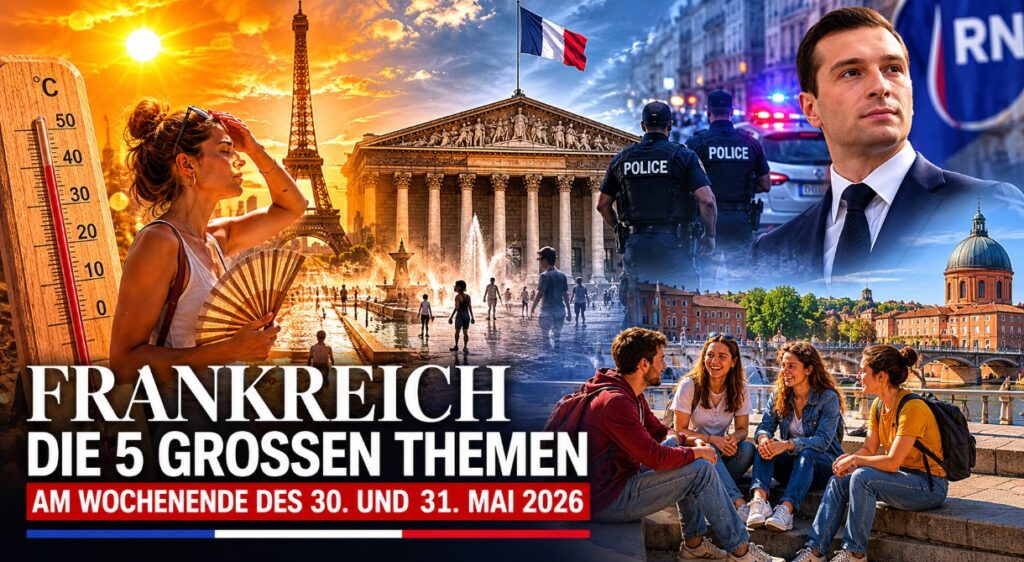
France is experiencing an extraordinary end of the month. An unusually early heatwave is dominating the headlines, while at the same time issues of internal security, political redirection, and social development are influencing the public debate. It is particularly clear that many of these topics are now closely interconnected. The discussion about the weather goes beyond meteorological aspects and touches on issues of infrastructure, public health, the economy, and the state’s political intervention capacity.
Historic heatwave dominates the news
No topic has drawn as much attention from the French media as the exceptional heatwave that has covered many large areas of the country. At the end of May, temperatures were recorded that are usually only reached in the summer months of July or August. Many departments broke monthly temperature records. Of particular interest is the new national temperature record for May.
The impact is already noticeable in daily life. Schools are adjusting their schedules, municipalities are extending the opening hours of public parks, and health agencies are warning about the effects of heatwaves and air pollution. Many media outlets now view the weather situation as a symbol of accelerating climate change, with its effects becoming increasingly evident in France.
The discussion is no longer limited to short-term weather events. Instead, the question is whether cities, public buildings, and transportation infrastructure in France are sufficiently prepared for a future where extreme heatwaves will occur more frequently.
The government is under pressure regarding its climate policy
Alongside the development of the weather, the political debate is growing more intense. Opposition parties accuse the government of underestimating the seriousness of the situation and reacting too late. In particular, representatives of environmental parties criticize the shortcomings in adapting to climate change.
In many comments, there is debate over whether France has enough schools, hospitals, and public facilities resilient enough to the climate. The heatwave has become a political test for the government.
At the same time, a fundamental conflict of objectives also emerges: on the one hand, the state must respond promptly to extreme weather events; on the other hand, long-term adaptation requires significant investments in urban planning, building renovations, and infrastructure. The current debate shows that climate policy is increasingly viewed as a central issue regarding the state’s capacity to act.
Drug-related violence and security issues once again come to the forefront
Alongside the weather situation, domestic security remains one of the main topics in French politics. In particular, the city of Nantes has once again become the focus of news reports. Many incidents of violence related to drug trafficking have sparked a lively debate about the effectiveness of the security strategy applied so far.
The term “Narcotrafic” has become popular in political vocabulary. These are organized crime networks that are increasingly gaining influence in many major cities in France. The government responds by intensifying police deployment and additional security measures, but many observers doubt that a strategy based solely on repression will be sustainable in the long term.
This development recalls debates that previously took place in Marseille, Lille, or certain areas of the Paris metropolitan region. There is growing fear that some neighborhoods might fall under the regular influence of organized crime. Therefore, there are lively discussions about new approaches in prevention, social policy, and security.
Jordan Bardella is working to build the image of a party capable of governing
Politically, attention is focused on Jordan Bardella and the strategic development of the Rassemblement National. Many media outlets are analyzing his efforts to steer the party towards a more responsible role in government.
Special attention is given to his position on pension policy. Observers see in Bardella’s recent statements an effort to adjust economic and social views to align with the expectations of a broader electorate. This strategy follows a known pattern of European right-wing factions to transform a protest movement into a party with the potential to take power.
At the same time, cultural controversies attract additional attention. The announced legal battle against rapper Soli has once again sparked debates about freedom of speech, political provocation, and the limits of public criticism. These discussions show how closely intertwined political and cultural conflicts in France have now become.
Toulouse remains the most attractive university city in France
Among the mainly positive topics of the week is the recognition of Toulouse as the best university city in France. This large southern city benefits from a combination of high quality of life, economic dynamism, and extensive educational offerings.
The importance of this development, however, goes beyond a university ranking. Many observers see it as a sign of profound changes within France. While Paris remains the political and economic center of the country, medium and small cities are becoming increasingly attractive.
The rising cost of living in the capital, better conditions in other areas, and gradual digitalization are changing the residential choices of many young French people. Cities like Toulouse, Rennes, Montpellier, or Nantes benefit from this trend and are developing into important centers for innovation, research, and startups.
A nation between adaptation and change
The picture of the French press this weekend draws a portrait of a nation in transformation. The heatwave is a symbol of deeper social changes. Issues of climate change, public security, political stability, and regional development are increasingly intertwined.
While record temperatures attract immediate attention, recent debates reveal one important thing: the French are increasingly asking serious questions about how to respond to long-term structural challenges. Current events are thus interpreted by many observers less as exceptions and more as harbingers of a new reality that will have a lasting impact on politics, economics, and society.