
Pentecost.
In Germany, many men pull carts along country roads, charcoal quietly burns at campsites, and highways experience traffic jams heading towards the Baltic Sea or the Alps. This public holiday often feels like a collective short vacation with people carrying boxes of beer. Noisy, lively, and sometimes a little silly.
And then there is France.
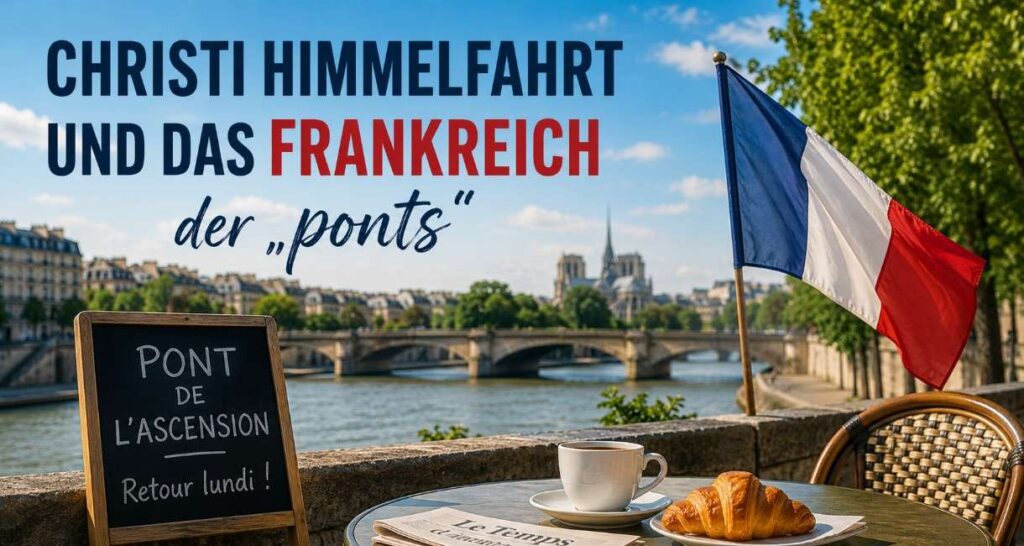
There too, this day has religious roots, but around Pentecost something takes place every year almost like a cultural ritual: the famous “bridge” (“pont”). If the public holiday falls on a Thursday, half of France connects Friday as a vacation day. Four days off. Four days to catch one’s breath. Four days of life.
The whole country simply shuts down.
Schools are closed, offices quiet down, and in small towns hand-written notes are posted on shop doors. “Back on Monday.” Back on Monday. End of story. No excuses, no flustered explanations, no guilt.
Exactly in that lies something deeply human.
France has an almost lost ability to not view leisure as a weakness. There, someone enjoying a long weekend is not automatically considered lazy or lacking ambition. Rather, that rest is part of life, like a baguette at dinner or coffee greeting the morning sun on the balcony.
Of course, entrepreneurs groan about production stoppages. Of course, some complain about ‘too many holidays.’ Of course, not everything in France is purely romantic. But nevertheless, this country continues this small cultural rebellion — opposing full availability, opposing constant performance pressure, opposing the feeling that every moment must be justified.
Honestly: people are a little envious of the French.
Because here people often proudly boast about ‘working even on holidays,’ but the French have a different skill: they take conscious breaks. They understand that a country does not collapse just because people take a rest now and then.
Perhaps that is exactly why some things actually work well.
If you pass through French towns on these days, you can feel that special atmosphere. Children riding bicycles. Streets filled with crowded cafés. Families genuinely making time for each other. Leisure that is not artificially optimized down to the minute. Rather, it feels like a collective sigh.
Almost like a quiet societal agreement: let’s stop now.
People might laugh this off. Or they might be sarcastic. Germans often do that. Thus, terms like ‘work ethic’ or ‘economic hub’ are sometimes mentioned. But at the same time, fatigue has been accumulating there for years. Burnout rates are increasing, city centers seem busy, and conversations constantly revolve around efficiency, crises, and productivity.
Humans are an ongoing project.
France reminds us in such moments that life is more than just optimizing schedules.
Perhaps this is the true power of these ‘ponts’. Bridges don’t just connect Thursdays and weekends. They connect something quietly disappearing in modern society — time with people. Real time. Unproductive time. Precious time.
Time for parents.
Time for friends.
Time for oneself.
It sounds ordinary, but today it is almost radical.
Ascension Day has a religious meaning linked to the concept of ascension. In France, this public holiday carries another meaning every year: a small ascension from everyday life. A break from functional living. An escape from constant to-dos.
At least for a few days.
In Germany, there is often discussion about how to work more intensively, but France shows a different perspective. It is not perfect and not always economically rational, but it is human. Very human.
Perhaps Europe needs exactly that now more than ever.
Not more speed.
Not more accessibility.
Not more self-improvement.
Sometimes a bridge is needed. One ‘pont’. A moment of pause together.
Society almost never collapses from too many breaks.
But very often collapses from continuous fatigue.
Comment by C. Hatty