
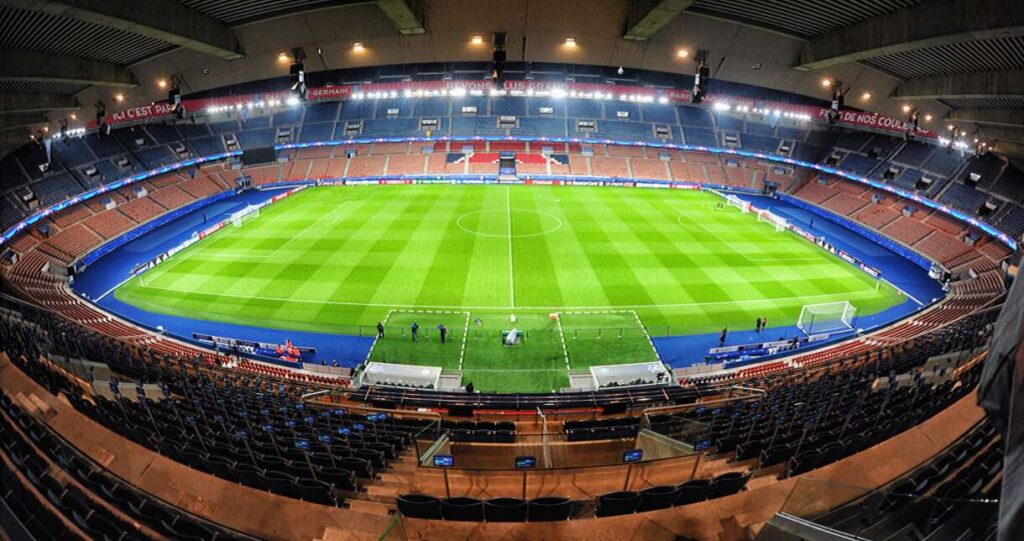
The future of Paris Saint-Germain at the Parc des Princes is more open than it has been in a long time. What was long regarded as a deadlock has developed into a dynamic political and economic negotiation situation within a short period. In the short term, much speaks for staying. In the medium to long term, however, the situation remains uncertain – and strategically highly charged.
Political Change of Course as Catalyst
For years, a fundamental conflict of interest between club management and city administration blocked any substantial development. Under the former Paris mayor Anne Hidalgo, a sale of the city-owned Parc des Princes was categorically ruled out. For PSG, this meant a structural limitation: as a tenant, they lacked both investment security and entrepreneurial control.
With Emmanuel Grégoire taking office in 2026, this situation fundamentally changed. The new city leadership signals willingness to negotiate and introduces concrete options for the first time: a regulated sale of the stadium or alternatively, a long-term secured usage contract with extended rights.
This political pivot is more than just a signal. It marks an attempt to prevent an imminent strategic break between the capital city and its most prominent football club. At the same time, it shows how strongly infrastructural issues in professional sports depend on political decision-making.
Strategic Ambivalence of the Club
On the PSG side, the tone has also changed. The club presents itself as willing to engage in dialogue and signals openness to new negotiations with the city. However, this rapprochement should not be misunderstood as a course correction. Rather, club management is pursuing a dual strategy: willingness to negotiate while maintaining credible alternatives.
These alternatives are concrete. Plans for a new stadium continue to be examined internally, especially at locations such as Massy or Poissy in the Greater Paris area. The planned capacity of 60,000 to 80,000 seats would not only meet international standards but also open up significant growth potential in hospitality, sponsorship, and event marketing.
PSG is thus acting like many top European clubs in comparable situations: as a globally operating company that consistently aligns its infrastructure on economic scalability.
The enduring appeal of the Parc des Princes
Despite all differences, the Parc des Princes remains a central factor in strategic considerations. Its significance goes far beyond its function as a venue. Since 1974, it has been inseparably linked with PSG’s identity and serves as the emotional center of the fan community.
Added to this is the exceptional location within the Paris city limits. At a time when many major clubs are relocating to peripheral areas, the Parc offers a rare competitive advantage: urban visibility, tourist attractiveness, and immediate access to the economic and cultural center of the city.
Economically, the stadium is also highly efficient. Revenue per spectator is among the highest in Europe – an indicator of the club’s strong brand position and its international appeal. A move would therefore not only open up infrastructural opportunities but also entail significant risks for brand identity and fan loyalty.
Ownership Question as Core Conflict
At the heart of the dispute is ultimately a classic power question: Who controls the club’s central infrastructure?
For PSG, ownership is the key to long-term investments. Only as an owner can the club carry out comprehensive modernizations, expand capacities, and develop new sources of income. In the logic of globalized football, this is virtually essential to keep pace with competitors like Real Madrid or FC Bayern Munich, who have highly modern, self-controlled arenas.
The city of Paris, on the other hand, follows a different logic. The Parc des Princes is part of the public assets and has not only economic but also symbolic value. A sale would remain politically sensitive – especially in an environment where issues of public services and urban identity are increasingly coming into focus.
The point of contention is particularly the price. The valuation of the stadium is in the range of several hundred million euros – an amount that has not only financial but also political implications.
Three realistic development paths
Against this background, three plausible scenarios are currently emerging, each with different consequences for the city and the club.
First: a permanent stay at the Parc des Princes. A prerequisite would be an agreement on sale or long-term usage rights. In this case, there would likely be gradual modernization and moderate capacity expansion. This scenario is currently gaining likelihood, as both sides signal an interest in stability.
Second: a transitional scenario. PSG would initially remain at the Parc while planning for a new stadium is concurrently advanced. This option would buy time but carries the risk of a prolonged state of uncertainty without a clear strategic direction.
Thirdly: the complete break. The club decides on a new building outside the city limits and leaves the historic location. This would possibly be the most economically consistent solution, but would be equivalent to a symbolic rupture – with uncertain consequences for the relationship between club, fans, and city.
The current dynamics suggest that a decision will not be made solely on the basis of economic rationality. Rather, different logics collide here: the global expansion strategy of a top club, the political interests of a metropolis, and the emotional bond of a developed football culture. It is precisely this overlap that makes the PSG case an exemplary example of the transformation of European football in the 21st century.
Author: Andreas M. Brucker