
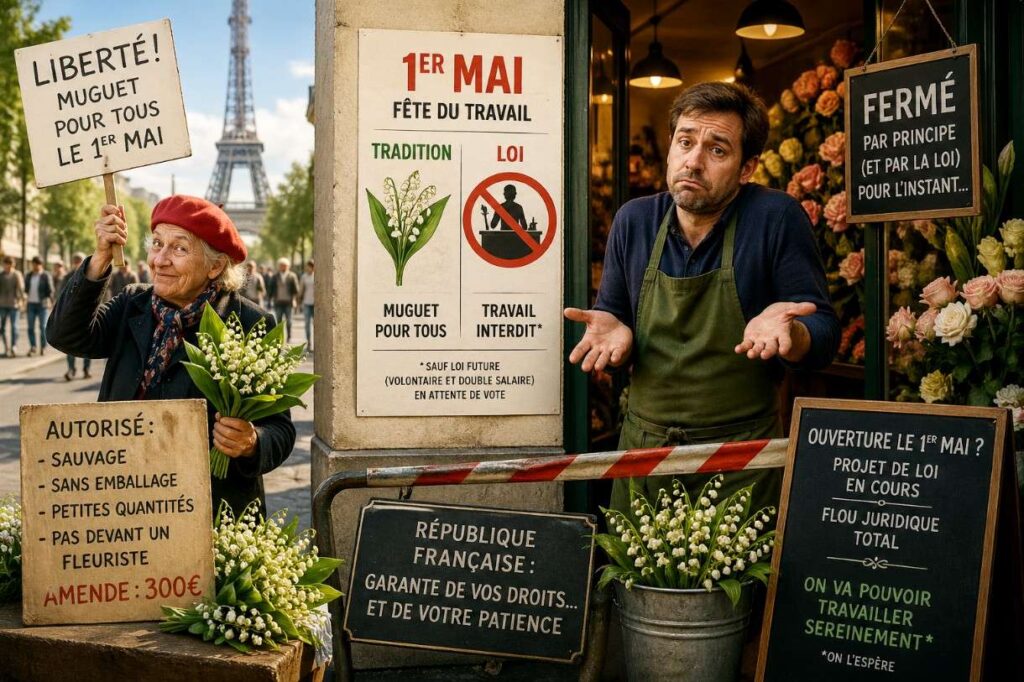
There are days in France when the state acts particularly sensitive. May 1st is such a day. A day of labor, on which – as is appropriate – ideally no one should work. Unless they are selling lily of the valley. Or baking baguettes. Or standing behind a flower stand. Or happen to be a florist and thus part of a political experiment called: “How much contradiction can a republic endure before it loses itself in the footnotes of its own regulations?”
The French state loves its traditions. And it loves its social achievements. Unfortunately, it loves both at the same time – and so much that it cannot bring itself to choose between them. The result is a legal holiday pastry, as delicate as a lily of the valley bouquet and as unpleasant as a rainy May 1st.
The freedom of the little people – strictly regulated
On May 1st, all citizens in France are allowed to sell lily of the valley. What a wonderful gesture of republican generosity! Finally, the common person may offer a few flowers, completely without a business license, completely without tax forms. Liberty, equality, fraternity – at the price of a few euros per bouquet.
But wait: This freedom comes with conditions. The flowers must be picked wild. They may not be packaged. They may only be sold in small quantities. And – particularly charming – not near a flower shop. The republic trusts its citizens. But not too much.
Anyone who violates these requirements risks a fine of 300 euros. A steep price for a little misunderstood freedom. One could say: The revolution has devoured its children – and then regulated them.
The Florists – Victims of Their Own Existence
While every amateur botanist is allowed to become a street vendor, the professional florists stand behind their closed doors. Because May 1st is a protected holiday. Working? Actually forbidden. Employing staff? Even more so.
Here it becomes unpleasant: precisely those who make a living from selling flowers are supposed to take a break on the day when the business flourishes like no other time of the year. It’s like forbidding bakers to work on Easter and Christmas or winemakers during the grape harvest.
Now the government has reacted – half-heartedly, as befits a well-maintained political compromise. A bill is supposed to allow florists and bakers to work on May 1st, voluntarily of course, and with double pay. That sounds generous, almost human. But none of this has been decided yet. The legal situation remains in limbo – a legal maybe, a legislative “on verra.”
The State as Gardener of Uncertainty
Here it becomes unpleasant: precisely those who make a living from selling flowers are supposed to take a break on the day when the business flourishes like no other time of the year. It’s like forbidding bakers to work on Easter and Christmas or winemakers during the grape harvest.
Now the government has reacted – half-heartedly, as befits a well-maintained political compromise. A bill is supposed to allow florists and bakers to work on May 1st, voluntarily of course, and with double pay. That sounds generous, almost human. But none of this has been decided yet. The legal situation remains in limbo – a legal maybe, a legislative “on verra.”
The State as Gardener of Uncertainty
What remains is a state of controlled uncertainty. The authorities give no clear instructions, the laws are announced but not passed. And somewhere between lily of the valley and ministry grows a feeling well known in France: the feeling that everything is somehow allowed — as long as no one looks too closely.
“On va pouvoir travailler sereinement,” say the florists. So, one will probably be able to work. Calmly. Composed. Maybe even a little illegally, but who really wants to know that exactly? The state turns a blind eye, maybe even both. Not out of generosity, but out of embarrassment.
Because what to do when tradition and social law get in each other’s way? When the protection of the worker becomes a threat to their existence? When the republic wants to be both caring and patronizing at the same time?
Between Symbolic Politics and Reality
May 1st is more than a holiday in France. It is a symbol. For workers’ rights. For solidarity. For history. And that is exactly why it is so hard to reform. Every change feels like an attack on the past, every exception like a betrayal of the idea.
But reality is persistent. It doesn’t smell like lily of the valley, but like revenue, rent, wages. And it doesn’t ask for symbols, but for solutions.
What France is showing here is a classic dilemma of modern welfare states: The attempt to preserve everything at once – tradition, protection, freedom – does not lead to harmony, but to contradiction. And this contradiction is not resolved, but managed.
In the end, an image remains: A florist who opens his shop on May 1st, half legal, half tolerated, holding a bouquet of lilies of the valley and relying on a law that does not yet exist. A symbol of a republic that stands in its own way – and yet appears surprisingly elegant.
A commentary by P. Tiko