
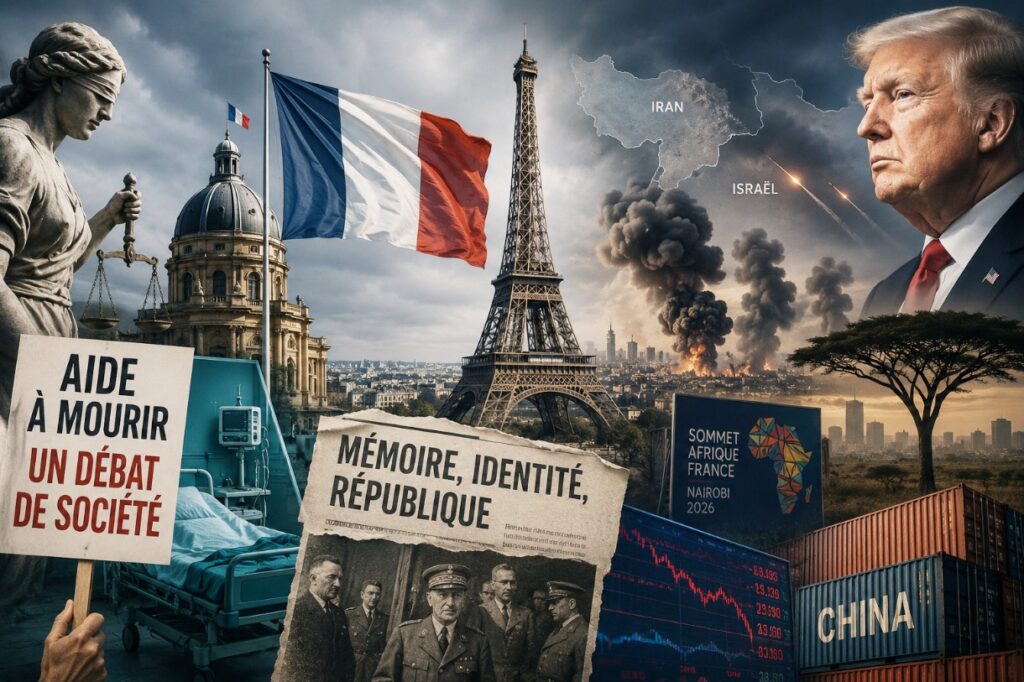
France is experiencing a political day this Monday in which several lines of crisis appear to overlap at once. Externally, the risk of escalation in the Middle East is troubling the government, while domestic debates are unfolding around euthanasia, the culture of remembrance, social polarization, and economic insecurity. The impression of a country in a constant state of alert is growing stronger.
The return of fundamental ethical questions
At the center of political attention today is a new debate in the Senate over “aide à mourir,” namely the legalization of active euthanasia and assisted suicide. Among all social issues, there is currently hardly any other in France that stirs emotions so strongly.
The debate does not follow traditional party lines. Conservative and Catholic groups warn of a fundamental change in the view of humanity and of growing social pressure on the elderly and the sick. Supporters, on the other hand, argue on the grounds of individual dignity, autonomy, and comparisons with European countries. Countries such as Belgium, the Netherlands, and Spain are now regarded as models by many reform advocates.
However, the intensity of the debate cannot be explained solely by legal or medical issues. France is indirectly debating the state of society as a whole. After the pandemic, inflation, pension issues, and geopolitical crises, the public mood appears exhausted. The debate on the end of life has therefore become a symbolic conflict over solidarity, freedom, and social responsibility.
The Middle East conflict heightens tensions
At the same time, the crisis in the Middle East dominates French news media. Tensions between Iran, Israel, and the United States are being watched with growing concern in Paris. Donald Trump’s tough response to Iranian statements in particular is heightening fears of a regional escalation.
The impact would be felt immediately in France. Energy and stock markets are already reacting sensitively to any renewed increase in tensions. Despite its strength in nuclear power, France still depends on stable global flows of resources and trade. A larger regional conflict would once again put pressure on inflation, transport costs, and industrial supply chains.
There is also a domestic political dimension. France has the largest Jewish and Muslim communities in Europe. The security authorities are therefore closely monitoring the impact of international conflicts on domestic political stability. Following the antisemitic incidents of recent years, concerns about further polarization of society have grown.
Macron seeks a new Africa strategy
On the diplomatic front, President Emmanuel Macron is simultaneously seeking to redefine France’s role in Africa. At the Africa-France summit in Kenya, Paris is visibly aiming for a strategic fresh start.
The fact that such a meeting is being held for the first time in an English-speaking country carries strong symbolic significance. France is responding to a substantial loss of influence in several countries in the Sahel region. Military coups, anti-French protests, and the growing presence of Russia and China have severely shaken traditional French Africa policy.
The Élysée Palace is increasingly focusing on economic cooperation, technological partnerships, and investment instead of traditional security primacy. France is seeking new points of contact, particularly in infrastructure, the digital economy, and the energy transition.
However, it remains unclear whether this restructuring will succeed. Many African countries still view France’s reform efforts with skepticism. Historical mistrust of the former colonial power runs deep.
Memory Politics Remains a Source of Conflict
France’s memory politics also continues to be highly contentious. The controversy surrounding the broadcast of the Vichy song “Maréchal, nous voilà !” in Carpentras has sparked a nationwide debate.
The investigation that has been launched shows how sensitively France reacts to any relativization of the Vichy regime. Eighty years after the Second World War, collaboration with Nazi Germany remains a painful issue for the French Republic.
In this context, historical issues are increasingly merging with current political conflicts. Debates over colonialism, migration, national identity, Islamism and antisemitism are closely intertwined. Memory politics has thus become a cultural power struggle over the definition of France as a nation.
This development also explains why local events today often trigger national political controversies within a matter of hours.
Economic Stability on a Fragile Foundation
Economically, France currently appears more resilient than at the height of the inflation crisis from 2023 to 2024. Nevertheless, considerable uncertainty remains.
While geopolitical tensions are putting pressure on markets, China’s economic slowdown is simultaneously burdening Europe’s export economies. French industry associations are increasingly sounding the alarm about long-term strategic dependencies in resources, battery technologies, and industrial intermediate goods.
This is precisely why the concept of “industrial sovereignty” has become even more important. Governments and companies are actively discussing the expansion of European production capacity, particularly in battery recycling, semiconductors, energy supply, and critical raw materials.
This debate follows a broader European trend: confidence in unrestricted globalization is gradually being replaced by an economic mindset focused on security.
A Republic in a Constant State of Tension
France on May 11, 2026, appears to be a country trying to navigate several historic turning points at once. The Republic is simultaneously debating war, euthanasia, the loss of geopolitical influence, national memory, and economic vulnerability.
It is precisely this simultaneity that creates a sense of constant overwhelm. Many French people no longer perceive political debates as isolated crises, but as expressions of a deeper social anxiety.
This has changed the country’s everyday political landscape. Even ordinary weekdays now carry an atmosphere of potential instability. France remains democratically stable and institutionally strong, but social nervousness has visibly increased.