
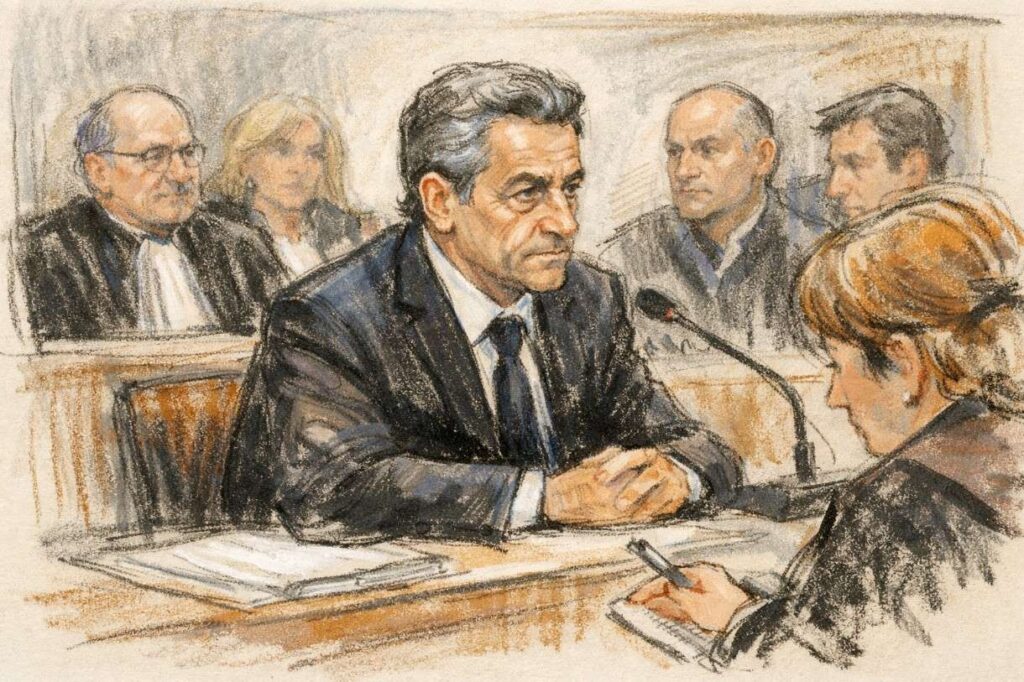
The former French president Nicolas Sarkozy is once again under massive legal pressure in the appeal trial concerning the so-called Libya affair. The Paris public prosecutor’s office has once again demanded a conviction for participation in a “criminal association” and painted a picture of a network of political and financial influence built up over years. The case is one of the most serious judicial scandals of the Fifth Republic and touches on fundamental questions about the integrity of state institutions and the role of foreign influence on democratic processes.
The very first day of the current appeal trial already made it clear that the prosecution does not intend to soften its stance. Prosecutor General Damien Brunet described Sarkozy as the “instigator” of an organized system aimed at securing financial support from the circle of the then Libyan ruler Muammar al-Gaddafi for the 2007 presidential campaign. The prosecution speaks of extraordinarily serious breaches of public trust and of an unprecedented level of operational organization.
The Core of the Charges
It is remarkable that the prosecution at the appellate level focuses less on the direct proof of specific money flows and more on the existence of a structured corruption pact. According to the investigators, there was a permanent organization consisting of political confidants, business intermediaries, and Libyan contacts, whose shared goal was to promote Sarkozy’s political rise.
Thus, the judiciary follows a strategy that is gaining increasing importance in complex corruption cases: not only the transfer of money is central, but the verifiable formation of a network to prepare corrupt actions. Legally, this allows a broader consideration of the political and economic relationships between the parties involved.
At the center of the proceedings are several longtime companions of Sarkozy, including former Interior Minister Brice Hortefeux and the former Secretary General of the Élysée Palace Claude Guéant. Added to these are the controversial intermediaries Ziad Takieddine and Alexandre Djouhri as well as the former Libyan official Béchir Saleh. The indictment describes a web of personal relationships that allegedly emerged in the early 2000s and facilitated access to Libyan power structures.
A historic verdict from the first instance
The current appeal hearing follows a historic verdict from September 2025. At that time, Sarkozy was sentenced to five years in prison for “association de malfaiteurs.” At the same time, the court acquitted him of several other charges, including corruption, illegal campaign financing, and embezzlement of public funds. According to the court, the evidence in these cases was not sufficient for a criminal conviction.
It is precisely this differentiation that makes the case legally particularly complex. The first-instance verdict did not establish that Libyan money was proven to have flowed into the 2007 campaign. However, the court did see sufficient indications of the existence of an organized structure intended for corrupt agreements.
The public prosecutor now seems determined to further tighten this argument in the appeal instance. Observers consider it possible that even higher penalty requests could be filed in the coming days.
Sarkozy and the series of political scandals
For Nicolas Sarkozy, the proceedings represent another serious burden on his political and personal record. The conservative politician, who governed France from 2007 to 2012, has already been convicted several times with finality. Particularly symbolic was the so-called “wiretapping affair,” in which Sarkozy was convicted of corruption and illegal influence peddling. He was also found guilty in the Bygmalion case concerning the financing of his 2012 election campaign.
This makes Sarkozy the first former president of the Fifth Republic to face such a multitude of criminal proceedings. Although France has already experienced political corruption scandals — such as under Jacques Chirac or François Fillon — the Libya affair has its own geopolitical dimension.
At its core, the accusation is that a foreign authoritarian regime tried to directly influence a French presidential election. If this accusation is ultimately confirmed, it would have significant historical importance for understanding political power structures in France.
The Geopolitical Dimension of the Case
The affair goes far beyond classic questions of illegal party financing. Investigators suspect that after Sarkozy’s election victory in 2007, political and economic quid pro quos with Libya were discussed. Alleged advantages in diplomatic relations, security cooperation, and economic projects are at stake.
This appears particularly explosive in hindsight against the backdrop of the later French military intervention in Libya in 2011. At that time, Sarkozy was among the most determined supporters of the NATO operation against Gaddafi. Critics of the former president have argued for years that the subsequent military escalation must also be viewed in light of the earlier relations with Tripoli — even though no court-admissible evidence has so far been presented for this.
The trial also illustrates the close interconnection between politics, secret diplomacy, and international business networks that have shaped part of French Africa policy over decades. Especially France’s relations with North African countries have traditionally been characterized by informal contacts and personal intermediaries.
The defense relies on doubt
Sarkozy’s lawyers continue to firmly reject all allegations. The defense argues that the proceedings are based predominantly on circumstantial evidence, contradictory statements, and disputed documents. It is particularly critical of the credibility of individual witnesses as well as the political instrumentalization of the trial.
The former president himself has spoken for years of a targeted campaign against him. His supporters in the conservative camp see the numerous proceedings against Sarkozy as an example of the increasing power of the judiciary over politics. Opponents, in turn, view the trials as proof that even the highest state offices in France are no longer protected from criminal prosecution.
This is precisely where the political explosive power of the trial lies: It touches on the self-image of French democracy and the question of how independent the judiciary can act with regard to former top politicians.
The prosecution’s closing arguments are expected to continue until May 13, before the defense presents its pleas. A verdict from the appellate court is not expected for several months. Regardless of the outcome, the affair has already secured a firm place in France’s political history — as a symbol of the grey areas between power, money, and international influence under the Fifth Republic.
P.T.