
When thinking of trash on French beaches, plastic bottles, packaging, or cigarette butts usually come to mind. They lie visibly in the sand, float in the water, or gather between rocks and dunes. But another type of waste often goes unnoticed – even though it occurs millions of times: chewing gum.
It is precisely this inconspicuous environmental problem that young biologist Marine Guilbaud from La Rochelle is addressing. With an unusual idea, she wants not only to relieve the coasts but also to raise awareness of a widespread misconception. Her project starts where many people don’t even suspect there is a problem.
Because modern chewing gums no longer consist of natural raw materials. The chewing base mainly contains synthetic polymers derived from petrochemicals. In other words: many chewing gums contain plastic. When a discarded chewing gum gets onto the street, in the sand, or in nature, it does not simply disappear. It remains for years, slowly breaks down, and can eventually become microplastics.
A small piece of waste with a big impact.
Cities and municipalities have known about this problem for a long time. Chewing gums are among the most frequently carelessly discarded items in public spaces. Because they are small, they hardly attract attention. However, their sheer quantity causes significant costs. Removing the sticky residues requires special cleaning procedures that consume time, personnel, and money.
The situation worsens along the coast. Rainwater washes chewing gums into the sewage system; from there, they enter rivers and eventually the sea. There, they join the already massive flood of plastic waste putting pressure on marine ecosystems.
Marine Guilbaud knows these connections from her scientific work. After studying environmental management and coastal ecology, she focused intensively on the consequences of marine pollution. From this experience, the idea for “CreaGum” emerged – a project that does not consider chewing gum as worthless waste but as a raw material.
The approach seems surprisingly simple.
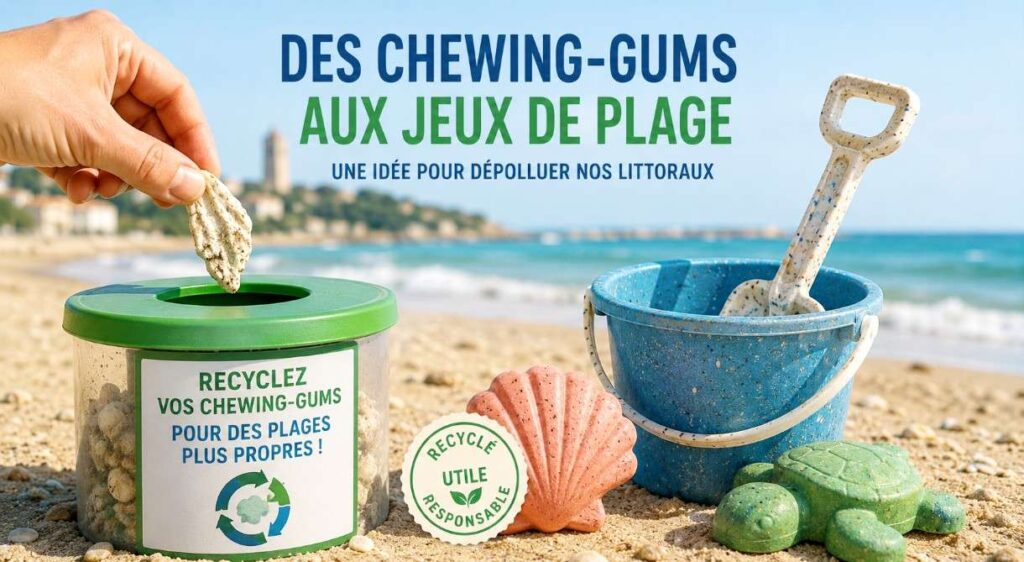
Used chewing gums are collected via collection points, sorted, and processed. They then enter a recycling process that produces new products. Beach toys for children are chiefly the focus. From something that previously polluted the sand, buckets, shovels, or other useful items are made.
It initially sounds almost a bit crazy.
But therein lies the strength of the idea. A child playing with a toy made from recycled chewing gums on the beach encounters the issue of environmental pollution in a very tangible way. Abstract concepts like circular economy or microplastics suddenly become something you can touch.
The initiative thus follows a trend gaining importance in many areas. More and more companies and municipalities are looking for ways to turn previously problematic waste into new raw materials. Materials that were previously simply disposed of are given a second chance.
CreaGum connects this idea with a clear regional reference. The coastal region around La Rochelle serves not only as the area of operation but also as a symbol for protecting sensitive marine landscapes. The combination of beach cleaning, environmental education, and reuse creates a cycle involving citizens, tourists, and municipalities alike.
Of course, recycling chewing gums does not solve the global plastic crisis. The quantities remain manageable compared to the gigantic flows of ocean waste.
But sometimes, small ideas have a special impact.
They show that environmental protection does not always have to come from billion-dollar large-scale projects. Sometimes a new perspective on everyday things is enough. A chewing gum carelessly spat on the ground appears insignificant. In reality, it tells a bigger story about consumption, responsibility, and handling resources.
Marine Guilbaud’s project makes exactly that visible. It transforms an inconspicuous waste material into something useful and reminds us that many environmental problems start right at our feet. Those who look closer often find solutions where others see only trash.
By C. Hatty