
When people think of trash on French beaches, they usually imagine plastic bottles, packaging, or cigarette butts. They lie conspicuously on the sand, float in the water, or accumulate between rocks and dunes. However, other trash often goes unnoticed – although it occurs in the millions: chewing gum.
This inconspicuous environmental problem is the focus of young biologist Marine Guilbaud from La Rochelle. With an unusual idea, she wants not only to reduce the burden on the coast but also to raise awareness of a widespread misconception. Her project starts where many do not even suspect the problem.
Because modern chewing gums no longer consist of natural raw materials. The chewing base mainly contains synthetic polymers derived from petrochemicals. Simply put: many gums contain plastic. When chewed gum is spat out onto the street, sand, or nature, it doesn’t just disappear. Over the years it remains, slowly decomposes, and eventually can turn into microplastic.
A small piece of litter with a big impact.
Cities and communities have long been familiar with this problem. Chewing gums are among the most frequently carelessly discarded items in public places. Because they are small, they are hard to notice. However, their significant quantity results in considerable costs. Removing sticky residues requires special cleaning methods that demand time, personnel, and money.
The situation on the coast is worsening further. Rainwater washes chewing gums into the sewage system, from where they enter rivers and eventually the sea. There they add to the already enormous wave of plastic waste, putting pressure on marine ecosystems.
Marine Gilbo knows these interconnections from scientific work. After studying environmental management and coastal ecology, she actively researched the consequences of marine pollution. From this experience, the idea for the “CreaGum” project was born – a project that sees chewing gum not as waste, but as raw material.
The approach seems extraordinarily simple.
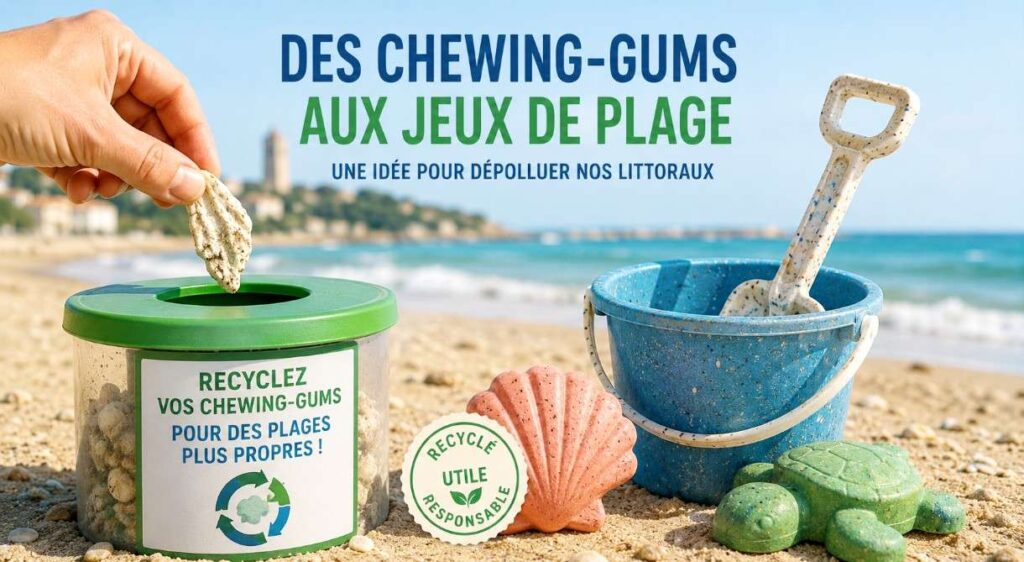
Used chewing gums are collected through collection points, sorted and recycled. Then they go into a recycling process that creates new products. Special attention is given to beach toys for children. From what once polluted the sand, buckets, shovels, and other useful items are made.
At first, this sounds almost a little crazy.
But that is precisely the power of the idea. A child playing with a toy made from recycled chewing gum on the beach encounters the topic of environmental pollution in a very tangible way. Abstract concepts like the circular economy or microplastics suddenly become something that can be touched.
The initiative follows a trend that is gaining popularity in many fields. Companies and communities are increasingly looking for ways to turn previously problematic waste into new raw materials. Materials that were previously simply discarded are given a second chance.
CreaGum combines this idea with a clear regional connection. The coastal region around La Rochelle is not only the project’s area of operation but also a symbol of protecting vulnerable marine landscapes. The combination of beach cleanups, environmental education, and recycling creates a closed loop that engages citizens, tourists, and local communities.
Of course, recycling chewing gum does not solve the global plastic crisis. The volumes remain relatively small compared to the huge flows of waste in the oceans.
But sometimes it is precisely small ideas that have a special impact.
They show that environmental protection does not always have to be large-scale multi-billion projects. Sometimes a new perspective on ordinary things is enough. A chewing gum carelessly spat out on the ground seems insignificant. In fact, it tells a bigger story about consumption, responsibility, and attitudes towards resources.
Marine Gilbo’s project makes this visible. It transforms unnoticed litter into something useful and reminds us that many environmental problems begin just under our feet. Those who look more closely often find solutions where others see only trash.
Author: S. Hetty