
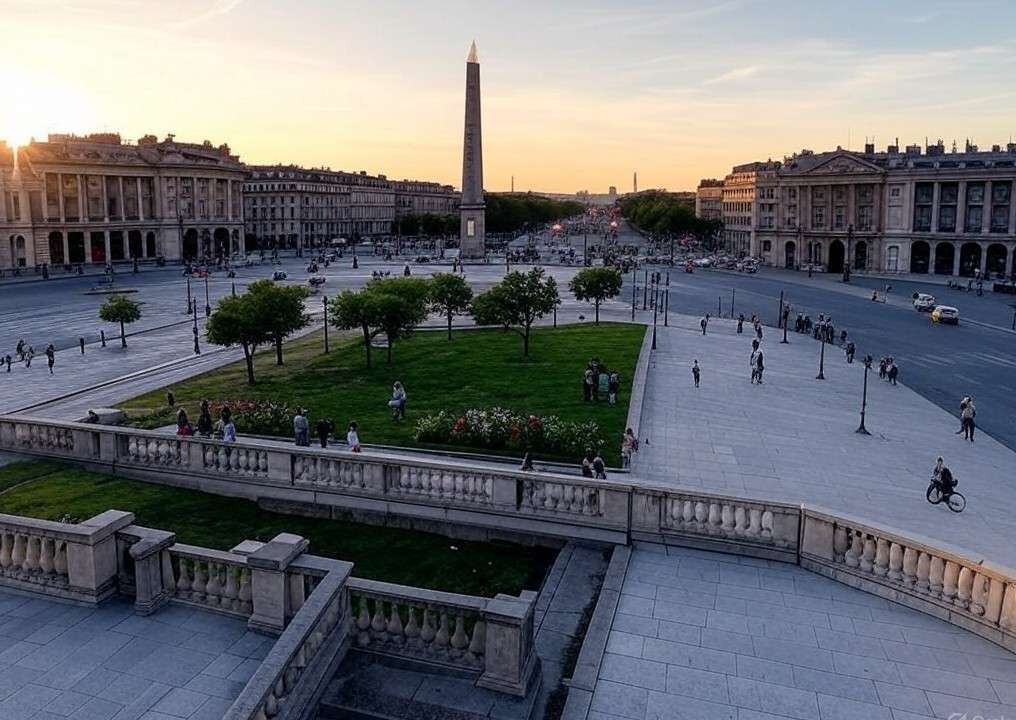
Place de la Concorde, the centerpiece of Parisian urban history and one of Europe’s most magnificent public squares, is facing a profound yet respectful transformation. With a clear goal: preserve the past, improve the present, and make room for the future.
Of kings and guillotines – a place steeped in history
Hardly any other place in Paris is as charged with symbolism as Place de la Concorde. Where the Luxor Obelisk now stands, heads rolled during the French Revolution in the 18th century. The square has witnessed uprisings, state ceremonies, and exuberant parades. Now, in the 21st century, a new chapter is beginning – one directed not against people, but against heat islands, traffic chaos, and environmental pollution.
A comprehensive renovation is planned, guided by the original design by Ange-Jacques Gabriel and the later additions by Jacques Hittorff. Six historic guardhouses are to be restored, two of the original eight rostral columns reconstructed, and damaged balustrades repaired. The architectural DNA will therefore be preserved – just refreshed.
A garden amid a sea of stone
The centerpiece of the redesign is called “Place-Jardin.” It sounds romantic, but above all it is smart: the site’s historic ditches will not only be reconstructed, but also greened – across an area of 2.8 hectares! This not only creates a visual highlight, but also acts like a natural cooling system.
Instead of sealed ground, half of the area is to remain open and permeable in the future – which could result in a reduction in soil temperature of up to 8 degrees. A real blessing in times of extreme summers, isn’t it?
The highlight: Two thirds of the area will be accessible to pedestrians – meaning more space for walkers, tourists and locals. The quality of stay will increase, car noise will give way to birdsong – or at least to stress-free strolling.
Green is not just green – climate-adapted plants in focus
The new planting will be chosen carefully. It is not about simply planting a few trees. The selected species are intended to be climate-resilient, able to withstand heat and drought without requiring much maintenance. At the same time, biodiversity in the city center is to be promoted.
This will turn the square into a small ecosystem – a green lung amid asphalt and stone. Air quality will also improve, not to mention the psychological effect: Green calms, relaxes and makes cities more livable.
Goodbye traffic jams, hello gentle mobility
Traffic planning is also being completely rethought. While car traffic will in future be limited to the western part of the site, the east will belong to pedestrians and cyclists. A 10-meter-wide balcony overlooking the Seine opens up new perspectives – literally.
This redistribution creates safe routes between the Tuileries and the Champs-Élysées without having to constantly watch out for traffic. People with limited mobility should also be able to cross the square more easily. Mobility is thus being reimagined—quietly, safely and inclusively.
Tradition meets the present—an architectural statement
The architects Philippe Prost and Bruel Delmar are behind the project. Their vision: a harmonious connection between historical heritage and modern urban planning. They rely on geometric precision, fine details and a contemporary language, without doing violence to the historic character.
The result is intended to be a place that not only tells history, but makes it tangible—and at the same time is open to new things. Sounds like a balancing act? Perhaps. But one that succeeds when respect and creativity go hand in hand.
What happens next?
The National Commission for Heritage and Architecture has given the green light. Before the excavators roll in, archaeological investigations will take place—after all, many a treasure could still be hidden beneath the paving. The first visible changes are expected from 2026 onward.
And then? The Place de la Concorde could become not only the green center of Paris, but also a model for other European cities. A square that lives the past, breathes the present and plants the future.
By C. Hatty