
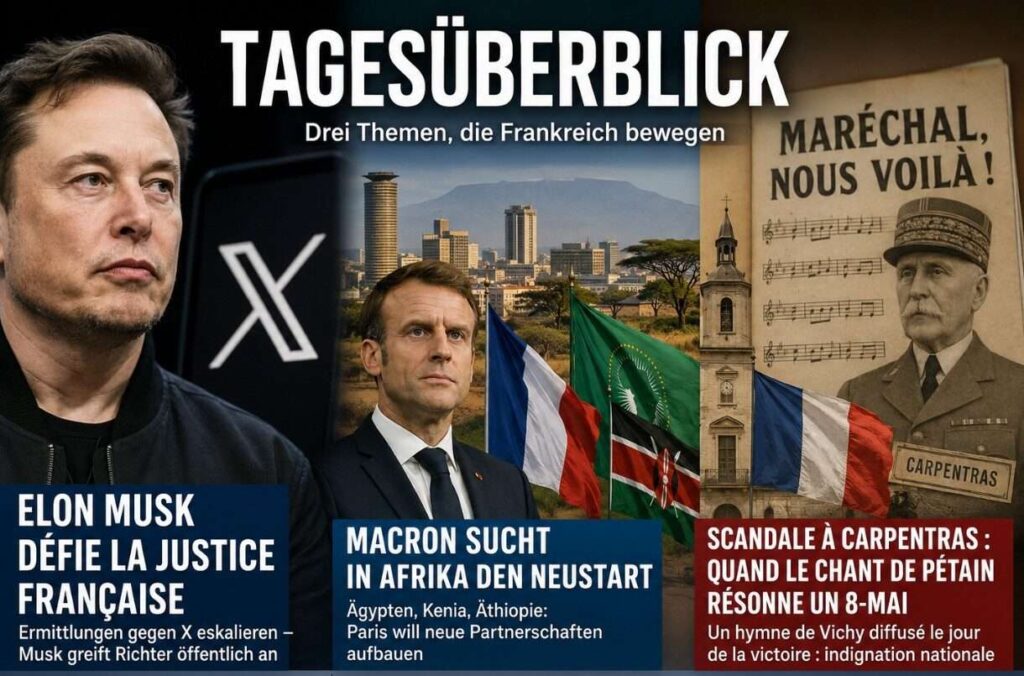
Elon Musk is escalating the conflict with the French judiciary. After an investigation was opened against the platform X in Paris, the American billionaire publicly insulted several French investigative judges on his platform on Friday – sometimes using vulgar and homophobic language. The trigger was a post about the legal problems of his company in France.
The Paris public prosecutor’s office officially initiated an investigation on May 6 and referred the case to several investigative judges. At the center are allegations of possible algorithmic manipulations, abusive use of data, as well as the dissemination of problematic content via X and the AI application Grok. This involves, among other things, sexual deepfakes, pedocriminal content, and revisionist posts.
As early as April 20, Musk had failed to respond to a summons from the French public prosecutor’s office. His confrontational course of action is now giving the case a political dimension. For critics, the case exemplifies how global tech entrepreneurs combine economic power, public reach, and political influence. Musk’s supporters, on the other hand, see it as an attack by European authorities on freedom of expression.
For France and the EU, the affair is developing into a potential precedent: Can European law actually be enforced against global platforms – even if their owners openly seek confrontation?
Macron Seeks Restart of French Influence in Africa
Emmanuel Macron begins a multi-day trip to Africa this Saturday, visiting Egypt, Kenya, and Ethiopia. Officially, the focus is on investments, innovation, energy policy, food security, and digitalization. Politically, however, it is about much more: France is trying to redefine its role on the African continent after the massive loss of influence in the Sahel.
The first stop takes Macron to Egypt, where talks with President Abdel Fattah al-Sisi and the inauguration of a new campus of the Senghor University in Alexandria are planned. Paris increasingly views Cairo as a strategic partner on regional stability issues—from the Middle East to security in the Red Sea.
The main focus of the trip, however, is Nairobi. There, France and Kenya are jointly organizing the summit “Africa Forward.” The meeting is intended to bring together heads of state, companies, investors, startups, and representatives of civil society. Especially important for Paris: For the first time, such a format is held together with a major Anglophone partner country.
The choice of Kenya is deliberately strategic. France is trying to move away from the traditional focus on former Francophone colonies and build new partnerships. President William Ruto is now considered an important ally of Macron in reforming international financial institutions and global development financing.
The background remains difficult, however. Since the military coups in the Sahel, several states have expelled French troops from their countries and expanded their relations with Russia. Even in Senegal, France recently had to reduce its military presence.
Macron’s strategy therefore increasingly relies on economic cooperation instead of military presence. Issues such as climate protection, education, energy supply, and technological cooperation are intended to form the new basis of the relations. But the competition for influence in Africa has become more intense. China, the Gulf States, India, Turkey, and Russia also offer partnerships – often faster, more pragmatically, and with fewer political conditions.
The trip therefore appears to be an attempt at a geopolitical realignment. Macron wants to show that France can still be a relevant actor in Africa – albeit under significantly changed conditions.
Outcry in Carpentras: Pétain Song on May 8 Sparks Outrage
An incident in the southern French city of Carpentras has sparked nationwide outrage. While France traditionally commemorates the end of World War II and the victory over Nazi Germany on May 8, the song “Maréchal, nous voilà” was played over loudspeakers in the city – the unofficial anthem of the Vichy regime and an open tribute to Philippe Pétain.
The symbolic shock is enormous. The song was closely associated with the collaboration of the Vichy regime during the German occupation and was disseminated at that time in schools, official ceremonies, and youth organizations. It even partially replaced the Marseillaise.
That such a song should be publicly played precisely on the national day commemorating the liberation of France is perceived by many as a serious transgression of boundaries. The central question now is whether this is an intentional provocation, a political act, or a negligent mishap.
The affair touches on a particularly sensitive area of French memory culture. For decades, the image of a predominantly resistant nation dominated in France. Only in 1995 did President Jacques Chirac officially acknowledge the responsibility of the French state for deportations and antisemitic crimes under the Vichy regime.
The incident gains additional volatility through the history of Carpentras itself. The city had already become a symbol of the debate over antisemitism in France in 1990 after the desecration of a Jewish cemetery.
The current political context further exacerbates the impact of the incident. In many European countries, debates about national identity, history, and memory policy are becoming increasingly polarized. References to Vichy and Philippe Pétain are therefore never considered neutral historical allusions but as highly political symbols.
It is precisely the contrast between the occasion and the content that makes the incident so disturbing: While France commemorates the liberation from National Socialism on May 8, a song that once glorified the collaborationist state sounds in a French city. Even if the incident ultimately turns out to be a technical glitch, the political and social discomfort is likely to remain.