
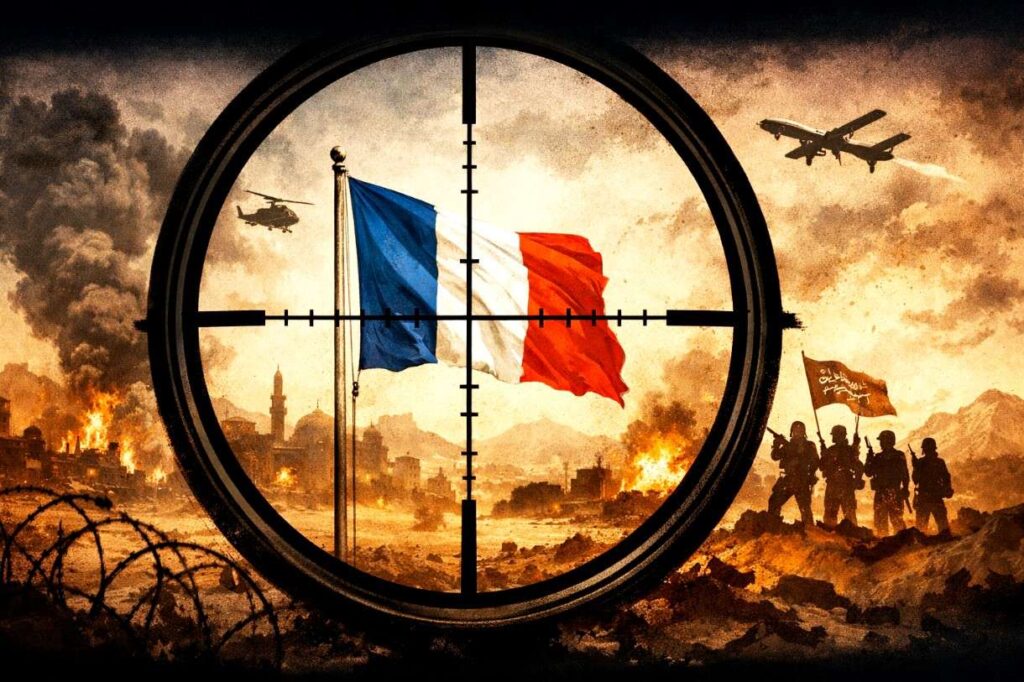
There are moments in politics when a single event destroys the comforting fiction of an entire strategy. The death of a French soldier in northern Iraq is one of those moments. With it ends the illusion that France can be present in the Middle East without becoming part of the current war itself.
The political formula so far has been: France is not fighting there against Iran, not against any state, but exclusively against terrorism. It is the language of diplomatic distancing, of careful categories. It sounds reasonable, rational, almost reassuring. Only: wars do not adhere to such categories.
The militias that carried out the drone attack in Iraq are not interested in the semantic nuances of French foreign policy. For them, France is a Western state with soldiers in the area of operations. That is all it takes to become a target.
This is the brutal logic of today’s conflicts in the Middle East: whoever is militarily present belongs to the battlefield – even if they see themselves as a force for stabilization.
France has long tried to play a special role in this region. A kind of third position between the blocs: not the reflexive ally of Washington, not the opponent of Tehran, but an independent actor with a diplomatic tradition. Paris has nurtured this claim since de Gaulle. It is part of the political DNA of French foreign policy.
But geopolitical identities do not protect against drones.
The attack in Iraq reveals a new reality: In a regionalized war, the diplomatic gray zones disappear. The lines of conflict become broader, more confusing, and more brutal. They run not only between states but also through networks of militias, proxy armies, and ideological alliances.
In such an environment, it matters less what a state says about its mission than where its soldiers are stationed.
The French troops are officially part of the international coalition against the “Islamic State.” That is correct and legitimate. But on the strategic chessboard of the region, this mission no longer plays the central role. For pro-Iranian groups, any Western military presence is automatically part of the larger conflict.
The war has created its own geography – and Iraq is once again one of its hubs.
The country has often been the place where regional rivalries explode. It is politically fragile, militarily fragmented, and geopolitically inevitable. Situated between Iran, the Arab states, Turkey, and the Western powers, Iraq repeatedly becomes a transit zone for foreign conflicts.
That France is now also coming under fire there is strategically not really surprising. The only surprise is how long Europe believed it could be otherwise.
The drone war is the perfect tool for this new form of conflict. It allows attacks without declarations of war, escalation without open fronts, pressure without responsibility. A drone costs little, but its political message is enormous: No one is out of reach.
This also applies to France.
The domestic political impact of such attacks should not be underestimated. Every fallen soldier raises a question that governments are reluctant to answer: Why are we there? And what risk are we willing to take?
This question will now become louder in Paris.
The French state faces a classic strategic dilemma. If it remains in Iraq, it risks further attacks. If it increases its military presence, it itself appears more like a party to the war. If it withdraws, it seems as if militias with their drones have changed the politics of a European state.
None of these options is politically comfortable.
But perhaps this is exactly the real lesson of this attack: There is no longer any comfort in this conflict.
Europe has long convinced itself that the war in the Middle East was primarily a regional problem with global consequences – energy prices, migration, diplomacy. Now it is becoming apparent that these conflicts have long moved closer. Not geographically, but strategically.
France now stands where many states in this region have stood for years: in the crosshairs of a war that knows no clear fronts.
And maybe that is precisely the bitterest realization: You can try to define yourself out of a war.
But you cannot always stay out of it.
P.T.