
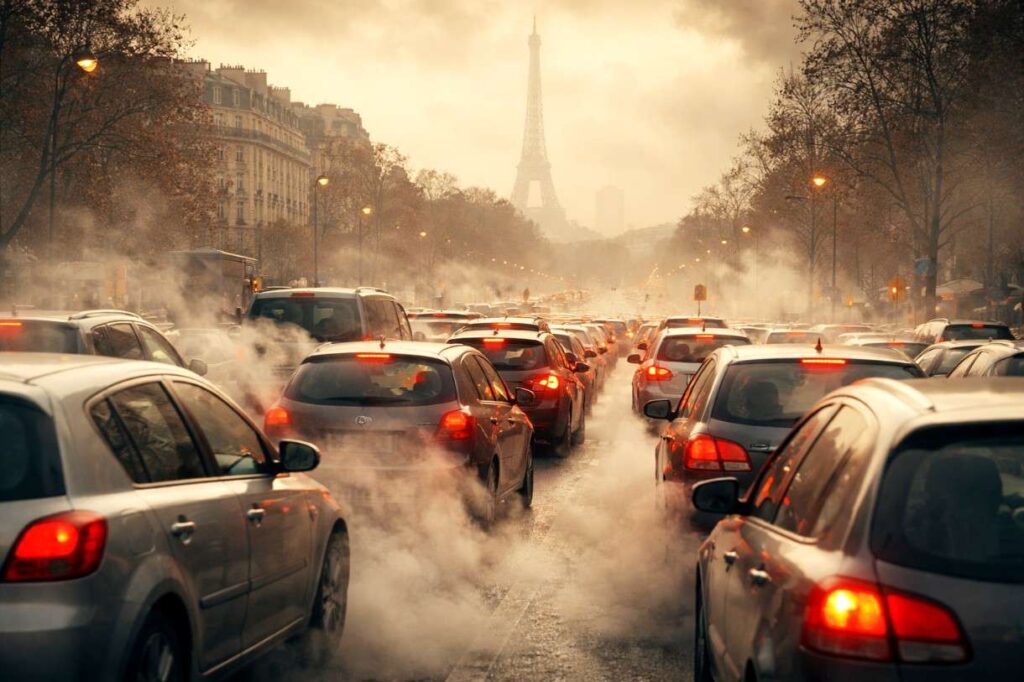
Sometimes it is not the great ideological battles on which politics fails, but the small, everyday impositions. A few kilometers less with the old diesel. A few euros more for clean mobility. A few uncomfortable truths about air that makes you sick. France has now decided to avoid exactly these impositions – and then calls that social justice.
The abolition of environmental zones is not an act of care. It is a political declaration of bankruptcy.
It is one of the bitter ironies of this decision that it is made in the name of the common people. In the name of commuters, caregivers, craftsmen – all those who rely on the car because the state has not built reasonable alternatives for them over decades. Now they protect them by continuing to allow them to “drive” themselves and others sick. That is not social policy. That is cynical.
Because the facts are unpleasantly clear: Poor air does not affect the wealthy first. It affects those who live near major roads, in densely built neighborhoods, in suburbs without greenery. Those who abolish environmental zones do not protect the poor – they shift the burden of their poor living conditions even deeper into their lungs.
The parliament has thus set a remarkable priority: the right to continue burning cheap fuel apparently outweighs the right to clean air. Freedom is defined here as the freedom to not have to change anything. And responsibility? That is elegantly discarded – along with the fine dust limits.
Of course, the argument of social hardship is not unfounded. Those who earn little and have to commute every day cannot simply afford a new vehicle. But this is exactly where real political work begins – or at least should begin. Instead, the easier path was chosen: abolish the problem, not its cause.
Solutions have long been on the table. Socially tiered subsidy models, massive expansion of public transport, and yes: programs like social leasing of electric cars, which have already been tested and show that ecological transformation and social cushioning do not have to be contradictory. It would have been possible to shape the transition fairly. One would only have had to want it.
But political will apparently ends where it gets serious – at investments, at structural reforms, at the demand for honesty. Instead, short-term relief prevails: no protests, no headlines, no trouble. The bill will come later. It comes in the form of asthma, cardiovascular diseases, overloaded health systems. But it will come reliably.
France, a country that likes to see itself as a pioneer of the Enlightenment, has chosen a remarkably backward-looking stance on this issue. The dangers are known – and yet they act against this knowledge. This is not simply ignorance. This is politically organized ignorance.
In the end, a bitter impression remains: Representatives who invoke their social conscience to justify a decision that precisely lacks that conscience. The health of the voters is not collateral damage. It is the measure of political responsibility.
France has missed it. And not out of necessity – but out of convenience.
A commentary by Andreas M. Brucker