
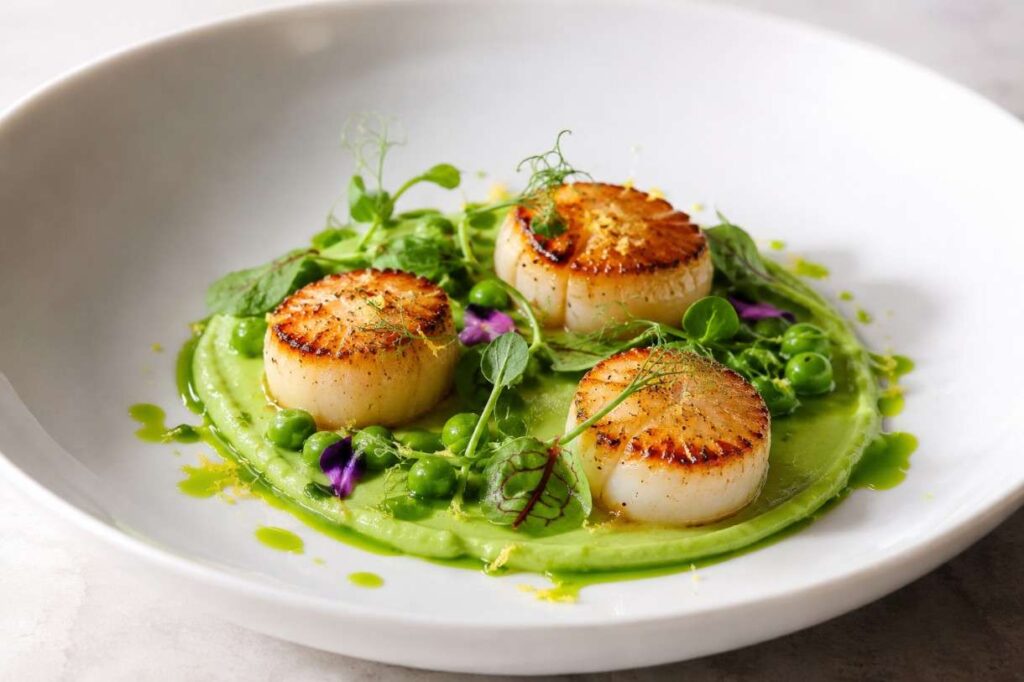
Modern French Spring Cuisine Full of Elegance
Modern French cuisine thrives on precision, lightness, and respectful use of high-quality ingredients. Few dishes embody this philosophy better than scallops with pea cream and lemon verbena. Here, the delicate sweetness of the scallops, the fresh creaminess of young peas, and the citrus herbal notes of lemon verbena come together. The result is an elegant spring course that is both refined and remarkably clear.
This dish fully reveals its character especially around Pentecost. The season’s first sweet peas harmonize wonderfully with seafood, while lemon verbena lends the plate that modern lightness which characterizes many contemporary French dishes.
This recipe is excellent as a starter for a festive menu but can also be served as a light main course.
The Role of the Scallop in French Cuisine
The scallop, known in France as “Coquille Saint-Jacques,” has held a special place in haute cuisine for centuries. Its fine texture and slightly sweet flavor make it an ideal ingredient for minimalist dishes where quality is more important than complexity.
The key lies in proper preparation: scallops need only a few minutes of heat. They should develop a golden crust on the outside while remaining translucent and tender inside. When this point is reached, that almost buttery texture for which they are so appreciated emerges.
Why Peas and Lemon Verbena Harmonize Perfectly
Peas bring natural sweetness and freshness that pair excellently with marine flavors. In modern French cuisine, they are often made into silky creams that serve as a base for fish or shellfish.
Lemon verbena, in turn, does not provide the aggressive acidity of lemon itself but offers a subtle, elegant citrus note with floral nuances. This finesse makes it ideal for sophisticated spring dishes.
Recipe: Scallops with Pea Cream and Lemon Verbena
Ingredients for 4 People
For the Scallops
- 12 large scallops
- 1 tbsp neutral oil
- 20 g butter
- Fleur de Sel
- freshly ground white pepper
For the Pea Cream
- 400 g young peas (fresh or frozen)
- 1 shallot
- 20 g butter
- 100 ml vegetable stock
- 50 ml cream
- salt
- white pepper
For the Lemon Verbena Oil
- 8–10 lemon verbena leaves
- 4 tbsp mild olive oil
Optional for Plating
- young pea shoots
- finely grated lemon zest
- some raw peas
- edible flowers
Preparation
Make the Lemon Verbena Oil
Finely chop the lemon verbena leaves and mix with the olive oil. Let the oil infuse for at least 30 minutes to allow the essential aromas to develop. Then strain finely or leave rustic.
This aromatic oil adds freshness and connects the elements of the dish.
Prepare the Pea Cream
Finely dice the shallot and sauté in butter until translucent. It should become soft but not take color.
Add the peas and briefly sweat them. Deglaze with vegetable stock and simmer gently for about 3–4 minutes. The peas should retain their bright green color.
Then add the cream and puree everything finely. For an especially elegant texture, pass the cream through a fine sieve.
Season with salt and white pepper.
The consistency should be silky and soft—not too firm, but not runny.
Perfectly Searing the Scallops
Carefully pat the scallops dry. Moisture prevents a nice crust.
Heat a heavy pan very hot and add the oil. Salt the scallops only just before searing.
Sear the scallops about 60–90 seconds on each side. As soon as a golden crust forms, add the butter and briefly baste the scallops with the foaming butter.
They should remain slightly translucent inside.
Finish by seasoning with a bit of white pepper and fleur de sel.
Plating Like in Modern French Cuisine
Place some warm pea cream in the center of deep plates and gently spread it with a spoon.
Arrange the scallops on top. Drizzle a few drops of lemon verbena oil around.
Garnish with pea shoots, raw peas, or edible flowers. Optionally, add a little finely grated lemon zest on top.
The dish thrives on clarity and elegance—less is definitely more here.
Culinary Balance of the Dish
This dish works so well because each component has a specific role:
- The scallops provide sweetness, umami, and delicate texture.
- The pea cream adds freshness and creaminess.
- The lemon verbena brings lightness and aromatic tension.
- The butter connects all the elements together.
Modern French cuisine often plays with such contrasts: warm and fresh, creamy and tender, sweet and aromatic.
Wine Pairing
Particularly elegant, mineral white wines pair well with this dish:
- Sancerre
- Chablis
- Pouilly-Fumé
- Pinot Blanc (Weißburgunder)
- Champagne Brut Nature
The wines should have freshness and fine acidity without overpowering the scallops.
Variations of the Dish
With Green Asparagus
Briefly blanched green asparagus wonderfully complements the spring aroma.
With Beurre Blanc
A light beurre blanc foam adds extra French depth.
With Scallop Carpaccio
Some of the scallops can be served raw to create different textures.
Vegetarian Interpretation
Seared king oyster mushrooms or celery slices can replace the scallops.
Conclusion
Scallops with pea cream and lemon verbena are a prime example of modern French spring cuisine. The dish appears elegant and luxurious while remaining light and surprisingly minimalist.
This focus on a few high-quality ingredients is what gives it its special appeal. Those who work carefully and give the products space will create a plate that recalls both the taste and visual style of a contemporary French bistro or fine-dining restaurant.
It is a dish for special occasions—and at the same time a wonderful reminder that true sophistication often lies in simplicity.