
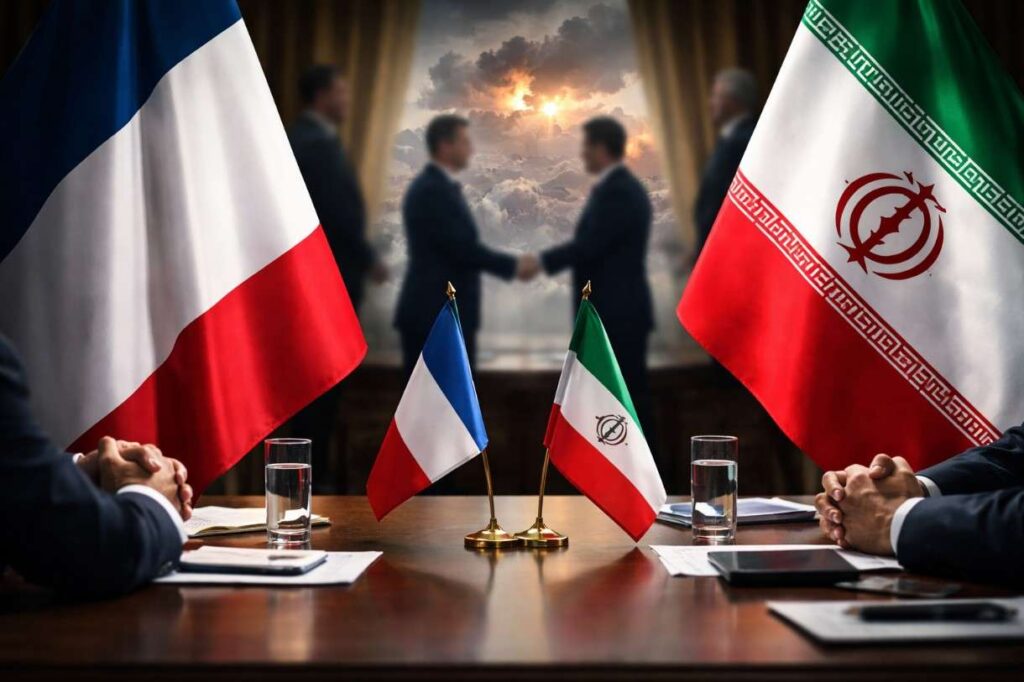
The release of Cécile Kohler and Jacques Paris initially marks a rare moment of relief in a world shaped by crises. After more than three and a half years of imprisonment in Iran, the two French citizens were able to leave the country yesterday and are on their way to France. President Emmanuel Macron confirmed their departure and especially praised the mediation role of Oman. However, behind this humanitarian news lies a complex web of geopolitical interests, diplomatic strategies, and quiet negotiations – a lesson that diplomacy remains possible even under the most adverse circumstances.
Hostage diplomacy as a strategic instrument
The Kohler/Paris case fits into a familiar pattern. For years, Tehran has used the detention of foreign citizens as a political leverage. The charges – often espionage or endangering national security – usually appear fabricated from a Western perspective. However, less decisive is the legal substance than the political function: prisoners become bargaining chips in a larger geopolitical game.
Noteworthy in this context is the graduated logic of Iranian detention policy. The fact that Kohler and Paris were able to leave the notorious Evin Prison already in November 2025, yet remained effectively under control, illustrates this strategy. Freedom is not granted abruptly but dosed – as part of a negotiation process. This “gradual easing” allows Tehran to flexibly modulate political pressure.
The Timing as a Signal
The release falls into a phase of heightened tensions in the Middle East. Especially at such moments, diplomatic channels gain importance. France has visibly paid attention in recent months to keeping lines of communication with Tehran open, without fully integrating into a confrontational front.
Officially, Paris denies having adjusted its foreign policy line regarding the prisoners. However, the coincidence of intensive diplomatic contacts, regional escalation, and the sudden departure of the two Frenchmen suggests that political constellations played a decisive role. In international politics, such temporal correlations are rarely coincidental.
The Art of Indirect Understanding
Whether there was a concrete exchange remains unclear – and will likely remain so. Iranian state media suggested a connection with other cases, including that of an Iranian citizen in France. The Élysée Palace denies this. Such contradictory narratives are typical of discreet negotiations.
Diplomacy in such cases rarely operates along clear, publicly verifiable agreements. Rather, it is a web of legal gestures, political signals, and indirect reciprocations. Third countries like Oman play a key role as mediators, enabling both sides to act while preserving face.
This form of “quiet diplomacy” is often the only way to make progress in deadlocked conflicts. It deliberately avoids public staging and is effective precisely for that reason.
Domestic Political Dimensions in France
For France, the return of Kohler and Paris means more than just a diplomatic success. Both had long become symbols – of the vulnerability of Western citizens abroad as well as of the limits of state power against authoritarian regimes.
The release offers President Macron the opportunity to demonstrate foreign policy capability. In a time of multiple crises, such a success can have a stabilizing effect domestically. It shows that results can be achieved even under difficult conditions – not through confrontation, but through perseverance and negotiation skills.
The Structural Limits of Success
As gratifying as the outcome is in this individual case, the structural assessment remains sobering. The case rather confirms an established pattern: The detention of foreign nationals remains an effective instrument for Tehran to exert political pressure and expand negotiation leeway.
That several months passed between the formal release from custody in November 2025 and the actual departure in April 2026 underscores this logic. Freedom in this context is not a legal state, but a politically controlled process. Humanitarian decisions are linked to strategic considerations.
For Europe, this results in a fundamental dilemma. On the one hand, there is an obligation to protect its own citizens and secure their release. On the other hand, every successful individual case carries the risk of indirectly legitimizing the underlying system.
Diplomacy as an Underestimated Constant
Especially against the backdrop of the military conflicts between Iran, the USA, and Israel, the release gains further significance. It shows that diplomacy is not obsolete even in times of escalating conflicts. On the contrary: the more tense the situation, the more important informal channels, confidence-building measures, and willingness to engage in dialogue become.
The notion that international politics is primarily shaped by pressure and deterrence falls short. Cases like this demonstrate that even between politically estranged actors, there are scopes for action. These are often narrow, fragile, and marked by contradictions – but they exist.
The return of Cécile Kohler and Jacques Paris is therefore more than a humanitarian success. It is an indication that diplomacy does not only work in peace but truly proves itself in conflict. Where military or political confrontation reaches its limits, it often remains the last instrument to achieve concrete results.
In a world increasingly shaped by bloc formation and mistrust, this insight seems almost unspectacular. Yet it contains one of the few constants of international politics: Even in the shadow of power politics, negotiation remains possible – and surprisingly successful.
Author: Andreas M. Brucker