
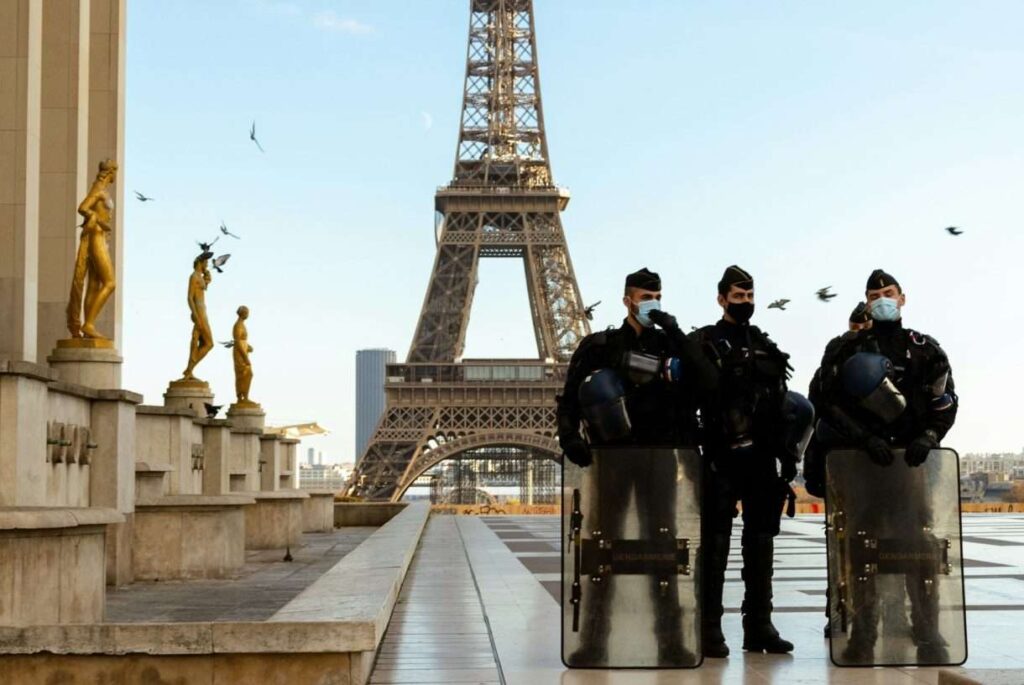
When Paris celebrates, all of France holds its breath. But this year, the nerves are particularly high: The traditional National Day on July 14 coincides with a major sporting event – the Club World Cup final between the Paris flagship club PSG and FC Chelsea. The consequence: a security apparatus that is extraordinary even for the French capital in this dimension.
Double challenge for the security forces
Already on Sunday, July 13, the heart of Paris will become a restricted zone. From 7 p.m. onwards, access will be blocked on the Champs-Élysées. The reason is the fan euphoria surrounding the football match, which will only kick off at 9 p.m. Paris time in New York but could cause crowds and tensions hours earlier. The Étoile and Concorde squares will be closed to traffic – whether on foot or by car. Even the metro stations in the affected area are closed.
Those who think this is all just overcautious are mistaken. An official decree prohibits all public broadcasts from Sunday 8 p.m. until Monday 3 a.m. – neither fan zones nor private screens on or facing the street are allowed. A clear cut: No collective football fever in the open air. Paris wants calm – not a state of emergency.
A national holiday under police protection
The morning after, July 14 begins as the Republic is used to: with a military parade, marching bands, and a president proudly looking over his troops. But what usually spreads a festive atmosphere will be accompanied by a serious tone in 2025. Between 6 a.m. and 3 p.m., a strict security cordon will be in place around the Champs-Élysées. Entry only with ID, including bag checks. Anyone who has no business there will be kept outside.
Fireworks, alcohol, weapons, or even objects that appear dangerous – all prohibited. Even political demonstrations are forbidden. Paris wants a celebration, not a forum. And the state makes it clear: those who provoke will face consequences.
Evening turns romantic – but only under control
After the martial start, it is supposed to become atmospheric after all. A classical concert at the Champ-de-Mars promises musical highlights from 9 p.m. – as an overture to the fireworks exploding over the Eiffel Tower at 11 p.m. Around 60,000 people are expected. But here too: access only through predefined points, with security checks and searches. From 5 p.m. the gates will be open. Metro stations? Partly closed from 7 p.m. – so that nobody gets any silly ideas.
Precaution meets repression
What sounds like the organization of a state visit is actually the security for two simultaneous major events. Paris Police Chief Laurent Nuñez has already set the tone: Almost 2,000 illegal fireworks have been confiscated, dozens of arrests have already been made. His message: Zero tolerance. Anyone who disturbs the peace will be taken away.
The Paris public prosecutor’s office currently sees no reason to panic – but their credo is also: show toughness where necessary. Especially in cases of attacks on emergency personnel, pyrotechnics, or acts of violence. Paris does not want images like from bad days.
What may security cost?
Despite all the necessity – so much control also causes skepticism. Are 11,500 police officers, gendarmes, and firefighters really necessary? Is it acceptable to simply close public spaces for peaceful fans and walkers? And is it proportionate to even prohibit private public screenings outdoors?
The balance between security and freedom remains a knife-edge dance. Of course: the world is watching Paris. And of course nothing should go wrong. But where does surveillance begin, where does trust end?
Celebrating with the handbrake on
So Paris is under high tension this year. A day of pride and unity – under the signs of control. The Republic presents itself vigilant, resilient, but also vulnerable. Perhaps that is exactly the message that resonates between the cannon fire, choral music, and rockets in the sky: France knows what is at stake.
Author: Andreas M. Brucker