
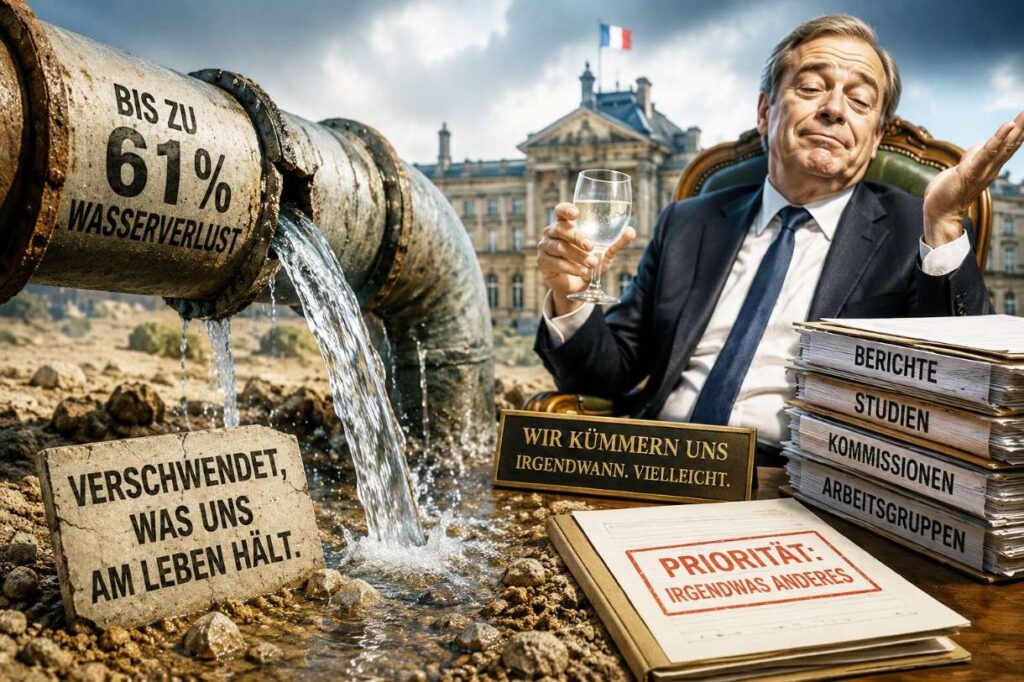
61 percent.
You really have to let that number sink in. Although – maybe better not. After all, who knows if there will even be enough water running from the tap.
While citizens in Pyrénées-Orientales are supposed to learn how to shower less, water plants less, use less water overall, and ideally even breathe less, more than half of the precious drinking water leaks away into the ground. Just like that. Day after day. Year after year.
But no worries: of course, citizens will continue to be lectured about their water consumption.
Those who spray their lawns are almost considered environmental criminals. Those who fill swimming pools are eyed critically. Farmers fight for their livelihoods, families count every drop – and at the same time, millions of liters disappear on their way to the faucet.
This is no longer a mishap.
This is organized indifference.
One wonders how many crisis meetings, working groups, expert panels, and glossy brochures are needed to state the obvious: water pipes from the last century will eventually have to be replaced. Apparently, a lot. Because while the infrastructure slowly decays, expenditures elsewhere continue to flow cheerfully.
The irony could hardly be greater.
The state tells people that water is a strategic resource of utmost importance. At the same time, it allows that resource to vanish through leaking pipes underground. It is reminiscent of a firefighter standing in front of a burning house advising the residents to use candles more sparingly.
Of course, renovation is expensive. You hear that immediately. There is no money for anything. Not for dilapidated pipelines. Not for long-term precautions. Apparently not even for the basic task of securing the population’s supply.
But when it comes to new programs, additional administrations, or producing more forms, the money often flows surprisingly easily.
But not for water.
What is particularly bitter is the message behind this situation. Citizens are being told they need to change their lifestyles, make sacrifices, and take responsibility. Meanwhile, no one takes responsibility for a network that has been rotting away for decades.
This creates an impression more dangerous than any drought: the feeling that more and more is being demanded from people while those managing the infrastructure deliver less and less.
Water is not a luxury item. Not a leisure commodity. Not a political toy.
Water is the foundation of life.
If a state is not even capable of protecting that foundation while admonishing its citizens to save, then something is seriously wrong.
And maybe that is the real disaster of this story: not the 61 percent water loss.
But the fact that apparently hardly anyone is surprised anymore.
By C. Hatty