
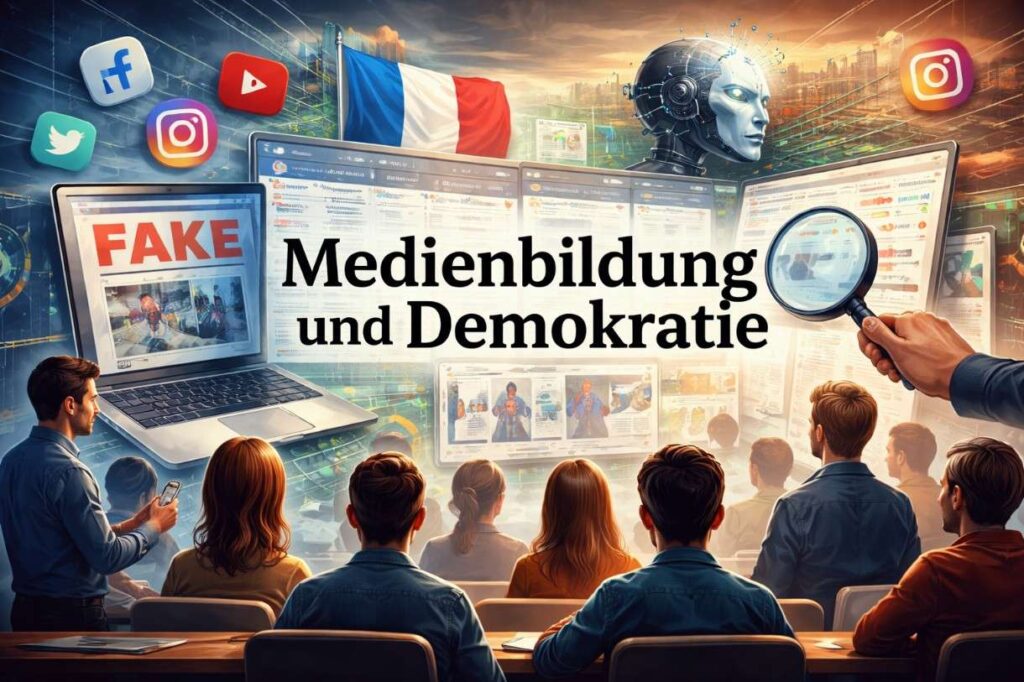
In a time when information circulates faster than ever before, media education is no longer a marginal educational topic. It is developing into a cornerstone of democratic societies. In France, this debate is gaining new urgency – driven by social networks, growing distrust of institutions, and the rapid spread of generative artificial intelligence.
A Republican Ideal in the Shadows
“Éducation aux médias et à l’information” (EMI) is by no means a new idea. It is deeply rooted in France’s republican tradition, which views the informed citizen as a central ideal. Institutions like CLEMI, founded in the 1980s, were intended to support teachers in educating students in dealing with media.
But for decades, media education remained a marginal phenomenon. It depended heavily on the commitment of individual teachers and was rarely systematically integrated into curricula. The consequence: while the information landscape changed radically, the school-based teaching of corresponding skills remained fragmented.
Today the conclusion is clearer than ever: it is no longer enough to provide information. What matters is the ability to understand, contextualize, and critically question information. Who produces content? In what context? With what intention? These questions mark the dividing line between an informed citizen and a passive consumer.
Digital Sovereignty Without Judgment?
French teenagers are among the most connected in Europe. Platforms like TikTok, Instagram, or YouTube are the primary access points to news and social debates for many. However, digital familiarity does not equate to media literacy.
The French regulatory authority ARCOM regularly points out that many young people have difficulty distinguishing reliable information from manipulative or false content. This vulnerability became especially apparent during the Covid-19 pandemic and international conflicts.
In addition, there is a worrying trend: a form of informational relativism. For a portion of the young generation, all sources appear equivalent – a viral video recording can hold the same weight as a carefully researched newspaper article. This radical equalization does democratize freedom of expression, but at the same time undermines established criteria of credibility.
Artificial Intelligence as a Turning Point
With the advent of generative AI systems, the situation has worsened further. Applications that can generate texts, images, voices, or videos fundamentally change the logic of disinformation. It is no longer just about distorting existing content, but about the factory-like production of deceptively real fakes.
This is particularly evident in the phenomenon of so-called deepfakes: deceptively real videos in which people say or do things that never happened. In such an environment, classic verification strategies reach their limits. Source comparison and context analysis remain necessary but are no longer always sufficient.
The educational challenge is thus shifting fundamentally. Media education must now also convey technical understanding – an “algorithmic literacy” that explains how content is created, how platforms distribute it, and which economic or political interests lie behind it.
The Education System Under Pressure
The French government has responded to these developments. At the latest since the terrorist attacks of 2015, which acted as a societal shock, media education has been brought more into focus. Programs such as the annual “Semaine de la presse et des médias à l’école” now reach thousands of schools.
But implementation remains challenging. Teachers face structural problems: overloaded curricula, lack of further training, and unequal distribution of resources between schools. Not all feel sufficiently prepared to competently teach complex topics such as algorithmic selection or AI-based content.
Moreover, media education is inherently interdisciplinary. It concerns politics, history, computer science, and ethics simultaneously – a circumstance that is difficult to map in the highly subject-divided school system.
Responsibility Beyond the Classroom
Focusing solely on school is too narrow. Media literacy is a societal task. Parents, platform operators, and traditional media also bear responsibility.
Digital platforms have been criticized for years for promoting misinformation. Although some companies have introduced measures such as fact-checking or contextualization, their effectiveness and transparency remain limited.
Traditional media are also challenged. They are increasingly trying to reach younger audiences with new formats and regain trust. However, trust cannot be mandated. It arises from understandable working methods, transparency, and long-term credibility.
The Political Dimension of Media Competence
Ultimately, the debate touches on a fundamental question: What kind of citizen should democracy produce? In an increasingly fragmented information world, the ability to critically assess information becomes a key competence.
Media literacy is therefore not only a technical or educational task but a deeply political one. It determines whether public debates are based on shared facts or collapse into parallel realities.
France has a strong educational policy tradition and institutional structures that could enable a systematic embedding of media education. However, this requires a clear political will and a prioritization that goes beyond individual initiatives.
In the age of artificial intelligence, the ability to doubt with reason could prove to be the central civic competence of the 21st century. Not skepticism for its own sake, but informed, reflective doubt – as a bulwark against manipulation and as the foundation of democratic judgment.
P.T.