
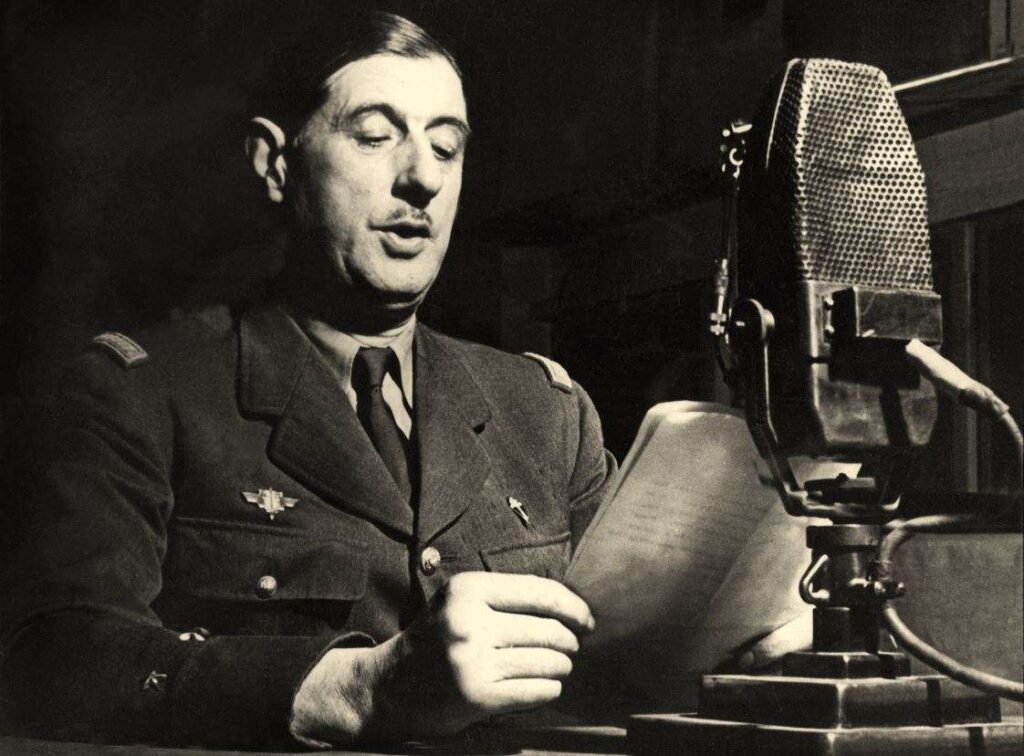
June 18, 1940, is today considered the founding date of the French Resistance. Few other events are as deeply rooted in France’s national memory as Charles de Gaulle’s appeal from London exile. Every year it is commemorated, schools teach it as a turning point in French history, and the later Fifth Republic elevated it to one of its central origin myths.
But behind the symbolic power of the “Appel du 18 juin” lies a historical paradox that often fades into the background: when Charles de Gaulle took the microphone at the BBC, he acted against the orders of the then legitimate French government. From the perspective of the existing law, his action was a form of disobedience. From the perspective of posterity, that very disobedience became an act of national salvation.
France on the Brink
In June 1940, France was in one of the most severe crises of its history. The German Western campaign had shattered French defensive lines within a few weeks. The Wehrmacht advanced rapidly, Paris was abandoned, and millions of people fled.
On June 16, Marshal Philippe Pétain, the World War I hero of Verdun, took over the government. Already the next day, he declared in a radio speech that the “fight must be stopped.” The government decided to negotiate an armistice with the German Reich.
For many French people, this step seemed inevitable at the time. The military defeat appeared complete. The alternative would have meant continuing the war from North Africa—an option few political and military decision-makers seriously considered.
A General Without a Power Base
At that point, Charles de Gaulle was by no means the national leader that later generations saw him as. The then 49-year-old had only recently been promoted to temporary brigadier general. Furthermore, he had held the post of Undersecretary of State for War and National Defense for just a few days.
Politically, he had no democratic legitimacy. He was neither head of government nor commander-in-chief. He commanded no significant troop units and did not represent any established political movement.
His influence was chiefly based on his strategic convictions. Even before the war, he had advocated for modernization of the armed forces and the increased use of armored units. Many of his warnings were ignored by military leadership.
When defeat came, De Gaulle was therefore not only an opponent of capitulation but also a critic of the political and military elite that had led France into catastrophe.
The Flight to London
On June 17, 1940, De Gaulle left Bordeaux in a British plane bound for London. This step was by no means a given.
The French government had clearly committed to an armistice course. De Gaulle deliberately distanced himself from this political line. Although formally still a member of the government, he refused to obey its central decision.
Legally, he was operating in a gray area. Politically, however, his action constituted an open challenge to state authority.
In London, he found a decisive ally: British Prime Minister Winston Churchill. Churchill early recognized the propaganda and political value of a French representative willing to continue fighting against Germany. He gave De Gaulle access to the BBC and thus to a public that he could no longer reach within France itself.
A Speech Against Official Policy
On the evening of June 18, De Gaulle spoke to the French over the BBC.
His message was simple yet revolutionary: France had lost a battle but not the war. The industrial strength of the British Empire and the economic resources of the United States would ultimately decide the fight. Therefore, resistance must continue.
De Gaulle called on officers, soldiers, engineers, and skilled workers to come to Great Britain and continue the war alongside the Allies.
This declaration was unauthorized. It was directly opposed to the official policy of the French government. While Pétain was preparing the armistice, De Gaulle was effectively stating that France must keep fighting.
Thus, a fundamental conflict between legality and legitimacy emerged.
The Traitor of 1940
From the perspective of the French authorities at the time, De Gaulle was not a hero but a rebel.
After the armistice was signed, a new regime led by Pétain was established in Vichy. This regime regarded De Gaulle’s activities as betrayal of the state and army.
On August 2, 1940, a military court sentenced the general to death in absentia. Charges included desertion, high treason, and endangering the external security of the state.
This decision illustrates how uncertain the historical situation was at the time. Today, De Gaulle’s path seems almost inevitable. Contemporary observers often saw it differently. Many French initially supported Pétain, whose prestige as a war hero was enormous. The eventual outcome of the war was by no means predictable in the summer of 1940.
De Gaulle therefore acted not on the basis of assured success but under conditions of considerable political and personal risk.
The Question of Higher Legitimacy
The core of the historical debate remains the question of which form of legitimacy takes precedence.
The Pétain government had initially been legally appointed. It had institutional continuity and state authority. De Gaulle, on the other hand, acted without mandate and against the government’s decisions.
His defense was based on a different understanding of political legitimacy. For him, France was more than its current government. A state that surrenders to the enemy and submits to its political demands may survive legally but loses its moral and national legitimacy.
From this point of view, it was not Vichy that represented the true continuity of France, but the “France libre,” the Free French Forces, and the continued fight alongside the Allies.
After France’s liberation, exactly this interpretation became official state doctrine. The Republic declared that the legitimate continuity of the French state had persisted not in Vichy but in the Free France movement.
The Emergence of a National Myth
Another historical fact long received little attention: the famous June 18 appeal was actually heard live by only a few French people.
The BBC’s reach was limited, many people had no access to the broadcasts, and the dramatic events of those days overshadowed the speech’s impact. The text known today does not fully correspond to the original radio address but was later published in newspapers and symbolically elevated in the postwar years.
The myth thus did not arise on a single evening. It developed gradually during the war and gained its final significance only after 1945.
Yet therein lies its historical importance. The June 18 appeal shows that political legitimacy is not always identical with formal legality. De Gaulle defied the orders of existing authorities because he was convinced they no longer served France’s interests. That history vindicated him today seems obvious. In the summer of 1940, it was far from certain.
The later founding father of the state acted then not as an undisputed national hero but as an isolated officer willing to defy his country’s government. The founding act of modern France was thus also an act of disobedience—a rare example of how violating existing authority could retrospectively become the highest form of political loyalty.
Author: P. Tiko