
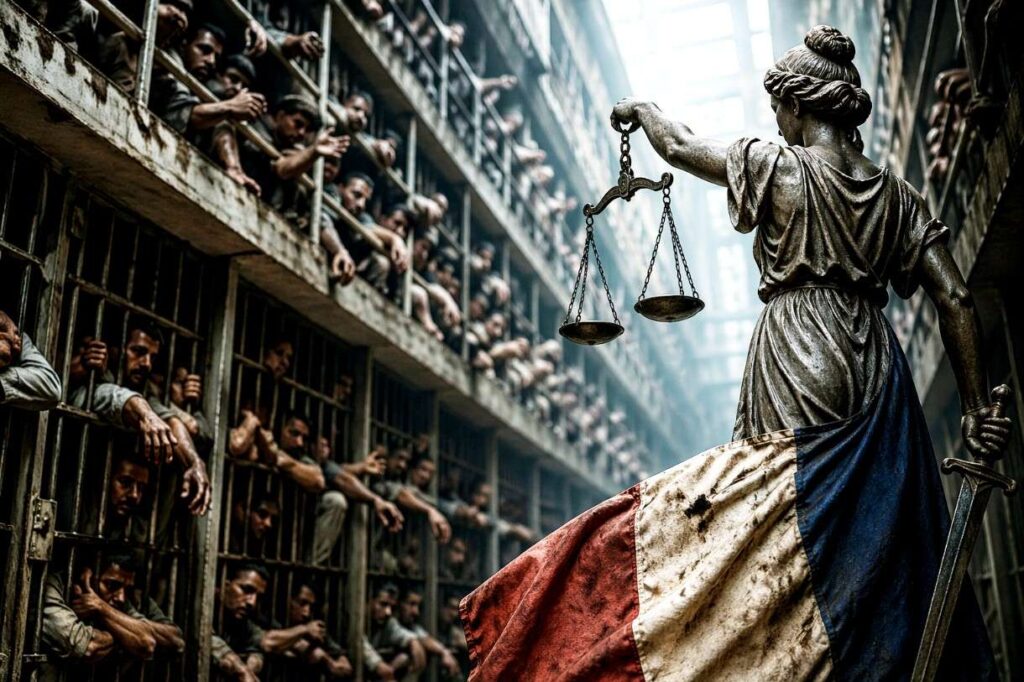
One has to imagine this: A constitutional state that fills its prisons so much that they overflow like poorly maintained sewage systems – and then wonders why it stinks. France, the land of human rights, has a problem as old as its republican self-affirmation: It preaches liberty, equality, fraternity – and meanwhile stacks people in cells meant for far fewer.
In the Centre pénitentiaire d’Aix-Luynes, and not only there, it becomes visible what happens when a state no longer has its punitive zeal under control and loses sight of its capacities. Too many prisoners, too little space, too few staff – but still enough self-satisfaction to call the whole thing a “justice system.” One could also say: It is a system that no longer takes its own standards seriously.
Because what does it actually mean when a state imprisons people – and then does not even grant them the space necessary for a minimum level of dignity? It means: This state consciously violates the rights of those it has entrusted to its care. That is not collateral damage. That is the system.
Of course, one could say now: Prisons are not wellness hotels. That is true. But they are also not lawless zones. Those who deprive others of their freedom assume responsibility. And not only for the safety of society, but also for the physical and mental integrity of the prisoners. This is not hidden somewhere in the fine print – it is a core element of every rule of law.
But apparently a strange logic applies here: The fuller the prisons, the emptier the principles of the rule of law. Overcrowding is declared to be normal, as if it were a natural disaster and not the result of political decisions. Too few detention places are built, too many are sentenced too quickly, too many are locked up – and this is then called consistent law enforcement. One could also say: It is consistent looking the other way.
The union UFAP-UNSa Justice protests, the guards are at their limit, the prisoners anyway. And politics? Reacts with what it does best: symbolic politics. A bit more equipment here, a few promises there – and otherwise the quiet hope that the problem will somehow resolve itself. Perhaps through social reintegration? Or through resignation?
This is a strange form of state failure that is showing here. No spectacular collapse, no dramatic bang – but a slow, stubborn erosion of principles. Human dignity, as stated in principle, is inviolable. In practice, however, it seems surprisingly flexible – at least when it comes to prisoners.
This is precisely where the true test of the rule of law lies. Not in dealing with the conformists, the law-abiding, the privileged. But in dealing with those who stand on the margins – or already behind them. Whoever lowers the standards there, lowers them for everyone.
France is not alone with this problem. Many European countries struggle with overcrowded prisons. But that does not make it better. It only makes it more convenient not to have to decide. Between security and human dignity. Between the need for punishment and the rule of law. Between what is possible – and what would be required.
In the end, an uncomfortable question remains: What does it say about a country if it locks people up without giving them the space to remain human?
Perhaps this: That it no longer quite takes itself seriously.